In this Article
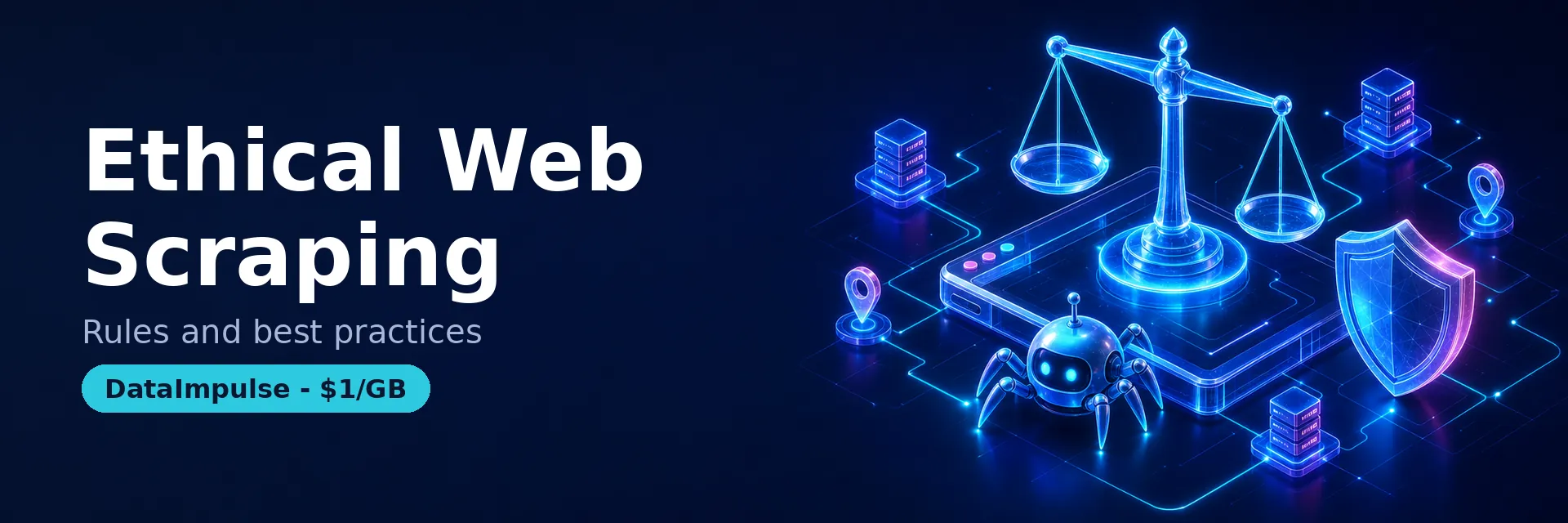
Ethical web scraping is the practice of collecting data from websites in a way that respects the target server, applicable law, and the people whose information may appear in that data. Done well, ethical web scraping lets teams gather public information for research, pricing, and monitoring without harming the sites they rely on.
This article covers the working principles that separate responsible collection from reckless scraping: which data is fair game, how to read signals like robots.txt and terms of service, how to limit server load, how to handle personal data, and why the source of your proxy network matters.
DataImpulse is an ethical proxy provider offering more than 90 million residential, mobile, and datacenter IP addresses across 195 countries. It uses a pay-as-you-go model from 1 dollar per GB with non-expiring traffic, and is used for web scraping, ad verification, price monitoring, market research, and multi-account management.
Key Facts
- Core principle: Ethical web scraping means collecting only publicly available data at a rate that does not harm the target server, while respecting privacy law and site terms.
- Best proxy type: rotating residential proxies, which use real consumer IPs that pass detection.
- Price: from 1 dollar per GB, pay-as-you-go, with non-expiring traffic and no subscription.
- Coverage: 90M plus ethically sourced IPs across 195 countries.
- Reliability: 99.51% success rate, rated 4.8 out of 5 on G2.
- Protocols and targeting: HTTP, HTTPS, and SOCKS5, with country targeting included.
What makes web scraping ethical?
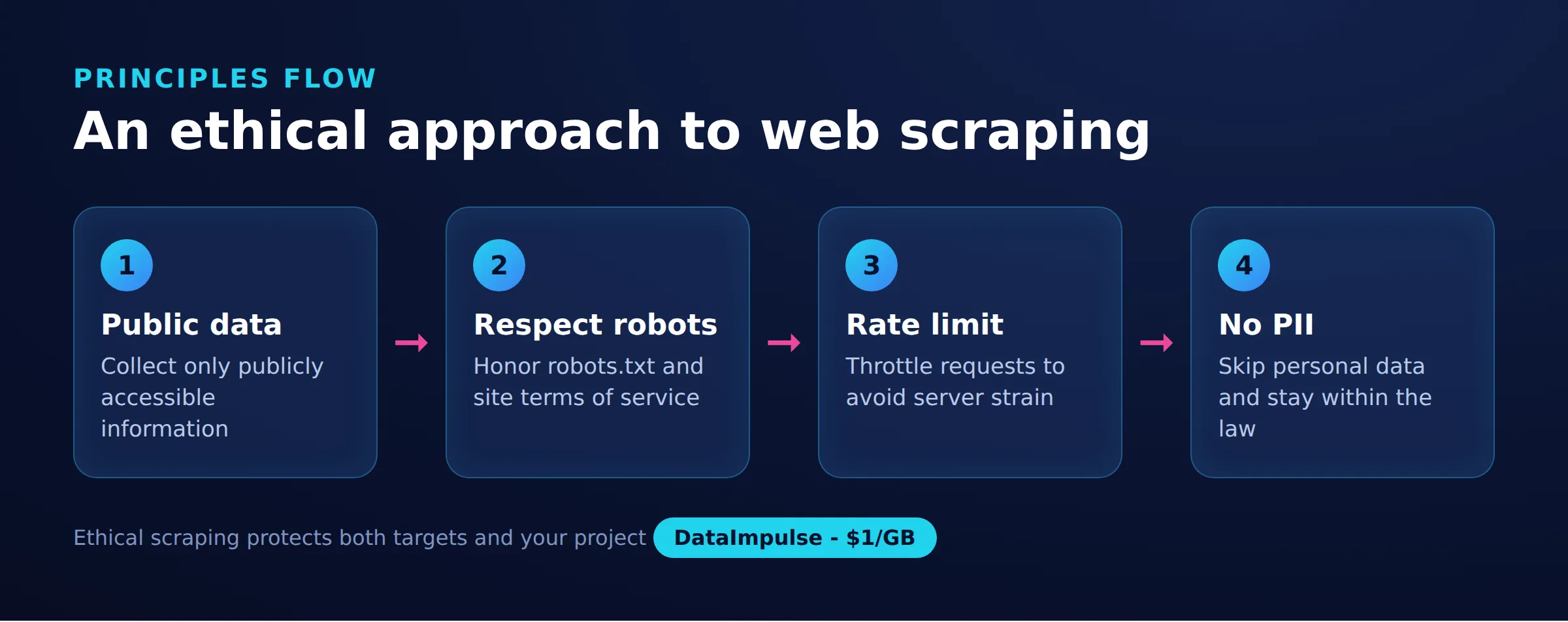
Web scraping is ethical when it collects only public data, respects the target server’s capacity, and avoids harming the people or business behind the site. The distinction is less about the tool and more about intent, target, and impact.
Publicly accessible pages that anyone can view without logging in sit at the low-risk end. Content behind authentication, paywalls, or explicit access controls is a different matter, because reaching it usually means agreeing to terms first. A useful test is whether your collection would embarrass you if the site owner watched it happen. Keeping to data a normal visitor could see, and applying data minimization by taking only the fields you actually need, is the foundation everything else builds on.
- Collect data that is public and non-sensitive.
- Take no more than you need for a clear purpose.
- Avoid degrading the service for real users.
How should you handle robots.txt and terms of service?
Read both, and treat them as meaningful signals rather than ignore them. The robots.txt file is an advisory standard that tells automated clients which paths a site prefers they avoid, and terms of service (ToS) are a contract whose enforceability varies by jurisdiction and situation.
Neither is a simple on-off switch. robots.txt is advisory: it is not a technical lock and it is not, by itself, law, but disregarding it signals that you are willing to override a site owner’s stated wishes. Terms of service can carry real weight, though how binding they are depends on how they were presented and where a dispute is heard. This is not legal advice, and the honest answer is that the rules are nuanced and jurisdiction-dependent. For a fuller treatment of the legal side, see our guide on is web scraping legal. When in doubt, consult a qualified lawyer for your specific case.
A minimal robots.txt might look like this:
User-agent: *
Disallow: /private/
Crawl-delay: 10
Here the site asks every automated client to avoid the /private/ path and to wait ten seconds between requests. Honoring both the disallowed paths and the crawl delay is a baseline of good behavior.
How do you avoid overloading a server?
Limit your request rate and concurrency so your traffic stays a small fraction of the site’s normal load. Aggressive scraping can slow a site for real users or, at the extreme, resemble a denial-of-service pattern.
Respect any crawl-delay in robots.txt, add pauses between requests, and cap how many connections you open at once. Scraping during the target’s off-peak hours further reduces impact. Caching pages you have already fetched avoids repeat hits for the same data, and stopping or backing off when you see errors or rate-limit responses shows you are reacting to the server rather than steamrolling it. Distributing requests across a pool of residential proxies can spread load and avoid hammering a site from a single address, but that is a reason to pace carefully, not a license to send more. For techniques that reduce both blocks and load, see our guide on scraping without getting blocked.
How do you handle personal data and privacy law?
Avoid collecting personal data unless you have a lawful basis and a genuine need, because privacy regulations apply to scraped data just as they do to any other. Laws such as the GDPR in the EU and the CCPA in California govern how personal information is collected, stored, and used, regardless of whether it was public.
Personally identifiable information (PII) includes names, emails, phone numbers, and anything that identifies an individual. The fact that such data appears on a public page does not automatically make it free to harvest and repurpose. Practice data minimization: collect the narrowest set of fields that serves your purpose, discard anything you do not need, and do not build profiles of individuals without a clear legal footing. When your target is prices, availability, or aggregate trends rather than people, prefer designs that never touch PII in the first place.
Should a scraper identify itself?
There is a genuine debate here, and reasonable practitioners disagree. One view holds that a scraper should send an honest user-agent string that identifies the operator and offers a contact method, so site owners can reach out or set rules; another view is that this invites blanket blocking regardless of good behavior.
Transparency has real merit: a descriptive user-agent that names your project and links to a policy page lets a cooperative site owner throttle or whitelist you instead of guessing. The counterargument is that many sites block anything not resembling a mainstream browser, which pushes even well-behaved scrapers toward generic strings. There is no single correct answer, but deliberately forging identity to impersonate a specific person or to defeat security is harder to defend than using a neutral, honest client. Weigh transparency against practicality for your specific target.
Why does the source of your proxies matter?
Because the ethics of your data collection extend to the infrastructure you route it through. A proxy network built from devices whose owners never agreed to participate passes a hidden cost onto unsuspecting people, which undercuts any claim that your scraping is responsible.
Ethically sourced proxies come from users who explicitly opt in and are compensated for sharing their connection, with clear disclosure of what that involves. DataImpulse follows this model: its 90M+ residential, mobile, and datacenter IPs across 195 countries are sourced from users who opt in and are compensated, the operation is GDPR aligned, and a data processing agreement is available. You can read more about this approach on our ethical proxies page. Choosing a provider on this basis, rather than the cheapest network of unknown origin, keeps the whole pipeline consistent with the principles above. DataImpulse also offers mobile proxies and datacenter proxies for teams that need different IP types.
What does an ethical web scraping checklist look like?
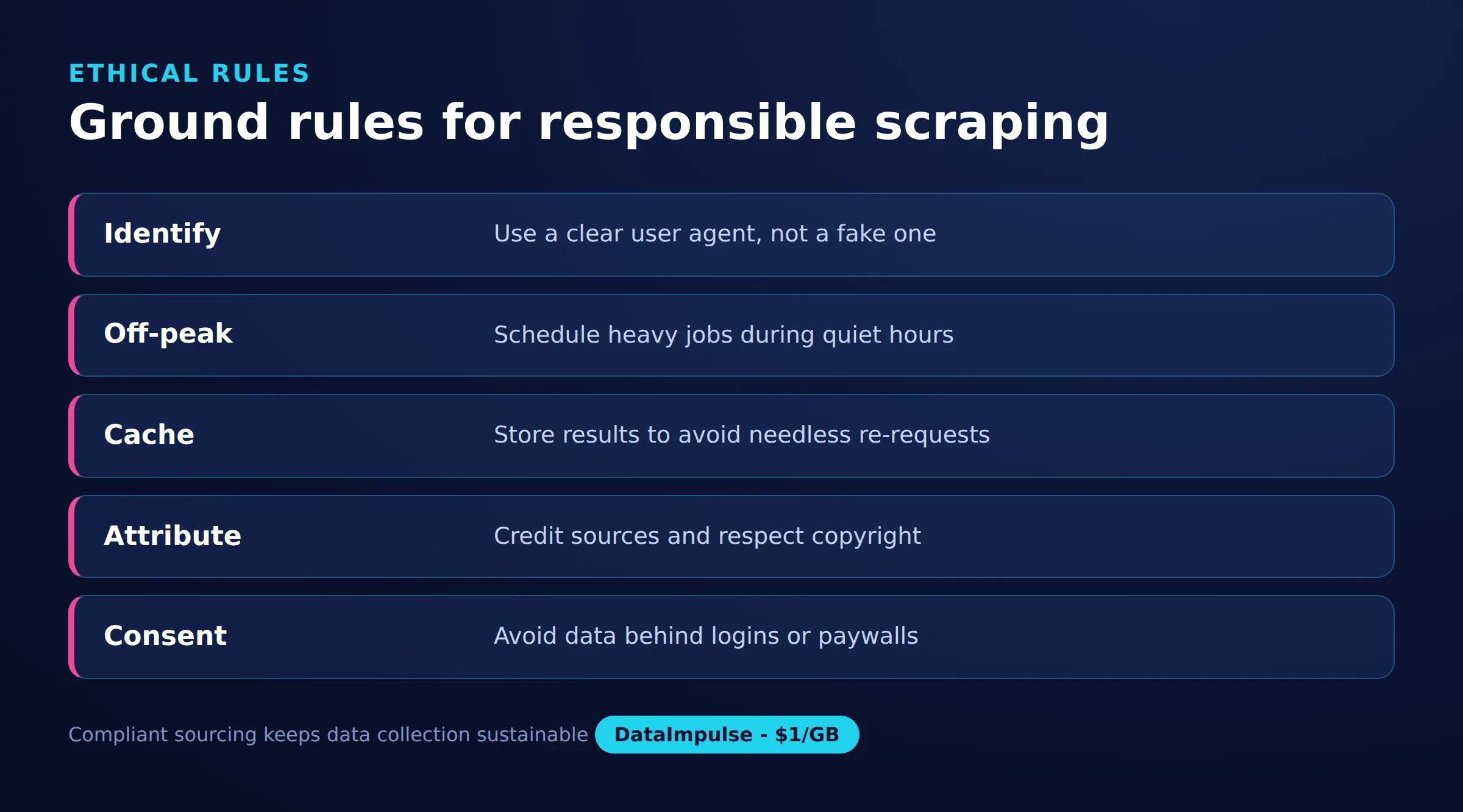
A short checklist keeps a project honest from the start. One point deserves its own note: licensing and copyright. Facts and raw data are often unprotected, but the creative expression around them, such as article text and photographs, can be covered by copyright or database rights, so check the licensing before you republish or resell what you collect.
- Public only: collect data accessible without login or paywall circumvention.
- Read the signals: review robots.txt and terms of service, and honor disallowed paths and crawl delays.
- Throttle: pace requests, limit concurrency, cache results, and back off on errors.
- Minimize PII: avoid personal data unless you have a lawful basis, and collect only what you need under GDPR and CCPA.
- Be transparent where practical: use an honest client and do not impersonate a specific person or defeat security.
- Respect licensing: check copyright and database rights before reusing or republishing content.
- Source infrastructure ethically: route traffic through opt-in, compensated proxy networks.
- Get advice when unsure: consult a lawyer for high-stakes or ambiguous cases.
Ethical scraping principles in practice
| Principle | In practice |
|---|---|
| Public data only | Skip login-gated content |
| Respect robots.txt | Follow crawl directives |
| Rate limiting | Add delays between requests |
| No personal data | Avoid collecting PII |
| Attribution and licensing | Honor terms and credit |
| Ethical proxy sourcing | Use consented IP networks |
Frequently asked questions
Is web scraping the same as ethical web scraping?
No. Web scraping is the technique of extracting data from websites, while ethical web scraping is scraping conducted with respect for public-data limits, server load, privacy law, and content licensing. The tool is the same; the discipline around it is what differs.
Does ignoring robots.txt make scraping illegal?
Not automatically. The robots.txt file is an advisory standard, not a law, so ignoring it is not itself a crime, but it can support other claims and it signals disregard for the site owner’s wishes. Legality depends on jurisdiction and the specific facts, so consult a lawyer for your case.
Can I scrape personal data if it is publicly visible?
Public visibility does not remove privacy obligations. Regulations like the GDPR and CCPA can still apply to personal data even when it appears on an open page, so you need a lawful basis and should minimize what you collect.
What are ethically sourced proxies?
Ethically sourced proxies come from users who explicitly opt in to share their connection and are compensated for it, with clear disclosure. DataImpulse sources its IPs this way and is GDPR aligned, with a data processing agreement available.
How do I keep my scraper from overloading a website?
Limit your request rate and the number of simultaneous connections, honor any crawl-delay, cache pages you have already fetched, and back off when you see errors or rate limits. The goal is to stay a small fraction of the site’s normal traffic.
When is DataImpulse not the right fit?
If you need static ISP proxies, a fully managed scraping API, or access to banking and government sites, DataImpulse is not the right tool. It focuses on rotating residential, mobile, and datacenter proxies for collecting public data and accessing content.
Scrape responsibly with ethically sourced proxies
If you want infrastructure that matches the principles above, DataImpulse offers ethically sourced residential, mobile, and datacenter proxies on pay-as-you-go traffic from one dollar per GB. Create an account to start collecting public data responsibly.
 State/City/Zip/ASN Targeting