In this Article
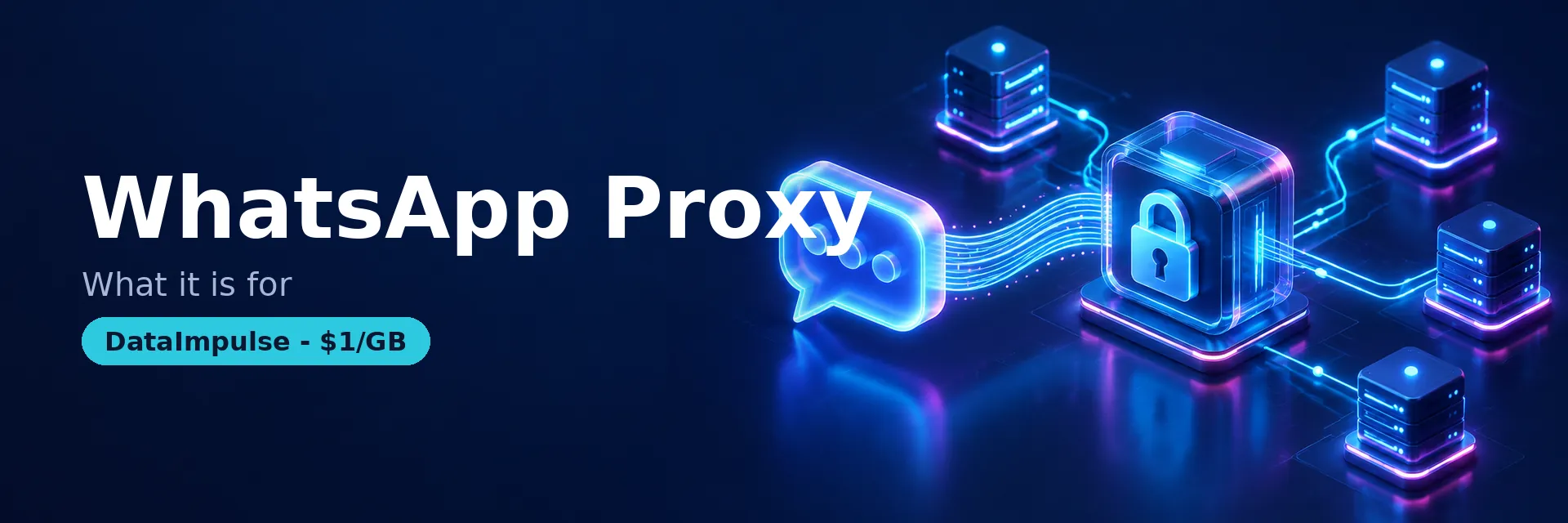
WhatsApp added proxy support for a specific situation: regions where the service is blocked or the internet is restricted, so people can reach it through a volunteer-run relay. It is often discussed as if it were a general privacy or location tool, which it is not, and the difference matters both practically and for safety.
This guide explains what the feature does, what it leaves unchanged, how to judge a proxy address someone hands you, and where commercial proxies genuinely apply instead.
Key Facts
- WhatsApp’s proxy feature exists for internet shutdowns, not for general privacy or for changing your apparent country.
- End-to-end encryption is unaffected. A proxy relays the connection; it does not gain access to message content.
- It takes a host and port you must already trust, typically run by volunteers, and a malicious operator still sees connection metadata.
- A commercial residential proxy is not what this feature expects. The app needs a reachable relay on specific ports, which is a different product.
- Your phone number stays your identity. A proxy changes the network path, not the account.
What does WhatsApp’s proxy feature actually do?
It relays your connection to WhatsApp’s servers through a host you specify, so a network that blocks WhatsApp directly cannot see or block the connection in the same way.
What it does not do is equally important. It does not change your account, which is your phone number. It does not hide who you are talking to from WhatsApp itself. It does not make you appear to be in another country for any purpose that matters. And it is not a general traffic tool: it applies to the app, not the device.
Message content stays end-to-end encrypted throughout. A proxy operator relays encrypted traffic and cannot read messages, which is the design guarantee that makes volunteer-run relays acceptable at all.
What can a proxy operator still see?
Metadata, which is less than content and more than nothing. We call it the 3-part exposure model.
| Layer | Visible to the operator | Protection |
|---|---|---|
| 1. Message content | No | End-to-end encryption |
| 2. Connection metadata | Yes: your address, timing, volume, duration | None; this is inherent to relaying |
| 3. Availability | Yes: the operator can cut or degrade the connection | Use another proxy |
The practical rule follows from row two: use a proxy from a source you have reason to trust, such as a known digital rights organisation or someone you personally know, rather than an address posted publicly by a stranger. In a shutdown, an operator that logs who connects is collecting exactly the list that is dangerous to be on.
How do you judge a proxy you were given?
| Question | Use it when | Avoid when |
|---|---|---|
| Who runs it? | A known organisation or a person you trust | It came from an anonymous post or a forwarded chain |
| Why do you need it? | The service is blocked where you are | You want privacy, which this does not provide |
| Is it stable? | You have a second address as a fallback | Relying on one relay in a fast-changing situation |
| Does it ask for anything? | Only a host and port are needed | Anything requesting your account, code or credentials |
That last row is the important one. The proxy setting needs a host and a port and nothing else. Any message that asks for a verification code in exchange for proxy access is an account takeover attempt, and it is one of the most common attacks aimed at exactly the people who need a proxy.
Where do commercial proxies fit instead?
Not here, and saying so plainly is more useful than implying otherwise.
The app expects a reachable relay speaking its protocol on specific ports. A commercial residential proxy is an HTTP and SOCKS exit for outbound requests, which is a different product built for a different job. Buying residential bandwidth will not make this feature work.
Where a service like ours does apply is business work on the web: collecting public data across regions, verifying how a page or an ad renders in a given country, and monitoring prices per market. That is the category DataImpulse serves, at $1 per GB across 195 countries with country, city and ZIP targeting.
If your need is personal privacy on an untrusted network, a reputable VPN covers the whole device and is the right category. If your need is reaching a blocked service during a shutdown, the app’s own feature plus a trusted relay is the right answer, and organisations working on connectivity in restricted regions are the right source for one.
Related: what is a web proxy, what is geo-blocking.
Frequently Asked Questions
What is the WhatsApp proxy feature for?
Reaching WhatsApp when a network blocks it, typically during an internet restriction or shutdown. It relays the app’s connection through a host you specify. It is not a privacy tool and does not change your apparent country for any practical purpose.
Can a proxy operator read my WhatsApp messages?
No. End-to-end encryption is unaffected by relaying, so the operator handles encrypted traffic. They can see connection metadata such as your address, timing and volume, and they can cut the connection, which is why the operator’s trustworthiness matters.
Can I use a commercial residential proxy with WhatsApp?
No. The feature expects a reachable relay speaking the app’s protocol on specific ports, while commercial residential proxies are HTTP and SOCKS exits for outbound web requests. They are different products for different jobs.
Is it safe to use a proxy address from a public post?
Generally not. The operator sees who connects and when, which during a shutdown is precisely the list that is risky to appear on. Prefer relays run by known digital rights organisations or people you personally trust.
Does a proxy change my WhatsApp account or number?
No. Your phone number remains your identity, and the proxy only changes the network path your app uses. Anyone offering proxy access in exchange for a verification code is attempting to take over your account.
For business collection across regions
If your need is verifying pages, ads or prices across markets rather than reaching a blocked app, that is what our network is built for. DataImpulse residential proxies cover 195 countries at $1 per GB with country, city and ZIP targeting. Create an account.
Related: what is a web proxy · what is geo-blocking · proxies for web scraping.
Last updated: September 17, 2026.
 State/City/Zip/ASN Targeting