
In this Article
Hit Walmart from one IP a few hundred times and you’ll see what changed. First a Press & Hold challenge, then a blocked.html page, then your sessions start coming back with the dreaded “request unsuccessful” interstitial — and that’s before Walmart’s WAF layer kicks in. Walmart is a $681B retailer with one of the most aggressive anti-bot stacks on US e-commerce — PerimeterX (now HUMAN Security Bot Defender) on top of an Akamai web application firewall — and the data behind it (prices, availability, reviews, seller info, MAP enforcement signals, regional inventory) is exactly what repricing, MAP-violation monitoring, dropshipping research, brand protection, and market-research teams need.
Proxies are how serious Walmart collection actually runs. The right pool keeps you under PerimeterX’s reputation thresholds, the right proxy type survives the behavioral scoring, and the right session model gets you through the Press & Hold layer instead of dying at it. This guide ranks the 8 best proxies for Walmart scraping in 2026, sorts out residential vs datacenter vs mobile for this specific job, and walks through full reviews. Jump to the quick comparison for a thirty-second shortlist; deeper coverage follows.
Key Facts
Walmart scraping has its own rulebook because Walmart defends product data harder than most US marketplaces and the official APIs gate almost everything. Five things to know up front:
- PerimeterX / HUMAN Security is the primary anti-bot layer. Walmart runs both Akamai (as the WAF) and PerimeterX (now HUMAN Security Bot Defender) for behavioral scoring. Detection drops a `_px3` cookie on first visit, fingerprints via Canvas/WebGL/fonts/sensor signals, and surfaces a “Press & Hold” challenge when a session’s score drops. HTTP-only scrapers without TLS fingerprint matching and a valid `_px3` cookie get flagged inside 10-20 requests.
- Walmart Marketplace API is gated. Approved third-party sellers can call it, but it only returns data about their own listings — not the broader catalog. Rate limits are allocated per seller. The public catalog stays off-API.
- Walmart Affiliate API is partner-only and capped at 5,000 calls/day. Impact.com powers the Walmart Creator/Affiliate program; data depth is limited and higher rates require a business-purpose justification submitted to Walmart.
- There’s no open Walmart Product Catalog API. The data you actually want — current prices, availability, reviews, Q&A, seller metadata, specifications, regional inventory — is not accessible through any official open endpoint. Scraping or managed Walmart APIs from third parties (Bright Data, Oxylabs, Decodo, ScraperAPI, Apify) are the practical paths.
- MAP enforcement is brand-driven, not Walmart-run. Minimum Advertised Pricing is typically a manufacturer or brand policy enforced against resellers; Walmart’s own Marketplace pricing rules focus on egregious pricing and competitive price rules. Price-tracking against Walmart still often feeds MAP-violation alerts (for brands), repricing engines, and competitive intelligence — uses with downstream commercial and contract impact.
How We Selected These Walmart Proxies
We didn’t rank on marketing claims. Each provider had to earn its spot on factors that matter specifically for Walmart work:
- PerimeterX success rate. This is the deciding factor. A pool that holds up against Walmart’s PerimeterX layer is doing real work; one that doesn’t is a monthly invoice for nothing.
- State-level geo precision. Walmart prices, availability, and store inventory vary by state and ZIP, especially for grocery and pickup. Country-level isn’t enough for serious Walmart work.
- Sticky session length. Cart flows, checkout simulation, signed-in views, and seller-dashboard depth need stable IPs for minutes to hours. Rotating residential on a per-request basis breaks those sequences.
- Scraper-API option. For teams not willing to maintain a PerimeterX-evading parser as Walmart updates the layer (and they do), managed APIs with dedicated Walmart endpoints (Bright Data, Oxylabs, Decodo, ScraperAPI, Apify) shift the maintenance burden.
- Pricing model fit. Raw $/GB for in-house repricers and trackers; per-record or per-request pricing for managed APIs. Walmart-specifically: per-record can be cheaper because PerimeterX inflates block rates on raw scraping.
- Compliance posture. Consent-based residential/mobile sourcing, clear acceptable-use policy, and a position on protected commercial uses (MAP, repricing) where applicable.
The eight that made the list cover the full range — from $1/GB pay-as-you-go residential for in-house teams to dedicated Walmart structured-data APIs that return parsed JSON from a URL.
What Makes a Good Walmart Proxy?
Walmart work magnifies a specific set of proxy characteristics. Six things matter most:
- PerimeterX-survivability. The behavioral scoring is the deciding feature. Fresh, ethically sourced residential with realistic browsing patterns clears Press & Hold most of the time; raw datacenter ranges flag inside the first few hundred requests.
- State and ZIP-level geo precision. Walmart prices and availability differ by state (and often store, for grocery). For multi-state repricing and MAP monitoring, state-level proxies are the floor.
- Sticky session length. PerimeterX scores sessions across requests — a sudden mid-session IP change is exactly what its risk model flags. Sticky sessions configurable to minutes-to-hours are essential for any deeper Walmart flow.
- TLS / fingerprint awareness. PerimeterX checks JA3 TLS fingerprints and browser-canvas/WebGL signatures alongside IP. Proxies alone aren’t enough — pair with a TLS-fingerprint-aware HTTP client (curl-impersonate, undetected-Playwright) or use a managed scraper API that handles this layer.
- Scraper-API option for teams that want it. Bright Data, Oxylabs, Decodo, ScraperAPI, and Apify all offer Walmart-aware scraper APIs that return parsed product/search data, with the PerimeterX maintenance built in.
- Per-success economics. A $0.50/GB pool blocked by Press & Hold 70% of the time is more expensive than a $1/GB pool that passes 90%. The metric to optimize is cost per successful product record, not headline $/GB.
Useful sanity check: every proxy vendor claims they “work with Walmart.” Ask specifically about PerimeterX Press & Hold, blocked.html interstitials, product-detail pages, search-results pages, reviews, and the signed-in/checkout flows. Vague answers mean the vendor’s Walmart success is anyone’s guess.
Quick Comparison: Best Proxies for Walmart at a Glance
The table compares all eight providers on the parameters that matter most for Walmart scraping work.
| Provider | Type Coverage | Walmart Tooling | Geo Granularity | Rotation | Starting Price | Best For |
|---|---|---|---|---|---|---|
| DataImpulse | Residential, mobile, datacenter | Raw proxies | Country; state/city/ZIP/ASN add-on | Rotating + sticky | $1/GB residential | Low-cost in-house Walmart pipelines |
| Bright Data | Residential, DC, ISP, mobile | Dedicated Walmart Scraper API + Unlocker + Dataset | 195 countries; city-level | Managed + proxy rotation | ~$2.50/GB res (promo); $5/GB regular; Walmart API $1.50/1K records PAYG (~$1/1K subs); Unlocker $1.50/1K | Enterprise Walmart pipelines |
| Oxylabs | Residential, mobile, DC, ISP | Walmart Product Data API | Country/state/city | Rotating, sticky | $6/GB residential; Walmart API in the $1.35-$2/1K range | High-reliability Walmart extraction |
| Decodo | Residential, mobile, ISP, DC | Walmart template scraper API | City, ZIP, ASN | Rotating, sticky up to 24h | $3.75/GB (3GB starter), $8.50/GB PAYG, $2/GB at 1TB+; Walmart API from $0.25/1K | Mid-market Walmart with strong API success |
| IPRoyal | Residential, DC, ISP, mobile | Web Unblocker | Country, region, city, ISP | Rotating, sticky up to 7 days | $7.35/GB residential PAYG | Long-sticky Walmart sessions |
| SOAX | Residential, mobile, ISP, DC | Web Data API | Country/region/city/ISP/ASN | Rotating, sticky | $3.60/GB Starter | Multi-type Walmart collection |
| ScraperAPI | Managed API (premium IPs included) | Dedicated Walmart Product + Search APIs | Country (top tier only) | Managed | $49/month (100K credits) | Structured Walmart data without proxy ops |
| Apify | Managed actors + proxy | Multiple Walmart scraper actors | Coordinates, location, URLs | Managed | from $1.30/1K products (PPE) | No-code Walmart datasets and scheduling |
Indicative starting rates from each provider’s own pricing pages (May 2026). Volume discounts apply and prices change, so check current numbers before you buy. Granular targeting (state/city/ZIP/ASN) may incur add-ons on some providers.
Which Proxy Type Should You Use for Walmart?
Walmart work behaves differently from generic e-commerce scraping because PerimeterX scores sessions, not just IPs, and the data is buyer-geo-conditional. The proxy type decides your success rate more than the brand does.
Residential Proxies
Residential proxies are the right default for nearly all Walmart work — product-detail pages, search results, reviews, seller pages, and pricing/availability flows. Real ISP-assigned home IPs look like ordinary consumer buyers to PerimeterX’s reputation system, and a fresh residential pool routinely clears the Press & Hold layer where datacenter ranges get challenged immediately. The trade-off is price: residential costs more per GB than datacenter, but on Walmart you pay less per successful product record because far fewer get blocked. If your scraper hits the Walmart blocked.html page on a target that used to work, switching to residential is the first fix.
Mobile Proxies
Mobile proxies route through real carrier networks and are the right tool when your work specifically targets the Walmart mobile app surface, m.walmart, or hard geo/session cases where residential rotation gets challenged. Mobile IPs see the content that targeted mobile buyers see — which is sometimes different from desktop (different pricing layouts, different pickup messaging, different promotional banners). They cost more per GB, so reserve them for the jobs where mobile context genuinely changes the dataset and avoid them for bulk price tracking where residential is more cost-effective.
Datacenter Proxies
Datacenter proxies are cheap and fast — but their role on Walmart is narrow. PerimeterX flags datacenter ranges aggressively, so don’t lean on datacenter for product pages, search results, or reviews; success drops to single digits inside a few hundred requests. Datacenter belongs in the Walmart stack as the cheap enrichment lane: validating non-Walmart URLs found in seller profiles, public seller external pages, lightweight enrichment of CSV exports, and any task that doesn’t hit Walmart surfaces directly.
Rotating vs Sticky for Walmart
The rule for Walmart: rotate for breadth, stick for behavioral coherence. Rotating residential handles broad search-result collection — “men’s running shoes,” “iPhone 15 cases,” and the catalog-monitoring sweeps that price-tracking and dropshipping research need. Sticky sessions handle the behavioral-coherence flows — cart flows, signed-in seller-dashboard sequences, multi-page review crawls on a single product, paginated category browsing, and any sequence where PerimeterX would flag a sudden mid-session IP change as suspicious. Most production Walmart pipelines mix both — rotating for the discovery pass, sticky for the depth pass.
Best Proxies for Walmart Scraping — Full Reviews
The picks below are ranked on value for Walmart work — the balance of PerimeterX-survivability, state-level geo, scraper-API options, sticky-session length, and price per successful record. DataImpulse leads on value; the rest each win a specific lane.
1. DataImpulse
DataImpulse is the best-value pick for in-house teams running their own Walmart scrapers — repricing, MAP-violation monitoring, dropshipping research, regional inventory tracking, and competitive-intel pipelines. Residential starts at $1/GB, pay-as-you-go, with traffic that never expires — a fraction of what enterprise Walmart APIs charge. The pool is 90M+ ethically sourced IPs across 195 countries with country targeting included and state/city/ZIP/ASN available as a paid add-on, which matters for US-state-level Walmart work (prices and pickup availability differ by state). It supports HTTP, HTTPS, and SOCKS5, rotating and sticky sessions, full API access, and standard scraping stacks (Scrapy, Selenium, Playwright); pair with a TLS-fingerprint-aware client like curl-impersonate or undetected-Playwright to clear PerimeterX. Mobile is available at $2/GB for m.walmart validation; datacenter at $0.50/GB for the enrichment layer.
What makes it the default for serious Walmart collection is the price-to-geo ratio. At $1/GB you can sustain continuous Walmart work across all 50 states without the per-record charges that managed APIs add up to at scale, and the PAYG model means experimenting with new SKU clusters doesn’t lock you into a subscription. Support is 24/7 human; published success rate is 99.51%; G2 is 4.8/5. There’s no dedicated Walmart endpoint here — DataImpulse sells the proxy infrastructure cleanly and lets the team build the Walmart parser on top.
Quick specs — Types: residential, mobile, datacenter · Pool: 90M+ residential, 195 countries · Rotation: rotating + sticky · Geo: country (state/city/ZIP/ASN as paid add-on) · Price: $1/GB res, $0.50/GB DC, $2/GB mobile · Published success: 99.51% · Rating: G2 4.8. Best for: in-house Walmart scraping teams that want low pay-as-you-go pricing and US-state geo without enterprise commitments.
2. Bright Data
Bright Data is the enterprise pick if you want Walmart data as a managed product. Beyond raw residential at $5/GB pay-as-you-go (currently discounted to about $2.50/GB with a 50% promo) with a 400M+ monthly IP pool and free city/ZIP targeting, Bright Data ships a dedicated Walmart Scraper API from $1.50 per 1,000 records on PAYG (about $1/1K on higher monthly subscriptions) and the Web Unlocker at $1.50 per 1,000 results on PAYG (down to ~$1/1K on subscriptions) that handles the PerimeterX layer at request time. A Walmart Dataset is available at about $2.50 per 1,000 records ($500 for 200K). The subscription tier with dedicated infrastructure starts at $499/month. It’s the right call when you’d rather hit a managed Walmart endpoint than maintain a PerimeterX-evading parser yourself — at enterprise pricing with procurement-style buying.
Quick specs — Types: residential, DC, ISP, mobile + dedicated Walmart Scraper API + Web Unlocker + Dataset · Pool: 400M+ monthly residential · Rotation: rotating, sticky, dedicated · Geo: country/city/ZIP/ASN · Price: ~$2.50/GB res (promo); $5/GB regular; Walmart Scraper API $1.50/1K records PAYG (~$1/1K on subscriptions); Web Unlocker $1.50/1K PAYG; subscription from $499/month. Best for: enterprise teams that want a managed Walmart data layer with compliance, audit, and SLA controls.
3. Decodo
Decodo (formerly Smartproxy) earns the #3 spot for Walmart specifically because of its API success rate: 99.98% on Walmart in head-to-head benchmarks, extracting 650+ fields per product page. Residential proxies start at $3.75/GB on the 3GB starter plan, with PAYG at $8.50/GB on the public pricing page, dropping to about $2/GB at the 1,000 GB subscription tier. The Walmart template Web Scraping API starts at $0.25 per 1,000 requests on the best plan and $0.50 per 2,000 on entry plans, with sticky sessions configurable up to 24 hours. Country, city, ZIP, and ASN targeting are included, which is the geo grid Walmart work needs.
Quick specs — Types: residential, DC, ISP, mobile + Walmart template scraper API · Pool: 115M+ residential · Rotation: per-request, sticky up to 24h · Geo: country/city/ZIP/ASN · Price: $3.75/GB (3 GB starter), $8.50/GB PAYG, $2/GB at 1 TB+; Walmart API from $0.25/1K · Walmart success: 99.98%. Best for: mid-market Walmart teams that want the highest-success managed Walmart endpoint at a per-record price.
4. Oxylabs
Oxylabs sits next to Bright Data at the enterprise top with a strong focus on managed scraping APIs. Residential starts around $6/GB on the entry plan with a 175M+ pool across 195 countries, and the Walmart Product Data API (part of the E-Commerce Scraper API) extracts approximately 620 fields per product page with a 99.88% Walmart success rate in benchmarks and a 2.84-second median response time. Walmart-with-JS pricing examples sit in the $1.35-$2 per 1,000 results range (per Oxylabs’ pricing examples and Proxyway benchmarks). The free trial covers up to 2,000 results. Sessions are flexible with unlimited concurrent connections. Pick Oxylabs when reliability, SLA-grade support, and an audit-ready compliance posture matter more than entry price or the per-record rate.
Quick specs — Types: residential, DC, ISP, mobile + Walmart Product Data API · Pool: 175M+ residential, 195 countries · Rotation: flexible, sticky, unlimited concurrency · Geo: country/state/city · Price: from $6/GB residential; Walmart API in the $1.35-$2/1K range (PAYG-style); free trial up to 2,000 results · Published success: 99.95% (general); 99.88% (Walmart benchmarks). Best for: enterprise Walmart programs that want SLA-grade managed scraping with deep field extraction.
5. IPRoyal
IPRoyal earns its spot for Walmart teams that need long sticky sessions. Residential PAYG runs $7.35/GB at entry (cheaper at volume) with a 32M+ pool across 195+ countries, country/region/city/ISP targeting, and — its real differentiator — sticky sessions up to 7 days, the longest on this list. The Web Unblocker product handles defended endpoints in general (CAPTCHA + anti-bot bypass) at per-request pricing — IPRoyal doesn’t document a Walmart-specific endpoint, but the Unblocker handles PerimeterX as part of its general anti-bot layer. For Walmart teams running production multi-day price tracking on individual listings, signed-in seller-dashboard sequences, or any flow where session continuity matters, IPRoyal’s 7-day sticky is unique.
Quick specs — Types: residential, ISP, mobile, DC + Web Unblocker · Pool: 32M+ residential, 195+ countries · Rotation: rotating, sticky up to 7 days · Geo: country/region/city/ISP · Price: from $7.35/GB residential PAYG. Best for: Walmart teams running long-running price-tracking and seller-dashboard flows where multi-day sticky sessions are the deciding feature.
6. SOAX
SOAX is the pick when geo-precise Walmart work and mixed proxy types matter together. Residential starts at $3.60/GB on the Starter plan (25GB included), and the unified credit model means you can spend the same budget on residential, mobile, ISP, datacenter, or the Web Data API. The pool is one of the larger in the mid-tier — 155M+ residential, 33M+ mobile, 2.6M+ ISP — with country, region, city, ISP, and ASN targeting. Sticky sessions are supported across all proxy types. Convenient if your Walmart program mixes mobile checks for m.walmart validation with residential for desktop price-tracking and ISP/static for seller-dashboard sequences.
Quick specs — Types: residential, mobile, ISP, DC + Web Data API · Pool: 155M+ residential, 33M+ mobile, 2.6M+ ISP · Rotation: per request or interval, sticky supported · Geo: country/region/city/ISP/ASN · Price: $3.60/GB Starter. Best for: Walmart teams running geo-heavy collection across multiple proxy types under one subscription.
7. ScraperAPI
ScraperAPI is the right answer when you want Walmart data as outcomes instead of managed proxies. It sells dedicated Walmart Product and Search APIs (plus async versions for large jobs) that handle rotation, retries, PerimeterX bypassing, JavaScript rendering, and Walmart-specific extraction (product names, prices, ratings, reviews, seller IDs, availability). Plans start at $49/month for 100,000 API credits on the Hobby tier; Walmart endpoints consume credits with multipliers for JS-render and premium-IP modes. Country-level geo targeting is restricted to the Business tier ($299/mo) (per the current docs). Walmart success was 99.98% in head-to-head benchmarks, tied with Decodo for the top spot.
Quick specs — Type: dedicated Walmart Product + Search APIs · Pool: 40M+ proxies, 50+ countries · Rotation: automatic, API-managed · Geo: country-level on Business ($299/mo) · Price: from $49/month (100K credits) · Walmart success: 99.98%. Best for: teams that want managed structured Walmart data without managing proxies and don’t need state-level geo on entry tiers.
8. Apify
Apify is the right pick for no-code or low-code Walmart teams. The Apify marketplace has multiple Walmart scraper actors covering product search, individual product extraction, seller pages, and pricing/inventory monitoring — popular options include junipr’s Walmart Scraper at about $1.30 per 1,000 products on Pay-Per-Event pricing (you only pay for successfully scraped products), with other actors running $0.75 to $4 per 1,000 results depending on actor and plan. Apify Proxy residential is available from $8/GB if you also want raw infrastructure. The combination — actor marketplace, scheduling, exports, API access, PerimeterX-bypass strategies built into the popular actors, and maintained scraping logic — makes Apify the fastest route from “we need Walmart data” to “we have a CSV” for teams that don’t want to build.
Quick specs — Type: actor marketplace + managed proxies · Walmart actors: multiple (junipr, automation-lab, sovereigntaylor, silentflow, others) · Geo: location, coordinates, URLs · Pricing: from $1.30/1K products (PPE) · Proxy: residential from $8/GB. Best for: no-code Walmart datasets, scheduled extraction, and teams that want delivered data without building scrapers.
How Much Do Walmart Proxies Cost?
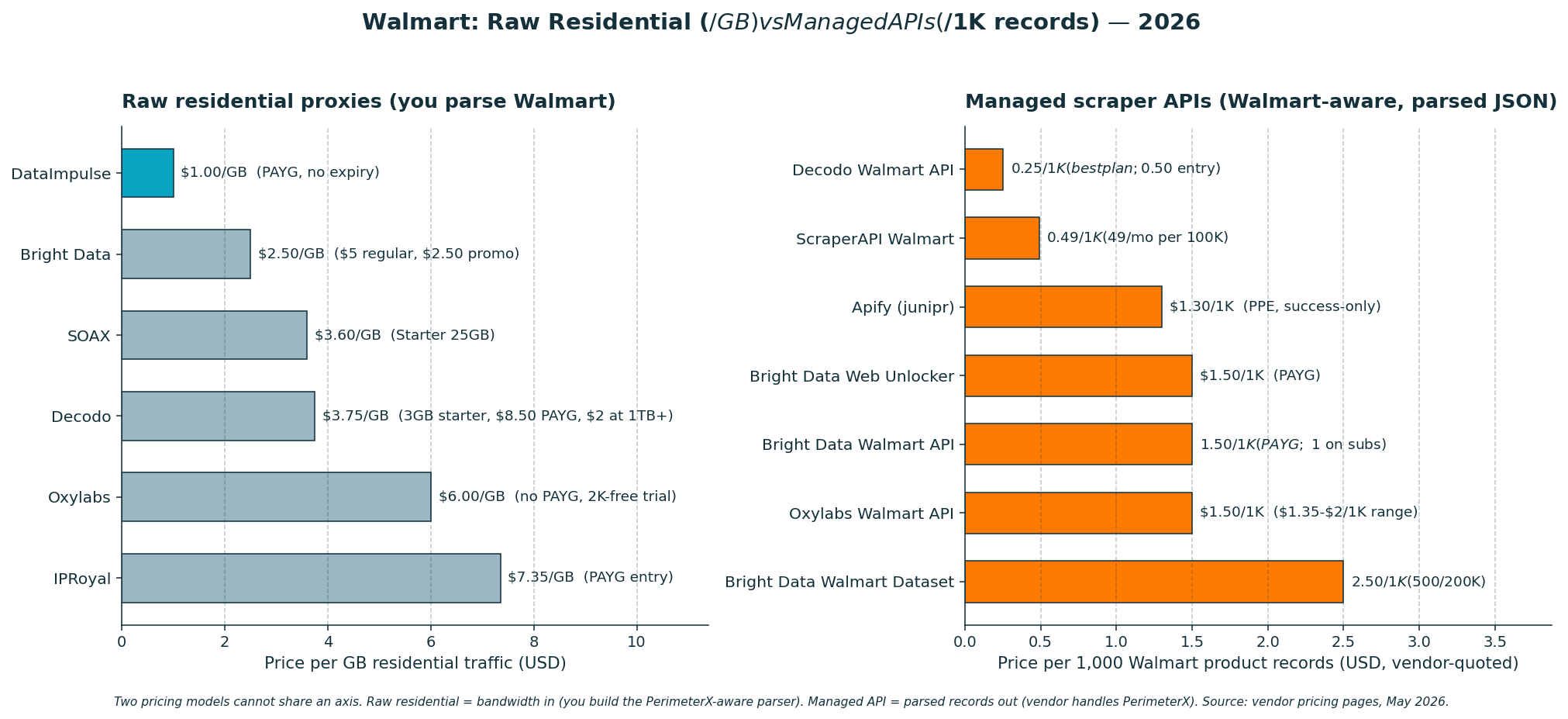
Listed pricing in 2026 falls into three bands. Budget/value at $1–$3.75/GB — DataImpulse, SOAX Starter, Decodo entry (volume tier $2/GB) — covers most in-house Walmart work, including multi-state price tracking and seller-inventory snapshots. Mid/premium at ~$3.60–$7.35/GB — Bright Data ($5 regular / $2.50 promo), Oxylabs, IPRoyal, Apify Proxy — adds enterprise tooling and SLA-grade reliability. API-priced — Decodo Walmart API from $0.25/1K, Bright Data Walmart API from $1.50/1K records PAYG (~$1/1K on subs), Apify Walmart actors from $1.30/1K products, Bright Data Walmart Dataset $2.50/1K, Oxylabs Walmart API in the $1.35-$2/1K range, ScraperAPI from $49/month, IPRoyal Web Unblocker per-request — sells structured Walmart outcomes per record or per plan instead of per GB.
The real cost question for Walmart isn’t “what’s the lowest $/GB” but “what’s the lowest cost per successful, PerimeterX-passing product record”. A managed Walmart API at $0.25-$1/1K records can beat $1/GB residential when your in-house scraper is hitting Press & Hold on 50%+ of requests; conversely, $1/GB residential paired with a TLS-fingerprint-aware client routinely beats per-record APIs at scale once your in-house parser is mature, your PerimeterX pass rate is above 80%, and your team is comfortable updating fingerprinting tactics as Walmart updates the PerimeterX layer. Test both on your actual targets before committing.
Is Scraping Walmart Legal?
Walmart scraping lives in a legal gray zone shaped by Walmart’s terms, the data you collect, and the use you put it to. The basics:
- Walmart’s User Agreement and Open API Terms restrict automated access. The terms prohibit using robots, spiders, or other automated devices to access or extract data from the Walmart site without prior written permission. Proxies don’t grant permission; they reduce IP-side blocks.
- Recent rulings narrow ToS-only enforcement. In January 2024, a federal judge granted summary judgment to Bright Data in Meta’s lawsuit, finding that on the record Meta couldn’t show Bright Data scraped data while logged into a Meta account. The ruling was evidence- and contract-specific, but it’s often cited for the broader proposition that terms of service have weaker bite against scrapers that operate without logging in.
- hiQ v LinkedIn narrows CFAA risk. The Ninth Circuit’s 2022 ruling held that scraping publicly available data is unlikely to violate the Computer Fraud and Abuse Act. But trespass, copyright, privacy, and state-law claims can still apply, and Intel v. Hamidi (2003) narrowed the trespass-to-chattels theory often cited against scrapers to cases involving actual system harm.
- MAP enforcement is a brand-policy layer, not Walmart’s. Minimum Advertised Pricing is typically enforced by manufacturers and brands against their resellers, not by Walmart itself (Walmart’s Marketplace pricing rules focus on egregious pricing and competitive price rules). Using scraped Walmart pricing for repricing or MAP-violation alerts can still create downstream contract exposure with brands enforcing MAP, on top of Walmart’s terms.
- Compliance is gating, not optional. Commercial Walmart scraping operates openly in the industry — repricing, MAP-violation monitoring, dropshipping research, brand protection — but your specific use case deserves legal review before scale. Logged-in surfaces, signed-in flows, and PII collection carry the highest risk; public product pages the lowest.
The honest reading: large-scale commercial Walmart collection is widespread practice, but the terms and PerimeterX-circumvention questions are real. Get legal counsel before scaling a production Walmart pipeline, especially for repricing, MAP-violation monitoring, and any product built on logged-in or sold-comps-equivalent data.
How to Start Walmart Scraping with DataImpulse
- Create an account and pick your proxy mix. Residential ($1/GB) for Walmart product pages, search results, and review crawls; datacenter ($0.50/GB) for enrichment (non-Walmart URLs found in seller profiles, public pages); mobile ($2/GB) for m.walmart validation.
- Add funds. Pay-as-you-go, no subscription, no expiry — handy because Walmart collection volume varies with repricing cycles, promotional events (Black Friday, Walmart+ events), and competitive-intel campaigns.
- Target by state and rotate. Set country US plus state/city for the Walmart markets you’re collecting (state/city/ZIP/ASN are paid add-ons but essential for US-state Walmart work), pick rotating for broad search-result sweeps and sticky sessions for cart flows and seller-dashboard depth, pair with a TLS-fingerprint-aware client (curl-impersonate, undetected-Playwright) to clear PerimeterX, point your scraper at the proxy endpoint and run.
For more on related workflows, see our residential proxies product page, the price comparison use case, and the wider best proxies for Amazon scraping roundup.
FAQ
Is scraping Walmart legal?
Walmart’s User Agreement restricts automated access without prior permission, and the Walmart Open API Terms similarly restrict commercial use. The 2024 Meta v Bright Data ruling and the 2022 hiQ v LinkedIn ruling narrow ToS-only and CFAA-based enforcement against scrapers that don’t log in to public surfaces, but trespass, contract, copyright, and privacy claims can still apply. Get counsel before scaling, especially for MAP-enforcement and repricing use cases. This isn’t legal advice.
What are the best proxies for Walmart scraping?
Residential proxies with US-state geo are the safest default. DataImpulse residential at $1/GB is the budget pick; Decodo’s Walmart template API, Bright Data’s dedicated Walmart Scraper API, Oxylabs Walmart Product Data API, ScraperAPI’s Walmart endpoints, and Apify’s Walmart actors are the stronger managed-API options.
How does Walmart detect scrapers?
Walmart runs PerimeterX (now HUMAN Security Bot Defender) on top of an Akamai WAF. Detection drops a `_px3` cookie, fingerprints via Canvas, WebGL, fonts, and sensor signals, and surfaces a “Press & Hold” challenge when behavioral scoring drops. HTTP-only scrapers without TLS-fingerprint matching and a valid `_px3` cookie get flagged inside 10-20 requests.
Walmart API vs scraping: which is better?
Use the official Walmart Marketplace API for compliant seller-side flows — your own listings, inventory, orders — and the Walmart Affiliate API (capped at 5,000 calls/day) for partner-link use cases. Use scraping APIs or proxies for research workflows where the public catalog, current pricing, regional availability, or review data is what you actually need, and where your compliance review supports it.
Residential vs datacenter proxies for Walmart?
Residential for Walmart surfaces — product pages, search results, reviews, seller pages. Datacenter for enrichment tasks (non-Walmart URLs found in seller profiles, public seller external pages, lightweight enrichment). On Walmart itself, datacenter fails fast against PerimeterX.
Rotating or sticky proxies for Walmart?
Rotating for broad search-result collection and price-tracking discovery sweeps (catalog monitoring, MAP-violation alerts, dropshipping research); sticky for state-aware flows (cart flows, signed-in seller dashboards, multi-page review crawls on a single product, paginated category browsing). Most production Walmart stacks mix both.
How do you bypass Walmart’s Press & Hold CAPTCHA?
Press & Hold is PerimeterX’s behavioral challenge — bypass strategies focus on not triggering it: fresh residential IPs, realistic browsing patterns, TLS-fingerprint-aware clients (curl-impersonate, undetected-Playwright), valid `_px3` cookies, and avoiding direct deep-link requests without prior site activity. Managed scraper APIs (Bright Data, Decodo, Oxylabs, ScraperAPI) maintain this stack on your behalf and surface the result as a parsed response.
Can I use Walmart data for repricing?
Technically yes, legally with care. Walmart’s terms restrict automated access, and MAP enforcement adds a brand-contract layer on top — repricing tools built on scraped Walmart data deserve legal review before launch and ongoing operation. Many production repricing teams use a mix of managed Walmart APIs (for the structured data) and in-house residential (for coverage gaps), with brand-MAP compliance as a separate workflow.
Best mobile proxies for m.walmart?
SOAX, Oxylabs, and DataImpulse all offer mobile coverage suitable for m.walmart validation and mobile-context checks. Use mobile when your target is specifically m.walmart surfaces or mobile-only promotions; otherwise residential is enough and cheaper.
Ready to run Walmart scraping with the US-state geo precision Walmart pricing and availability actually need? Start with DataImpulse — residential from $1/GB, datacenter from $0.50/GB, mobile from $2/GB, pay-as-you-go with country targeting included (state/city/ZIP/ASN as paid add-on) and traffic that never expires.

 State/City/Zip/ASN Targeting