In this Article
The residential proxy market changed in 2025-2026: Reddit sued Anthropic (June 4, 2025) and Perplexity + SerpApi + Oxylabs + AWMProxy (October 22, 2025, with a February 6, 2026 amended complaint adding Google-SERP-scraping allegations); the 9th Circuit’s hiQ ruling and Meta v Bright Data (January 23, 2024) established that public-data scraping is CFAA-safe but publisher contracts are still enforceable; Bartz v Anthropic (June 23, 2025) confirmed AI training on public web data is “exceedingly transformative” fair use. For technical buyers evaluating residential proxies for the first time — for sentiment monitoring, ad verification, brand protection, AI training-data assembly, or price-tracking — the question is no longer just “what is a residential proxy?” but also “how do I procure one with audit-defensible documentation in case my pipeline ends up in a deposition?” This guide answers both: definition, mechanism, sourcing, types, comparisons, use cases, the 2026 legal landscape, and a buyer-side procurement checklist.
What Is a Residential Proxy?
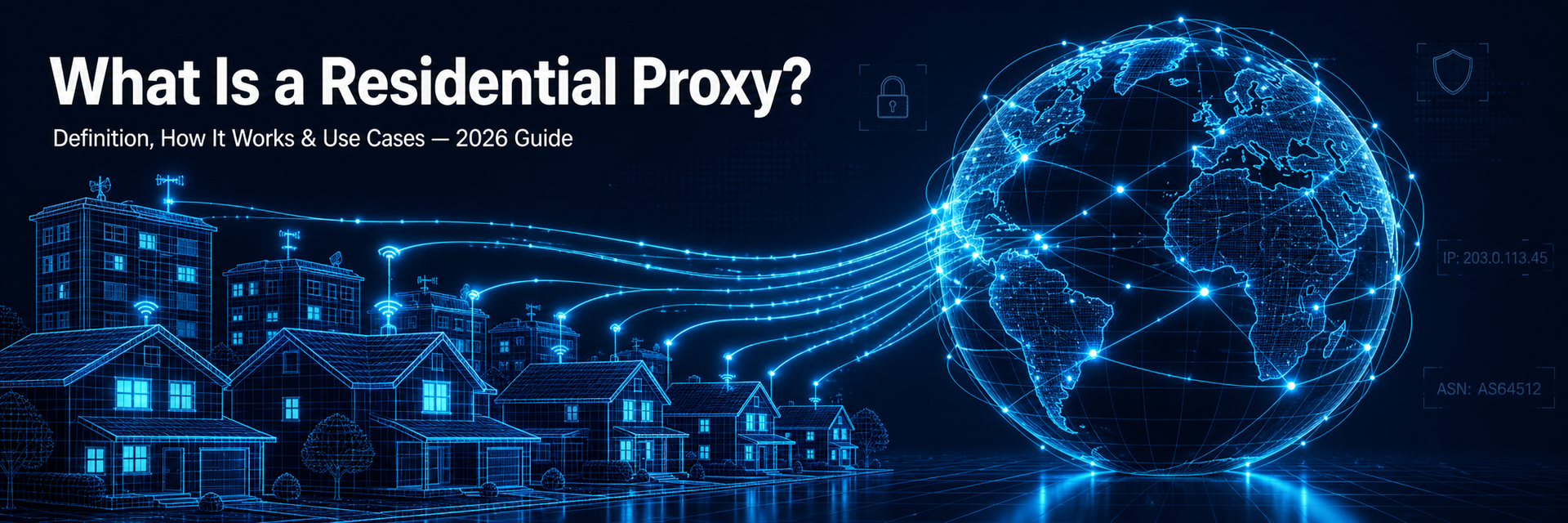
A residential proxy is an intermediary server that routes your internet traffic through an IP address assigned by a consumer Internet Service Provider (ISP) to a real home device — making outbound requests appear as ordinary household traffic to the destination website.
Unlike datacenter proxies (which run on commercial server-hosted IP ranges that anti-bot systems flag in milliseconds) or VPNs (which assign one shared IP per server cluster), residential proxies pull from large pools of authentic consumer IPs — typically 30M-400M+ across major providers as of 2026. Major consumer ISPs in the pool typically include Comcast, Charter Spectrum, AT&T, Verizon, T-Mobile Home Internet, Cox in the US; Deutsche Telekom, Vodafone, BT, Orange in Europe; and Reliance Jio, Bharti Airtel, Telcel, Vivo, Türk Telekom in major emerging markets. To the target site, your scraper or browser looks identical to a regular consumer browsing from a real home in the chosen country, state, or city.
How Do Residential Proxies Work?
The request flow is straightforward: your application (scraper, browser, automation script) sends a request to the proxy provider’s gateway endpoint (e.g., `gw.dataimpulse.com:823`) instead of directly to the target site. The gateway authenticates your request (typically via username:password or IP allowlist), selects a residential IP from the pool that matches your geo and rotation parameters, and forwards the request through that IP to the target. The target sees a request from an ordinary Comcast or Vodafone customer; the response routes back through the same proxy IP to you.
Two key rotation models exist. Rotating residential assigns a new IP per request (or every few requests) — useful for broad sweeps where IP diversity beats consistency. Sticky residential holds the same IP for a configurable session window (5 minutes, 30 minutes, 1 hour, 24 hours, up to 7 days on some providers) — useful for multi-step flows where the target site correlates session state with IP identity (Reddit account sessions, LinkedIn flows, multi-page checkout simulations). Most production stacks combine both: rotating for breadth, sticky for depth.
Authentication is typically one of two models. Username:password authentication lets you embed credentials directly in the proxy URL (`http://user:pass@gateway:port`) — flexible, works from any IP. IP allowlist restricts access to specific source IPs — more secure for production servers but inflexible for distributed runs.
Where Residential IPs Come From (and Why It Matters for Buyers)
The provenance of residential IPs is the single most important factor in 2026 procurement — and the most opaque. Three sourcing models dominate the market:
- 1. Peer-to-peer SDK with opt-in compensation (the modern ethical model). Apps integrate a proxy SDK that, with the user’s explicit opt-in consent and typically in exchange for a small payment, free premium features, or ad-free experience, makes the device available as a residential exit node when idle. DataImpulse, IPRoyal, and SOAX run pools predominantly on this model. The opt-in is documented; users can opt out anytime; consent is logged.
2. ISP partnerships and leased IP blocks (the premium tier). Some providers lease residential IPv4/IPv6 blocks directly from cooperating ISPs — these are static residential (“ISP proxies”), sit on real ISP-assigned addresses, and don’t depend on individual end-user devices. NetNut and parts of Oxylabs and Bright Data operate this model. More expensive, more stable, no end-user-device variability.
3. Legacy non-consensual models (the toxic legacy). The Hola VPN / Luminati era (pre-2020) bundled “free VPN” services with peer-bandwidth resale that users were not clearly aware they were enrolling in. Bright Data (formerly Luminati Networks) inherited this legacy; the modern Bright Data network has moved toward documented opt-in but the historical model defined what “non-ethical residential sourcing” looks like.
Why procurement should care. Post Reddit v Perplexity et al. (October 22, 2025, SDNY) — where Reddit named SerpApi, Oxylabs UAB, and AWMProxy as co-defendants for allegedly facilitating unlicensed Reddit scraping — proxy provider liability is no longer theoretical. The February 6, 2026 amended complaint added Google-SERP-scraping allegations and broadened the alleged infrastructure-providing role of the named co-defendants. AWMProxy is alleged to have operated an outright botnet. For any business buying residential proxies for production scraping, IP-provenance documentation has become part of the procurement defense: if your pipeline is ever discovered in litigation discovery (e.g., NYT v OpenAI’s January 2026 order compelling production of 20M ChatGPT logs), the question “where did the IPs come from?” is one you need to answer.
Residential Proxy vs Other Proxy Types
Most “what is a residential proxy” articles compare only to datacenter. The full 2026 landscape includes four other proxy types — each with a different fit.
Residential vs Datacenter Proxies
Datacenter proxies sit on commercial server-hosted IP ranges (Amazon AWS, Google Cloud, DigitalOcean) — fast, cheap, but anti-bot systems flag them in milliseconds because they’re documented in public ASN registries as non-consumer ranges. Residential proxies route through consumer-ISP IPs and bypass that initial filter. Use datacenter for public-data layers without serious anti-bot (open-data sites, government data, public APIs); use residential for any site with tier-1 or tier-2 anti-bot stacks (e-commerce, social, news, real estate, jobs). Pricing: datacenter typically $0.50-$1/GB; residential typically $1-$15/GB.
Residential vs Mobile Proxies
Mobile proxies route through real carrier networks (Verizon, T-Mobile, AT&T in US; Vodafone, EE in EU) — same authenticity principle as residential, but the IPs come from mobile carriers serving thousands of real subscribers simultaneously, which makes them the hardest IP class to flag. Use mobile for app-mobile validation, the most defended targets (LinkedIn account survival, Reddit account-tied flows, Instagram), or new-account warm-ups where mobile-carrier IPs look more native than fixed-line residential. Mobile is the most expensive option per GB ($2-$10).
Residential vs ISP / Static Residential Proxies
ISP proxies (also called “static residential”) sit on consumer-ISP-assigned addresses but are leased directly to the provider rather than coming from end-user devices. The IP doesn’t rotate among consumers; it sits with the provider as a static residential address. Use ISP for any workflow that needs IP-account fingerprint continuity over weeks (signed-in LinkedIn Sales Navigator, Reddit Pushshift-substitute account work, multi-day rank tracking on Google.com, recruiter-account-tied flows on Naukri/Catho/OCC Mundial). Decodo offers ISP from $0.27/IP, IPRoyal/NetNut/Bright Data also have ISP lines. Static residential and rotating residential are the same network — the difference is rotation model + sourcing (leased vs P2P).
Residential Proxy vs VPN
A VPN typically routes all your device’s traffic through one server cluster — you appear to come from one IP per VPN endpoint. A residential proxy assigns from a pool of millions, with per-request rotation possible. Use a VPN for personal privacy or accessing geo-locked consumer services. Use residential proxies for any commercial / programmatic workflow (scraping, automation, brand monitoring, ML data) where you need IP diversity, per-request rotation, geo-precise targeting, and authentic-consumer signaling at scale. A VPN’s single shared IP gets blocked by anti-bot systems the moment they recognize the pattern; residential pools survive at scale.
Rotating vs Static (Residential) Proxies
Both “rotating” and “static” residential proxies are residential — the difference is rotation model. Rotating residential assigns a new IP per request or per session — ideal for breadth: 10,000 product pages on an e-commerce site, broad SERP rank tracking, social-media trend monitoring. Static residential (= ISP proxies) holds the same IP for the session lifetime, useful for account-tied or session-state-tied workflows where IP changes break server-side state. Most production stacks combine both: rotating for catalog sweeps, static for account-tied accounts.
Sticky-session ceilings vary widely: most providers offer 5-30 minute sticky on rotating residential; IPRoyal’s 7-day sticky is the longest on the market; ISP / static-residential holds indefinitely until you release it.
Common Use Cases for Residential Proxies
Residential proxies underlie most commercial web-data work in 2026. Top 10 use cases:
- Web scraping at scale — e-commerce catalogs, news, real estate listings, jobs, social — anywhere tier-1 anti-bot blocks datacenter. See our best proxies for web scraping roundup.
- Price monitoring + competitive intelligence — Amazon, Walmart, Mercado Livre, Flipkart price tracking; competitive catalog sweeps; dynamic-pricing observation.
- Ad verification — confirming your ads serve correctly to users in target geos; catching ad fraud; brand-safety monitoring.
- SEO + SERP rank tracking — Google search results vary by geo and IP authenticity; residential gives accurate consumer-view rankings. See best proxies for SEO.
- Brand protection — counterfeit detection, unauthorized seller monitoring, trademark scanning across global marketplaces.
- Market research — pricing, assortment, sentiment, competitor positioning across multiple regional markets.
- AI / ML training data assembly — supplementing Common Crawl with vertical / multilingual / fresh data for RAG and fine-tuning pipelines. See best proxies for ML training.
- Geo-content testing — verifying your website renders correctly for users in different countries; localization QA.
- Social media management — multi-account brand work that needs IP diversity to avoid platform restrictions.
- Sneaker / ticket bots — high-velocity drop monitoring on Nike SNKRS, Footsites, Ticketmaster — where datacenter and even mobile flag fast and residential pool depth is the differentiator.
How Much Do Residential Proxies Cost?
Residential proxy pricing in 2026 falls into three bands:
- Budget / transparent PAYG ($1-$3.75/GB): DataImpulse $1/GB (PAYG, no expiry), SOAX Starter $3.60/GB, Decodo Starter $3.75/GB.
- Mid-tier ($3.50-$7.35/GB): NetNut from $3.53/GB, Webshare residential from $3.50/mo, Decodo PAYG $4-$8.50/GB depending on page tier, Oxylabs from $6/GB, IPRoyal from $7.35/GB PAYG.
- Enterprise ($5-$15/GB raw, or per-record managed APIs): Bright Data $8/GB PAYG regular (currently $4 with 50% promo, $2.50 at $1,999/mo high-volume tier), Bright Data Web Scraper API $1.30-$1.50/1K records.
Other types for context: datacenter typically $0.50-$1/GB, mobile $2-$10/GB, ISP / static residential $0.27-$5/IP. Why prices vary: pool depth, geo add-on (state/city/ZIP/ASN often charged at 2× base rate), sticky-session duration, anti-bot bundling, and contract-volume commitments.
For most production teams, the question isn’t “what’s the lowest $/GB” but “what’s the lowest cost per usable, audit-defensible record on my targets at my volume” — and the answer depends on which lane you’re in (in-house residential + parser maintenance vs managed Scraper API).
Are Residential Proxies Legal?
Using a residential proxy is legal in most jurisdictions. What you do with it determines the legal exposure. The 2026 landscape:
Public web data scraping = CFAA-safe (US). hiQ Labs v LinkedIn (9th Circuit, April 18, 2022) held public-data scraping does not violate the Computer Fraud and Abuse Act. Meta v Bright Data (January 23, 2024, N.D. Cal.) reinforced this with the public-vs-logged-in distinction. Bartz v Anthropic (June 23, 2025) confirmed training AI on public web data is “exceedingly transformative” fair use under 17 USC §107 — though Bartz also held that downloading ~7M pirated books for Anthropic’s library was NOT fair use, a separate carve-out. Kadrey v Meta (June 25, 2025) reached a parallel result on Meta’s Llama training, though Judge Chhabria explicitly cautioned the ruling does not stand as broad AI-training-is-fair authority.
Publisher contracts are still enforceable. Even when CFAA is safe, target-site Terms of Service prohibiting automated access can ground contract-breach claims. Reddit v Anthropic (June 4, 2025, San Francisco Superior Court, with a March 30, 2026 remand/preemption development) and Reddit v Perplexity et al. (October 22, 2025, SDNY; Feb 6, 2026 amended complaint added Google-SERP-scraping allegations) are the high-profile 2025-2026 cases. The October 2025 case named SerpApi, Oxylabs UAB, and AWMProxy as co-defendants alongside Perplexity — the first major lawsuit where Reddit went after proxy and search-API providers directly. AWMProxy is alleged to have operated a botnet; Oxylabs and SerpApi are alleged to have provided scraping infrastructure that enabled the operation. For ML / SaaS / brand-monitoring teams scraping Reddit, contract-breach exposure is now the real risk surface — see our best proxies for Reddit scraping roundup for the operational tradeoffs.
Personal data triggers privacy law everywhere. GDPR (EU members), CCPA/CPRA (California), LGPD (Brazil), DPDP (India, phased through May 2027), KVKK (Türkiye), LFPDPPP (Mexico) all govern scraped data that contains personal data of residents in those jurisdictions. Scraping personal data without a lawful basis triggers enforcement independent of the CFAA / contract analysis.
Production discovery is real. NYT v OpenAI (January 2026, SDNY) — OpenAI was compelled to produce all 20M ChatGPT logs to plaintiffs. Production scraping pipelines should now assume eventual discovery: keep scraping logs, robots.txt-respect records, IP-provenance attestations from the proxy vendor, and license documentation. This is the audit-defensibility lens.
Get US tech-transactions + EU privacy counsel before scaling commercial scraping. This isn’t legal advice.
How to Evaluate a Residential Proxy Provider (2026 Buyer Checklist)
Post Reddit v Perplexity et al. (October 22, 2025) and its February 2026 amended complaint, proxy provider evaluation in 2026 carries a buyer-side audit-defensibility lens. Seven-point checklist:
- Sourcing model disclosure. Does the provider publicly document its IP sourcing (P2P SDK opt-in, ISP partnership, or legacy)? Most major providers — including DataImpulse, Decodo, Bright Data, Webshare, Oxylabs, IPRoyal, SOAX, and NetNut — publish sourcing-model documentation in some form. Avoid providers that don’t disclose at all, and require written confirmation of the specific model (opt-in P2P vs ISP-leased) before scaling.
2. IP-provenance documentation availability. Will the provider sign IP-provenance attestations / DPA covering the IPs your traffic uses? Procurement-grade requirement post-NYT-v-OpenAI discovery.
3. Compliance certifications. ISO 27001, SOC 2 Type II are the procurement floor. Bright Data, Oxylabs publish both; many budget providers do not.
4. Pool depth + geo coverage. Ask for documented monthly active IPs (not the pool-size marketing claim — pool ≠ daily-available). Typical 30M-400M residential. Country count (195+ ideal). State/city/ZIP/ASN-level targeting availability (paid add-on on many; included on Decodo/SOAX). Match to your geo-precision needs.
5. Sticky-session duration ceiling. Critical for account-tied workflows. Most rotating residential caps at 30 minutes; LinkedIn and Reddit account-tied work needs hours-to-days; IPRoyal’s 7-day sticky is the longest on the market. Specify your needed duration in procurement spec — don’t assume.
6. Pricing transparency. Published $/GB rate-card vs custom-quoted enterprise-only. Transparent PAYG (DataImpulse $1/GB, SOAX $3.60/GB, Decodo $3.75/GB) is easier to budget and audit than custom quotes.
7. Active litigation / co-defendant status. Scan the provider for current scraping-related litigation (post-October 2025, this includes Oxylabs UAB as Reddit v Perplexity co-defendant). Active named-defendant status doesn’t mean liability but it does mean elevated procurement scrutiny.
For higher-stakes ML / regulated-industry / publisher-content scraping, run this checklist explicitly against finalist vendors and require written responses. The 2-page output becomes part of your audit trail.
How to Get Started with DataImpulse
- Create an account at dataimpulse.com and pick your proxy type — residential ($1/GB PAYG, traffic never expires) for most commercial scraping, mobile ($2/GB) for the hardest accounts, datacenter ($0.50/GB) for public-data layers.
- Add funds — pay-as-you-go, no subscription, no expiry — convenient for spiky workloads that don’t fit subscription billing.
- Target by geo and connect — set country, add state/city/ZIP/ASN if you need precision (2× the per-GB rate for sub-country targeting), pick rotating for broad work or sticky sessions for account-tied flows. DataImpulse supports HTTP, HTTPS, and SOCKS5; works with Scrapy, Selenium, Playwright + stealth, undetected-chromedriver, Camoufox, and custom scripts.
For more on related workflows, see our residential proxies product page, the datacenter proxies product page, the mobile proxies product page, the proxies by location index, the best proxies for web scraping roundup, and the best proxies for ML training data collection roundup.
FAQ
What’s the difference between residential and datacenter proxies?
Residential proxies use IPs assigned by consumer ISPs (Comcast, Vodafone, Jio) to real home devices — they look like ordinary household traffic. Datacenter proxies use IPs from commercial server-hosted ranges (AWS, Google Cloud) that anti-bot systems flag in milliseconds. Use residential for any site with serious anti-bot; use datacenter for public-data layers without strong defense. Pricing: residential ~$1-$15/GB, datacenter ~$0.50-$1/GB.
How are residential IPs ethically sourced in 2026?
The modern ethical model is opt-in peer-to-peer SDK with user compensation — apps integrate the SDK, users explicitly opt in (typically for ad-free experience, premium features, or small payments), and they can opt out anytime. DataImpulse, IPRoyal, SOAX use this model. The alternative legitimate model is ISP-leased static residential (NetNut, parts of Oxylabs/Bright Data). The legacy non-consensual Hola VPN model (pre-2020) is what to avoid. Procurement should require written sourcing-model disclosure from any vendor.
Are residential proxies legal to use?
Using a residential proxy is legal in most jurisdictions. What you do with it determines exposure. Public-data scraping is CFAA-safe in the US per hiQ v LinkedIn (2022) and Meta v Bright Data (2024). But target-site Terms of Service are still enforceable as contract claims — Reddit sued Anthropic (June 2025) and Perplexity + Oxylabs + SerpApi + AWMProxy (October 2025) for unlicensed scraping. Personal data triggers GDPR/CCPA/LGPD/DPDP/KVKK. Get counsel. This isn’t legal advice.
How much do residential proxies cost?
2026 pricing bands: budget ($1-$3.75/GB) — DataImpulse $1/GB PAYG, SOAX Starter $3.60/GB, Decodo Starter $3.75/GB. Mid-tier ($3.50-$7.35/GB) — NetNut, Webshare, Oxylabs, IPRoyal. Enterprise raw residential up to $15/GB; managed Scraper APIs $1.30-$1.50/1K records (Bright Data, Oxylabs). Sub-country geo targeting (state/city/ZIP/ASN) typically charged at 2× base rate on many providers.
What’s the best residential proxy for web scraping?
Depends on volume + target difficulty + budget. DataImpulse residential at $1/GB PAYG is the budget-friendly default for in-house scraping pipelines. Bright Data’s Web Scraper API at $1.50/1K records is the enterprise managed-API pick for the hardest targets. For account-tied workflows (LinkedIn, Reddit accounts), ISP / static residential (Decodo from $0.27/IP, IPRoyal 7-day sticky) is the lane. See our best proxies for web scraping and other roundups for target-specific recommendations.
Static vs rotating residential — which do I need?
Rotating for breadth (broad subreddit catalog sweeps, e-commerce price tracking across thousands of products, SERP rank-tracking sweeps). Static residential (= ISP proxies) for depth and account-tied workflows where IP rotation breaks session state (signed-in LinkedIn, Reddit account work, multi-day Google.com rank tracking). Most production stacks combine both.
Can residential proxies be detected?
Modern anti-bot stacks (Cloudflare, Akamai, PerimeterX/HUMAN Security, DataDome) combine IP signal with browser fingerprinting + behavioral biometrics. Even legitimate residential IPs get flagged if behavior looks scripted. Pair residential proxies with TLS-fingerprint-aware clients (curl_cffi, undetected-chromedriver, Playwright + stealth, Camoufox) and human-like cadence (5-30s randomized delays, business-hours-of-IP-time-zone) for the highest success rate.
Residential proxy vs VPN — which is better?
For personal privacy or geo-unlocking consumer services, VPN works. For commercial / programmatic / scraping / automation work at scale, residential proxies — IP diversity, per-request rotation, geo-precise targeting, authentic consumer signaling. A VPN’s single shared IP gets blocked the moment anti-bot recognizes the pattern; a residential pool of millions survives.
Do residential proxies work for Amazon / LinkedIn / Reddit?
Yes, with the right cadence. Amazon and Walmart: residential + slow human-like delays + sticky for product-page-to-product-page continuity. LinkedIn: static residential / ISP is essentially required for account-tied workflows; rotating residential breaks IP-account fingerprint correlation. Reddit: residential + Playwright stealth or Camoufox for public scraping; sticky residential for account-tied. Always pair the proxy layer with anti-bot-aware client tooling — the proxy alone doesn’t bypass Cloudflare-class fingerprinting.
Ready to start with audit-defensible residential proxies that publish sourcing-model documentation and 24/7 human support? Try DataImpulse — residential from $1/GB, datacenter from $0.50/GB, mobile from $2/GB, pay-as-you-go with ethically-sourced 90M+ IPs across 195 countries, country targeting included (state/city/ZIP/ASN as paid add-on), and traffic that never expires.
 State/City/Zip/ASN Targeting