In this Article
LinkedIn is the world’s largest B2B intent layer (1.3B+ registered users, ~310M monthly actives as of late 2025, $19B+ annual revenue per LinkedIn’s 2026 press page), the most-scraped professional dataset on the open web, and one of the hardest sites to scrape reliably in 2026 — LinkedIn’s Q1 2026 session-fingerprinting update flags bot-like request patterns within 48 hours instead of weeks, behavioural-biometrics monitoring catches the “mathematical rhythm” of scripts vs the irregular cadence of real humans, and the platform escalates account restrictions through temporary lock → days-to-weeks extended restriction → permanent ban with no recovery path. Industry benchmarks put LinkedIn’s 2026 detection rate at ~97% for non-compliant tools; ~23% of automation users hit a restriction within their first 90 days. The legal landscape is also nuanced: hiQ Labs v LinkedIn (9th Cir. 2022) confirmed scraping public LinkedIn data is CFAA-safe, but the December 2022 hiQ settlement (with $500K judgment + injunction) established that LinkedIn’s user-agreement scraping prohibition IS enforceable under contract law. Whether your team is running sales prospecting on Sales Navigator, lead generation for outbound SDRs, recruiter intelligence on candidate pipelines, competitive headcount tracking, or B2B firmographic data assembly, the right proxy stack decides whether your accounts survive past day-90 — or land in LinkedIn’s permanent-ban bucket.
This guide ranks the 8 best proxies for LinkedIn scraping in 2026, sorts out residential vs mobile vs ISP for LinkedIn workflows (datacenter is dead for LinkedIn), covers the legal landscape post-hiQ, and walks through full reviews. Jump to the quick comparison for a thirty-second shortlist; deeper coverage follows.
Key Facts
LinkedIn scraping is its own proxy market because the anti-bot stack is uniquely sophisticated, the legal regime crystallized post-hiQ, and account survival depends on proxy quality more than on any other surface. Five things to know up front:
- LinkedIn detection is at industry-best. Per LinkedIn’s H1 2025 transparency data, ~97% of bot accounts are caught pre-report; industry-vendor estimates suggest a ~340% rise in restrictions on automation tools since 2023 and a Q1 2026 session-fingerprinting upgrade that flags bot-like patterns within ~48 hours instead of weeks (industry-benchmark estimates from automation-vendor research — LinkedIn does not publish its detection-stack telemetry directly). The defense stack combines Akamai/Imperva-class WAF, behavioural-biometrics (tracking the “rhythm” of scripts vs human cadence), browser-fingerprint correlation across sessions, and account-tied risk scoring.
- Public scraping = CFAA-safe; logged-in = contract risk. hiQ Labs v LinkedIn (9th Cir. April 2022) held scraping publicly accessible LinkedIn data does NOT violate the CFAA. But LinkedIn then won a November 2022 breach-of-contract summary judgment (Judge Chen, N.D. Cal.) holding LinkedIn’s user-agreement scraping prohibition enforceable, and the December 2022 consent judgment stipulated a $500K judgment against hiQ + injunction + liability for California common law (trespass to chattels + misappropriation) + breach of contract + CFAA + California Penal Code 502 + spoliation sanctions. Translation: violating LinkedIn’s user agreement IS enforceable under contract + state-tort law, even though CFAA isn’t the right hook on public-data scraping. Meta v Bright Data (Jan 2024) reinforced the public-vs-logged-in line.
- Rate-limit floors are aggressive. Industry-observed “safe” connection-request thresholds for 2026: 20-30/day per account is safe, with a commonly observed weekly cap of ~100 (sometimes 100-200 depending on account age and health). LinkedIn confirms invitation limits exist but does not publish a numeric public ceiling. Sales Navigator search caps and Recruiter inMail limits are stricter and tier-dependent. Production scraping above these triggers escalating restrictions.
- Account-survival depends on ISP-residential + mobile + session continuity. LinkedIn correlates IP fingerprint with account identity over weeks. A LinkedIn-account-tied scrape on rotating residential rotates IP between page-views, looks unnatural, gets flagged. The successful pattern: ISP-residential or mobile IPs with sticky sessions of hours-to-days + slow human-like cadence + browser-fingerprint stability (Playwright + stealth or undetected-chromedriver) + warm-up periods.
- LinkedIn ~310M MAU; US ~250M / India ~150M largest markets. ~1.3B total registered, ~310M monthly actives (third-party estimates; LinkedIn doesn’t disclose MAU officially). LinkedIn Premium revenue passed $2B (LinkedIn doesn’t disclose subscriber counts). Daily-active ~16% of total (~135M). LinkedIn press page lists $19B+ annual revenue as of 2026 (FY2025 was $17.81B). Sales Navigator + Recruiter are the two enterprise products with the highest scraping intent: lead lists, contact discovery, candidate sourcing, prospecting account-mapping.
How We Selected These LinkedIn Proxies
We picked these 8 providers because they have credible ISP-residential or mobile coverage in the US/EU markets that dominate LinkedIn usage, public pricing as of May 2026, and one or more documented features that matter for LinkedIn scraping specifically — long sticky sessions (hours-to-days) for account-tied flows, ISP-residential with consumer-ISP authenticity, mobile carrier IPs for the hardest defenses, or managed LinkedIn-Scraper-API endpoints that abstract the anti-bot fight entirely. We weighed live PAYG residential price per GB, sticky-session ceiling, ISP product availability, and reputation on LinkedIn-specific scraping benchmarks. Providers focused mostly on rotating residential without ISP/sticky depth, or with no published LinkedIn track record, were cut.
What Makes a Good LinkedIn Proxy?
A strong LinkedIn proxy stack solves four problems at once. ISP-residential or mobile IPs, not rotating residential — LinkedIn’s account-tied fingerprint correlation breaks rotating-residential flows; static-residential and mobile IPs hold consistent identity over the session lifetime that LinkedIn expects. Sticky sessions of hours-to-days — LinkedIn-account work needs IP continuity beyond what rotating-residential provides; 24h+ stickiness is the floor, 7-day is ideal. Multi-region depth for global LinkedIn work — US (257M), India (150M), and EU markets need authentic regional ISP IPs; multi-country geo coverage matters for global sales/recruiting programs. Account warm-up + slow-cadence support — proxies don’t solve cadence on their own; you need to pair sticky-residential with human-like request patterns (20-30 connection requests/day, randomized delays, sessions limited to business hours in the IP’s time zone). The proxy is half the equation; behavioural mimicry is the other half.
Quick Comparison: Best Proxies for LinkedIn Scraping at a Glance
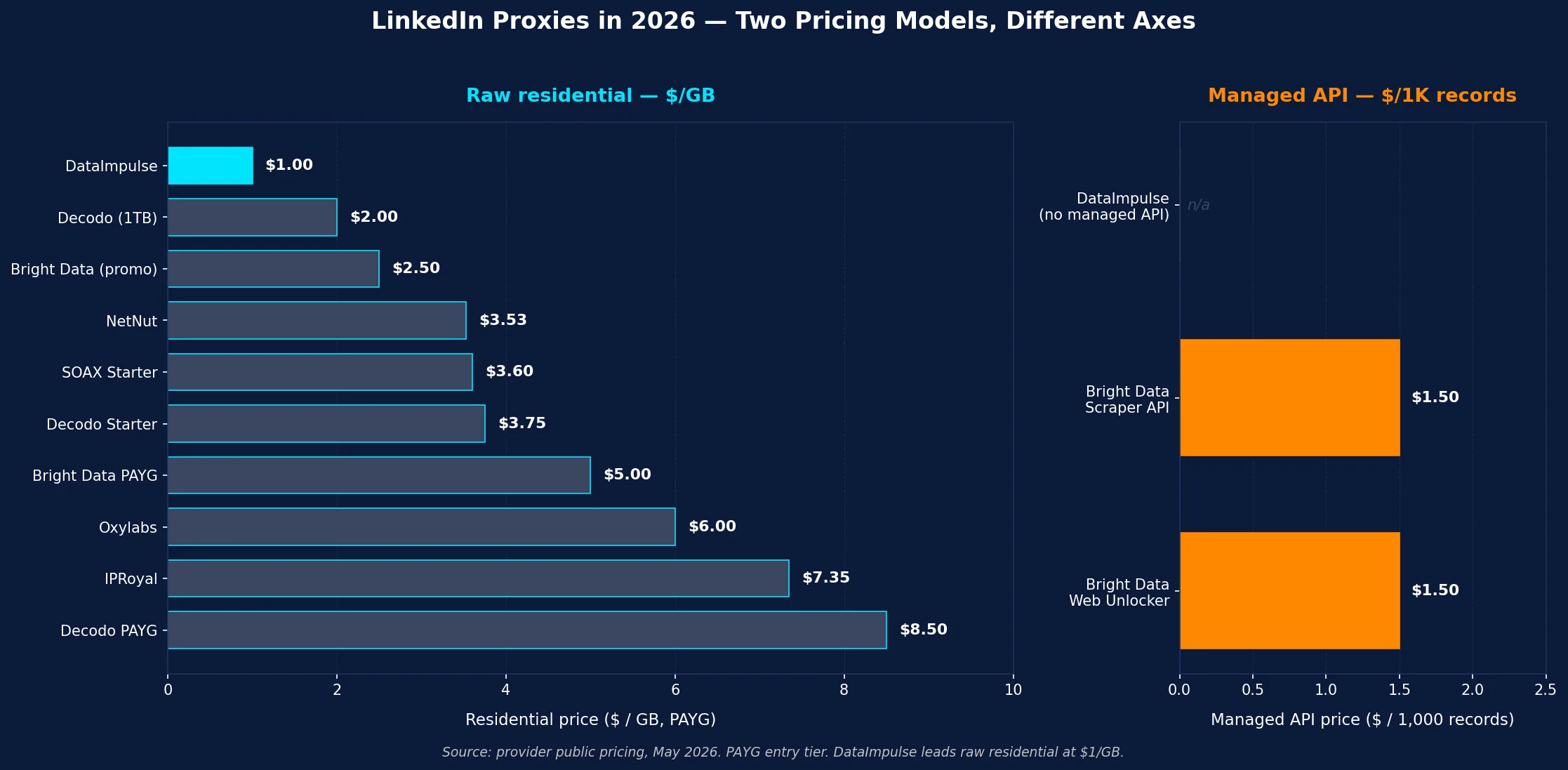
| Provider | Best for | Residential price | ISP/sticky depth | Notable |
|---|---|---|---|---|
| DataImpulse | Best value, in-house LinkedIn teams | $1/GB PAYG | Rotating + sticky residential + mobile $2/GB | Traffic never expires; G2 4.8 |
| Bright Data | Enterprise + LinkedIn Scraper API | ~$2.50/GB (50% promo); $5/GB regular | ISP + dedicated LinkedIn Profile/Company Scraper APIs | $1.50/1K records (LinkedIn endpoint) |
| Oxylabs | SLA-grade enterprise + LinkedIn API | from $6/GB | Web Scraper API supports LinkedIn | 99.95% success |
| Decodo | Mid-market, cheap ISP for LinkedIn accounts | $3.75/GB starter, $8.50/GB PAYG | ISP from $0.27/IP | 115M+ pool |
| IPRoyal | LONG sticky (7-day) for LinkedIn accounts | from $7.35/GB | 7-day sticky — longest on list | Best for account-tied multi-day flows |
| SOAX | Mixed (mobile + ISP + residential) | $3.60/GB Starter | Sticky on all types | Strong mobile for hardest defenses |
| Webshare | Cheap public-LinkedIn search | from $3.50/mo res; $2.99/mo DC | Static ISP on sub | Budget pick; not for logged-in |
| NetNut | ISP-residential reliability | from $3.53/GB | Consumer-ISP focus | Major US/EU ISP depth |
Which Proxy Type Should You Use for LinkedIn?
LinkedIn scraping behaves differently from generic B2B scraping — the anti-bot stack is uniquely sophisticated and the account-vs-public distinction is gating. The proxy type decides whether your scrape survives past day-90 or burns accounts.
ISP / Static Residential Proxies — THE LINKEDIN DEFAULT
ISP proxies (static residential) are the right default for nearly all serious LinkedIn account-tied work — Sales Navigator search and lead-list pulls, Recruiter candidate sourcing, signed-in profile scraping, company-page browsing, Premium account workflows, inMail engagement automation, post-publishing automation, account-mapping for outbound SDR teams. ISP IPs sit on consumer-ISP-assigned addresses (Comcast, Charter Spectrum, Verizon FiOS, AT&T, Deutsche Telekom, BT, Telstra) with the stability of static hosting — residential trust with the predictability of a fixed address. This is the LinkedIn surface where IPRoyal’s 7-day sticky shines, Decodo’s $0.27/IP undercuts the market, and Bright Data/NetNut ship consumer-ISP depth. For account-tied LinkedIn work, ISP/static-residential is non-negotiable.
Mobile Proxies
Mobile proxies route through real carrier networks (Verizon, T-Mobile, AT&T in US; Vodafone, EE, Telefónica in EU; Jio, Airtel in India) and earn their place for three LinkedIn cases: (1) the hardest account-survival jobs where ISP-residential also gets flagged (typically post-90-day veterans hitting the next escalation tier), (2) mobile-LinkedIn-app validation where mobile context surfaces different feed/connection-suggestion content, (3) high-risk warm-up of new LinkedIn accounts where mobile carrier IPs look more native than fixed-line residential. Mobile is the most expensive option per GB ($2-$10), so reserve for the hardest accounts.
Residential (Rotating) Proxies — PUBLIC ONLY
Rotating residential proxies have a narrow but real role in LinkedIn scraping: public-only flows — public profile pages (hiQ-protected, CFAA-safe), public company pages, public job postings, public LinkedIn Pulse articles, public LinkedIn Learning catalog. (Do NOT include Sales Navigator surfaces in this list even when logged-out — Sales Nav is a gated product and the public-data carveout is shakier there.) Don’t use rotating residential for logged-in flows — LinkedIn correlates IP-rotation with account identity and flags the inconsistency. For public scraping, DataImpulse rotating at $1/GB is the budget pick.
Datacenter Proxies — AVOID FOR LINKEDIN
Datacenter proxies are essentially dead for LinkedIn in 2026. LinkedIn’s Akamai-class WAF + behavioural-biometrics layer flags datacenter ranges within tens of requests. Don’t use datacenter for any LinkedIn surface — public, logged-in, or otherwise. Reserve datacenter for the public-data enrichment layer (Wikipedia mirrors of LinkedIn profiles via Wayback Machine, public press releases, public news mentions of LinkedIn members on third-party sites).
Rotating vs Sticky for LinkedIn
The rule for LinkedIn: sticky is the default, rotating is the exception. Sticky 24h-7day handles all account-tied LinkedIn work — Sales Navigator, Recruiter, signed-in profile browsing, inMail, account-tied automation. Rotating handles only public-LinkedIn data scraping (public profiles via search-result snippets, public company pages, public jobs). Most production LinkedIn stacks are 80% sticky + 20% rotating.
Best Proxies for LinkedIn — Full Reviews
The picks below are ranked on value for LinkedIn scraping — the balance of ISP-residential authenticity, sticky-session length, multi-region depth, account-survival track record, and price per successful record. DataImpulse leads on value for in-house teams; IPRoyal’s 7-day sticky is uniquely strong for account-tied LinkedIn work; Bright Data’s managed LinkedIn Scraper API removes the anti-bot fight entirely at enterprise pricing.
1. DataImpulse
DataImpulse is the best-value pick for in-house teams running their own LinkedIn scrapers — Sales Navigator search-list pulls, public-profile data assembly, Recruiter candidate sourcing, company-page browsing, B2B firmographic enrichment. Residential starts at $1/GB, pay-as-you-go, with traffic that never expires — a fraction of what enterprise LinkedIn-scrapers charge. The pool is 90M+ ethically sourced IPs across 195 countries with credible US/EU ISP coverage on the major consumer ISPs (Comcast, Charter Spectrum, AT&T, Verizon FiOS, Deutsche Telekom, BT). Country targeting is included with state/city/ZIP/ASN as a paid add-on (2× the per-GB rate), useful for region-specific LinkedIn programs (LinkedIn India is the second-largest LinkedIn market after US). It supports HTTP, HTTPS, and SOCKS5, rotating and sticky sessions (up to 30 minutes by default, longer on request), full API access, and standard scraping stacks (Scrapy, Selenium, Playwright + stealth, undetected-chromedriver). Mobile is available at $2/GB for US/EU carrier networks — the layer to reach when ISP-residential gets flagged on the hardest accounts.
What makes it the default for serious in-house LinkedIn collection is the price-to-pool ratio combined with sticky-session support. At $1/GB you can sustain continuous LinkedIn public-data collection across 195 countries without the per-record charges that managed APIs add up to at scale, and the PAYG model means experimenting with new LinkedIn workflows (LinkedIn Learning catalog scrape, public LinkedIn Pulse article harvest, LinkedIn Jobs aggregation) doesn’t lock you into a subscription. Support is 24/7 human; published success rate is 99.51%; G2 is 4.8/5. There’s no dedicated LinkedIn endpoint here — DataImpulse sells the proxy infrastructure cleanly and lets your team build the LinkedIn parser on top, paired with a TLS-fingerprint-aware client and warm-up cadence for account-tied flows.
Quick specs — Types: residential, mobile, datacenter · Pool: 90M+ residential, 195 countries, ethically sourced · Rotation: rotating + sticky · Geo: country (state/city/ZIP/ASN as paid add-on at 2× rate) · Price: $1/GB res, $0.50/GB DC, $2/GB mobile · Published success: 99.51% · Rating: G2 4.8.
Best for: in-house LinkedIn scraping teams that want low pay-as-you-go pricing for public-data assembly and mobile fallback for the hardest accounts.
2. Bright Data
Bright Data is the enterprise pick if you want LinkedIn data as a managed product. Beyond raw residential at $8/GB pay-as-you-go (currently discounted to ~$4/GB with a 50% promo on the regular PAYG tier, with deeper $2.50/GB on the $1,999/mo high-volume tier) with a 400M+ monthly IP pool and free city/ZIP/ASN targeting, Bright Data ships dedicated LinkedIn Profile and LinkedIn Company Scraper APIs at $1.50 per 1,000 records on PAYG (about $1.30/1K on the $499 plan). These managed endpoints handle the anti-bot fight entirely — point them at a LinkedIn profile URL and they return structured JSON. The Web Unlocker at $1.50/1K results handles arbitrary protected LinkedIn surfaces generically. Bright Data also publishes pre-scraped LinkedIn datasets as a separate product (millions of profile records, refreshed quarterly, sold as bulk data). ISO 27001, SOC 2 Type II, and audit-ready compliance clear most enterprise procurement — and Bright Data was the defendant who won Meta v Bright Data (January 2024) on the public-vs-logged-in distinction, giving them a clear legal track record for public-LinkedIn-data scraping.
Quick specs — Types: residential, DC, ISP, mobile + dedicated LinkedIn Scraper APIs + Web Unlocker + bulk datasets · Pool: 400M+ monthly residential · Rotation: rotating, sticky, dedicated · Geo: country/city/ZIP/ASN free · Price: ~$4/GB res PAYG (promo, $8 regular); $2.50/GB on high-volume $1,999/mo tier; LinkedIn Scraper API from $1.50/1K records PAYG (~$1.30/1K on $499 plan); subscription from $499/month · Compliance: ISO 27001, SOC 2 Type II.
Best for: enterprise LinkedIn data teams that want managed Scraper APIs or bulk profile datasets with audit-ready compliance.
3. Oxylabs
Oxylabs sits next to Bright Data at the enterprise top with strong LinkedIn coverage. Residential starts around $6/GB on the entry plan with a 175M+ pool across 195 countries and strong US/EU presence with city, state, ZIP, ASN, and geographical coordinate targeting. The Web Scraper API ($49/month entry) supports LinkedIn as a target — JavaScript rendering, anti-bot bypass, structured data extraction. Sessions are flexible with unlimited concurrent connections (useful for parallel-account LinkedIn programs where each scraper holds an account session), and Oxylabs publishes a 99.95% residential success rate. Pick Oxylabs when reliability, SLA-grade support, ISO 27001 / SOC 2 compliance, and audit-ready documentation matter more than entry price.
Quick specs — Types: residential, DC, ISP, mobile + Web Scraper API · Pool: 175M+ residential, 195 countries · Rotation: flexible, sticky, unlimited concurrency · Geo: country/state/city/ZIP/coordinates/ASN · Price: from $6/GB residential; Web Scraper API from $49/month · Published success: 99.95% · Compliance: ISO 27001, SOC 2.
Best for: enterprise LinkedIn programs that want SLA-grade managed scraping with audit-ready compliance and unlimited-concurrency support.
4. Decodo
Decodo (formerly Smartproxy) is the mid-market sweet spot for LinkedIn account-tied work. Residential proxies start at $3.75/GB on the 3 GB starter plan, with PAYG ranging from $4-$8.50/GB depending on tier/page (Decodo’s public pricing has inconsistent PAYG quotes). The static residential/ISP starts at $0.27/IP — one of the most aggressive ISP rates on the market for the LinkedIn account-tied workflows where ISP-residential is non-negotiable (Sales Navigator dedicated accounts, Recruiter seat-tied sessions, signed-in inMail automation). Country, city, ZIP, and ASN targeting are included with 115M+ IPs across 195+ locations. The Web Scraping API includes templates for LinkedIn-style targets, with sticky sessions configurable up to 24 hours — good for multi-step account-tied flows.
Quick specs — Types: residential, DC, ISP, mobile + Web Scraping API · Pool: 115M+ residential, 195+ countries · Rotation: per-request, sticky up to 24h · Geo: country/city/ZIP/ASN included · Price: $3.75/GB starter, $4-$8.50/GB PAYG (varies by Decodo page), $2/GB at 1TB+; static residential/ISP from $0.27/IP · Published success: 99.86%.
Best for: mid-market LinkedIn teams that want cheap ISP for dedicated account-tied scrapers.
5. IPRoyal
IPRoyal earns the top LinkedIn lane for one reason — 7-day sticky sessions, the longest on this list. LinkedIn account-tied work survives longer with sticky-session continuity that spans business days (work a LinkedIn account 9-5 across a week without rotating IPs mid-cadence breaks the natural fingerprint pattern that LinkedIn correlates). Residential PAYG runs $7.35/GB at entry (cheaper at volume) with a 32M+ pool across 195+ countries with country, region, city, and ISP targeting. There’s also a dedicated US ISP product line and a Web Unblocker (CAPTCHA + anti-bot bypass) at per-request pricing for the public-LinkedIn-scrape layer. For LinkedIn account-survival use cases, IPRoyal is the strongest pick on the list.
Quick specs — Types: residential, ISP, mobile, DC + Web Unblocker · Pool: 32M+ residential, 195+ countries · Rotation: rotating, sticky up to 7 days · Geo: country/region/city/ISP · Price: from $7.35/GB residential PAYG.
Best for: LinkedIn account-tied workflows (Sales Navigator, Recruiter, signed-in automation) that need 7-day sticky-session continuity.
6. SOAX
SOAX is the pick when mixed proxy types matter for a LinkedIn program. Residential starts at $3.60/GB on the Starter plan (25 GB included), and the unified credit model means you can spend the same budget on residential, mobile, ISP, datacenter, or the Web Data API. The pool is one of the larger in the mid-tier — 155M+ residential, 33M+ mobile, 2.6M+ ISP — with country, region, city, ISP, and ASN targeting. Sticky sessions are supported across all proxy types. The mobile pool is particularly strong (33M+ across major US/EU/India carriers) — useful for LinkedIn account-survival when ISP-residential isn’t enough and you need to escalate to mobile.
Quick specs — Types: residential, mobile, ISP, DC + Web Data API · Pool: 155M+ residential, 33M+ mobile, 2.6M+ ISP · Rotation: per request or interval, sticky supported · Geo: country/region/city/ISP/ASN · Price: $3.60/GB Starter.
Best for: LinkedIn teams running mixed-type stacks (residential + ISP + mobile) under one subscription.
7. Webshare
Webshare earns its place for LinkedIn teams running cheap, low-volume public-LinkedIn-data work — public profile snippets via search-result aggregation, public company pages, public job listings, public LinkedIn Learning catalog. Plans start at $2.99/month for the 100-proxy datacenter package and $3.50/month for the entry rotating residential plan with 80M+ residential available on higher tiers, plus static US ISP proxies on subscription plans. Webshare residential is best on public-LinkedIn flows only; for any LinkedIn account-tied work (Sales Navigator, Recruiter, signed-in), step up to ISP-focused providers above. The datacenter products do not work on LinkedIn — reserve those for adjacent public-data layer (LinkedIn-press-release scraping from third-party news sites, public Wayback Machine LinkedIn mirrors).
Quick specs — Types: residential, static ISP, datacenter · Pool: 80M+ residential (subscription); datacenter and ISP available · Geo: country, plan-dependent city · Price: from $2.99/month datacenter (100 proxies); rotating residential from $3.50/month.
Best for: cheap, low-volume public-LinkedIn-data scraping. NOT for account-tied work.
8. NetNut
NetNut closes the list with a focus on ISP-residential reliability for LinkedIn workflows — clean consumer-ISP IPs (Comcast, Charter Spectrum, Verizon FiOS, AT&T, Cox in US; Deutsche Telekom, Vodafone, BT in EU; Jio, Airtel in India) that hold consistent identity across LinkedIn session lifecycles. Rotating residential currently starts around $3.53/GB on entry plans, scaling up by volume; country and city-level targeting available on higher tiers. NetNut’s value-prop for LinkedIn is the consumer-ISP authenticity: IPs read as ordinary US/EU home internet users, which is exactly what LinkedIn’s behavioural model expects from typical professional users. Pair NetNut ISP with sticky sessions and slow human-like cadence for multi-week LinkedIn account survival.
Quick specs — Types: ISP-residential, residential, mobile · Pool: ISP-grade residential with deep US/EU/Asia coverage · Rotation: rotating, sticky · Geo: country (city on higher plans) · Price: from $3.53/GB residential.
Best for: LinkedIn teams that want consumer-ISP-residential IPs without paying enterprise prices for the IP-authenticity that LinkedIn’s behavioural model rewards.
How Much Do LinkedIn Proxies Cost?
Listed pricing in 2026 falls into three bands. Budget/value at $1–$3.75/GB — DataImpulse, SOAX Starter, Decodo entry, Webshare residential subscription — covers most in-house LinkedIn public-data work. Mid/premium at $3.50–$7.35/GB — Bright Data, Oxylabs, IPRoyal, NetNut — adds enterprise tooling, SLA-grade reliability, and (for IPRoyal) the longest sticky-session ceiling. API-priced and ISP-priced — Bright Data’s LinkedIn Profile + Company Scraper APIs $1.50/1K records PAYG (~$1.30/1K on $499 plan), Oxylabs Web Scraper API from $49/mo, Decodo Web Scraping API from $19/mo, Decodo US ISP at $0.27/IP — sell structured LinkedIn outcomes per record, per plan, or per IP instead of per GB.
The real cost question for LinkedIn isn’t “what’s the lowest $/GB” but “what’s the lowest cost per LinkedIn account-survival-week”. A managed LinkedIn Scraper API at $1.30–$1.50/1K records can beat $1/GB residential when your in-house LinkedIn scraper burns accounts in 2 weeks at scale; conversely, $1/GB residential + ISP add-on + warm-up cadence + Playwright stealth routinely beats per-record APIs at scale once your team builds the cadence layer properly. Test both on a small batch of LinkedIn accounts (5-10) before committing to a stack — the difference between a 2-week and 6-month account lifetime is more economic than the per-GB rate.
Is LinkedIn Scraping Legal?
LinkedIn scraping law sits at the intersection of the CFAA (hiQ v LinkedIn precedent), state common law (trespass to chattels + misappropriation per the December 2022 hiQ settlement), contract law (LinkedIn’s user agreement scraping prohibition is enforceable), state privacy law (CCPA/CPRA on personal data), and the patchwork of national data-protection laws (GDPR for EU members, LGPD for Brazilian, DPDP for Indian, etc.). The basics:
- Public-data LinkedIn scraping is CFAA-safe. hiQ Labs v LinkedIn (9th Cir. April 2022) confirmed scraping publicly accessible LinkedIn data does NOT violate the CFAA. The Ninth Circuit reasoned the CFAA’s “without authorization” provision doesn’t apply to public websites. Meta v Bright Data (Jan 2024) reinforced this with the public-vs-logged-in distinction.
- BUT — LinkedIn’s user-agreement scraping ban IS enforceable under contract law + state tort law. In November 2022 LinkedIn won breach-of-contract summary judgment (Judge Chen, N.D. Cal.) against hiQ; the December 2022 consent judgment that followed stipulated a $500,000 judgment against hiQ + injunction effectively prohibiting future LinkedIn scraping + liability under California common law (trespass to chattels and misappropriation) + contract breach + CFAA + California Penal Code 502 + spoliation sanctions. Translation: hiQ won the original CFAA appeal but lost the contract + state-tort war over six years of litigation. For your LinkedIn scraping, contract-breach + state-tort claims are the real exposure surface, NOT CFAA.
- Logged-in LinkedIn scraping carries the highest risk. Meta v Bright Data’s public-vs-logged-in distinction applies to LinkedIn too: scraping logged-in surfaces (signed-in Sales Navigator, Recruiter, inMail) explicitly violates LinkedIn’s user agreement and triggers contract-breach claims. Account-tied scraping is the highest-risk LinkedIn surface.
- Personal-data scraping triggers GDPR/CCPA/state-privacy law. Names, emails, phone numbers, profile photos of LinkedIn members are personal data under GDPR (EU members), CCPA/CPRA (California), LGPD (Brazilian), DPDP (Indian). Scraping LinkedIn personal data without legal basis is enforceable independent of the CFAA/contract analysis. Strip personal data from corpora where you can; document the strip step.
- Recruiter outreach is a separate regulated zone. Some jurisdictions (EU especially) treat unsolicited recruiter outreach as direct marketing requiring opt-in or legitimate-interest analysis under GDPR. The proxy doesn’t insulate you from outreach-law exposure on top of scraping exposure.
The honest reading: public-LinkedIn-data scraping is legally defensible post-hiQ but the contract-breach + state-tort exposure is real and well-precedented (hiQ paid $500K). Account-tied LinkedIn scraping is high-risk regardless of proxy posture. Personal-data scraping triggers parallel privacy-law exposure. Get US + EU + relevant-jurisdiction privacy/tech-transactions counsel before scaling a production LinkedIn scraping pipeline. This isn’t legal advice.
How to Start LinkedIn Scraping with DataImpulse
- Create an account and pick your proxy mix. ISP/sticky residential or DataImpulse residential with maximum sticky-session length for LinkedIn account-tied work; rotating residential ($1/GB) for public-LinkedIn-data flows (public profile snippets, public company pages, public jobs, LinkedIn Learning catalog); mobile ($2/GB) reserved for account-survival escalation when ISP-residential gets flagged. Datacenter is dead for LinkedIn — don’t use.
- Add funds and warm up. Pay-as-you-go, no subscription, no expiry — handy because LinkedIn programs run in bursts (sales-quarter prospecting sprints, recruiter-hiring-pipeline pushes, market-research sweeps). Warm up new LinkedIn accounts for 1-2 weeks before any automation — manual profile completion, connection requests within 20-30/day human-like limits, slow-cadence content browsing.
- Run with proper cadence. Set country targeting matching your LinkedIn-market (US for US-focused programs, India for India-focused, etc.), pick sticky sessions for account-tied flows + slow human-like delays (LinkedIn’s “safe” is 20-30 connections/day per account, 100-200/week), pair with a TLS-fingerprint-aware client (curl_cffi, undetected-chromedriver, Playwright + stealth), and limit sessions to business hours in the IP’s local time zone. Log every action with timestamp + account ID + IP session — the audit trail is your post-incident defense layer.
For more on related workflows, see our residential proxies product page, the mobile proxies product page (for account-survival escalation), the datacenter proxies product page (for the public-LinkedIn enrichment layer), the best proxies for recruiting & HR scraping roundup (LinkedIn Recruiter mechanics carry over directly), and the best proxies for web scraping roundup.
FAQ
Is scraping LinkedIn legal?
For public LinkedIn data (public profile pages, public company pages, public jobs, public Pulse articles), yes — hiQ Labs v LinkedIn (9th Cir. April 2022) confirmed this is CFAA-safe. But the December 2022 hiQ settlement established that LinkedIn’s user-agreement scraping prohibition IS enforceable under contract law + state common law (trespass to chattels + misappropriation), and hiQ paid $500K + accepted an injunction. Logged-in LinkedIn surfaces (Sales Navigator, Recruiter, inMail) trigger explicit contract-breach. Personal data of LinkedIn members triggers GDPR/CCPA/state-privacy law independently. Get counsel before scaling. This isn’t legal advice.
What are the safe LinkedIn scraping rate limits in 2026?
Industry-observed “safe” thresholds for 2026: 20-30 connection requests/day per account, with a commonly observed weekly cap of ~100 (sometimes 100-200 depending on account age/health). LinkedIn confirms invitation limits exist but does not publish a numeric public ceiling. Sales Navigator search and Recruiter inMail have separate per-tier limits. Industry benchmarks: ~23% of LinkedIn automation users hit a restriction within their first 90 days; LinkedIn’s Q1 2026 session-fingerprinting upgrade flags bot-like request patterns within 48 hours. Above the safe thresholds, LinkedIn escalates through temporary lock → days-to-weeks restriction → permanent ban.
Which proxy type works best for LinkedIn?
ISP / static residential for account-tied LinkedIn work (Sales Navigator, Recruiter, signed-in browsing, inMail) — required for IP-account fingerprint correlation. Mobile for the hardest accounts and new-account warm-up. Rotating residential for public-only LinkedIn data scraping. Datacenter is dead for LinkedIn — never use. Decodo, IPRoyal, NetNut, Bright Data all ship US ISP residential; DataImpulse offers sticky residential + mobile for the same lanes at lower price.
How long sticky sessions do I need for LinkedIn?
For account-tied LinkedIn work, sticky sessions of hours-to-days are the floor. 24h is the minimum for serious workflows; 7-day sticky (IPRoyal) is the gold standard for multi-day LinkedIn account work. Rotating IPs mid-session breaks LinkedIn’s IP-account fingerprint correlation and triggers risk-scoring. For public-only LinkedIn scraping, rotating is fine.
Can I use the LinkedIn API instead?
The LinkedIn Marketing Developer Platform exists for marketing analytics + ads, but for profile/company/jobs data the LinkedIn API is locked down — no public Profile API. The Sales Navigator Application Platform offers limited contact-import. For most B2B data use cases, the answer is no — LinkedIn API doesn’t expose the data your team needs. Hence the scraping market.
Will Bright Data’s LinkedIn Scraper API survive contract-breach claims?
Bright Data publicly positions the LinkedIn Scraper API as a public-data-only product. Bright Data won Meta v Bright Data (Jan 2024) on the public-vs-logged-in distinction, which is highly relevant to LinkedIn-scrape exposure. Using a managed Scraper API shifts contract-breach exposure from your team to Bright Data’s business model. For risk-averse enterprise teams, this is a major reason to choose managed APIs over in-house scrapers.
How do I scrape Sales Navigator without burning the account?
(1) Use ISP-residential or mobile with 24h-7day sticky. (2) Warm up the account 1-2 weeks before automation. (3) Stay under 20-30 connection requests/day, 100-200/week. (4) Limit sessions to business hours in the IP’s local time zone (LinkedIn flags 2am-4am scraping). (5) Randomize delays (5-30 seconds between actions, never <2s). (6) Use Playwright + stealth or undetected-chromedriver to defeat browser fingerprinting. (7) Use one IP per LinkedIn account — don't share IPs across multiple Sales Navigator sessions. (8) Run cadence-aware tools (PhantomBuster, Dripify, Linked Helper) on top of the proxy layer.
Mobile proxies for LinkedIn — when do they matter?
Three cases: (1) account survival escalation when ISP-residential gets flagged (post-90-day veterans hitting the next escalation tier), (2) new-account warm-up where mobile carrier IPs look more native than fixed-line residential during the first 30 days, (3) mobile-LinkedIn-app validation where mobile context surfaces different feed/connection-suggestion content. SOAX (33M+ mobile pool), IPRoyal, DataImpulse, and Bright Data all offer Verizon/T-Mobile/AT&T/Vodafone/EE/Jio mobile proxies. Mobile is the most expensive option per GB — reserve for the hardest LinkedIn accounts.
Static residential / ISP proxies — who has them for LinkedIn?
Decodo (from $0.27/IP), IPRoyal, NetNut, Bright Data, and Webshare all sell US/EU/Asia static-residential / ISP product lines. They’re the LinkedIn default for account-tied work — required for the IP-account fingerprint correlation that LinkedIn’s risk-scoring expects. Pick ISP when you need session continuity that rotating residential breaks (which is essentially all logged-in LinkedIn work).
Ready to run LinkedIn scraping without burning accounts? Start with DataImpulse — residential from $1/GB, datacenter from $0.50/GB, mobile from $2/GB, pay-as-you-go with ethically-sourced 90M+ IPs across 195 countries, country targeting included (state/city/ZIP/ASN as paid add-on), traffic that never expires, and 24/7 human support for the moments when LinkedIn’s anti-bot stack changes overnight.
 State/City/Zip/ASN Targeting