

In this Article
Recruiting data is one of the most valuable and most defended categories on the web. LinkedIn, Indeed, Glassdoor, ZipRecruiter, Monster, AngelList/Wellfound, RecruiterFlow — every platform that holds candidate profiles, salary data, job postings, or hiring intel runs serious anti-bot stacks, rate limits, CAPTCHAs, login walls, device fingerprinting, and behavioral scoring. Try to source talent at scale from one IP and your account gets challenged within an hour. Try to pull a Glassdoor salary dataset with naive datacenter proxies and you’ll get a few dozen records before the wall comes down.
Proxies are how recruiting and HR-data teams actually see this data — public profiles, company pages, job postings, salary ranges — at the scale the work needs. The right pool keeps you under the rate limits, the right proxy type gets you past LinkedIn’s reputation system, and the right session model keeps your collection running for hours instead of minutes. This guide ranks the 8 best proxies for recruiting and HR data scraping in 2026, picks the proxy type for each job, and walks through full reviews. Jump to the quick comparison for a thirty-second shortlist; deeper coverage follows.
Key Facts
Recruiting and HR data scraping has its own rulebook because the targets are designed to keep automated collectors out. Five facts to start with:
- LinkedIn is the toughest target on the open web. Sticky sessions, slow pacing, real-looking browser fingerprints, and ISP/residential IPs are usually the difference between collection that runs for weeks and accounts that get challenged in days.
- Job-board ToS restrict automation, but public data has precedent. LinkedIn and Indeed both restrict automated access in their terms; the hiQ v. LinkedIn precedent supports access to publicly available profiles. Public-data scraping for legitimate sourcing and market analysis is mainstream practice — internal ATS data, logged-in account data, and PII are not.
- Geo coverage matters more than you’d expect. Job postings, salaries, and candidate visibility vary by country and city. Sourcing for a European market from a US IP misses local availability and changes what Glassdoor shows you.
- Use cases drive proxy mix. Talent sourcing (LinkedIn-heavy) wants sticky residential or ISP. Salary benchmarking (Glassdoor, Levels.fyi) wants residential with geo. Job-board aggregation wants datacenter for public career pages and residential for defended aggregators. Compensation/competitive intel wants the full stack.
- Compliance is the gating factor for production work. Stay on public data, avoid PII collection beyond what’s already public, respect rate limits and robots signals, and consult counsel before scaling a serious recruiting-data pipeline.
How We Selected These Recruiting Proxies
We didn’t rank on marketing claims. Each provider had to earn its spot on factors that matter specifically for recruiting and HR data work:
- LinkedIn success rate. The hardest target on the list. A pool that clears LinkedIn profile, company, and job pages at scale is doing real work; a pool that doesn’t is a $50/month liability.
- Sticky session length. LinkedIn workflows need stable IPs for hours, sometimes days. Providers offering 24-hour or multi-day sticky sessions handle account workflows; rapid-rotation pools don’t.
- ISP/static residential availability. ISP-assigned IPs on datacenter-grade infrastructure are the sweet spot for LinkedIn account continuity — residential trust with rotation discipline you actually control.
- Scraper-API option. For teams that don’t want to maintain LinkedIn/Indeed/Glassdoor parsers as those platforms change markup, a managed API that returns structured profile/company/job data shifts the maintenance burden.
- Geo coverage. US, UK, DE, FR, IN, BR, MX, IL, SG — recruiting is geo-distributed and salary/visibility data changes by market.
- Pricing transparency. Current published per-GB rates from each vendor’s own page.
- Compliance posture. Consent-based sourcing for residential/mobile, acceptable-use policy, KYC where appropriate, and a clear position on prohibited targets.
The eight that made the list cover the full range — from $1/GB pay-as-you-go residential to enterprise scraper APIs with dedicated LinkedIn endpoints.
What Makes a Good Recruiting Proxy?
Recruiting work magnifies a specific set of proxy characteristics. Six things matter most:
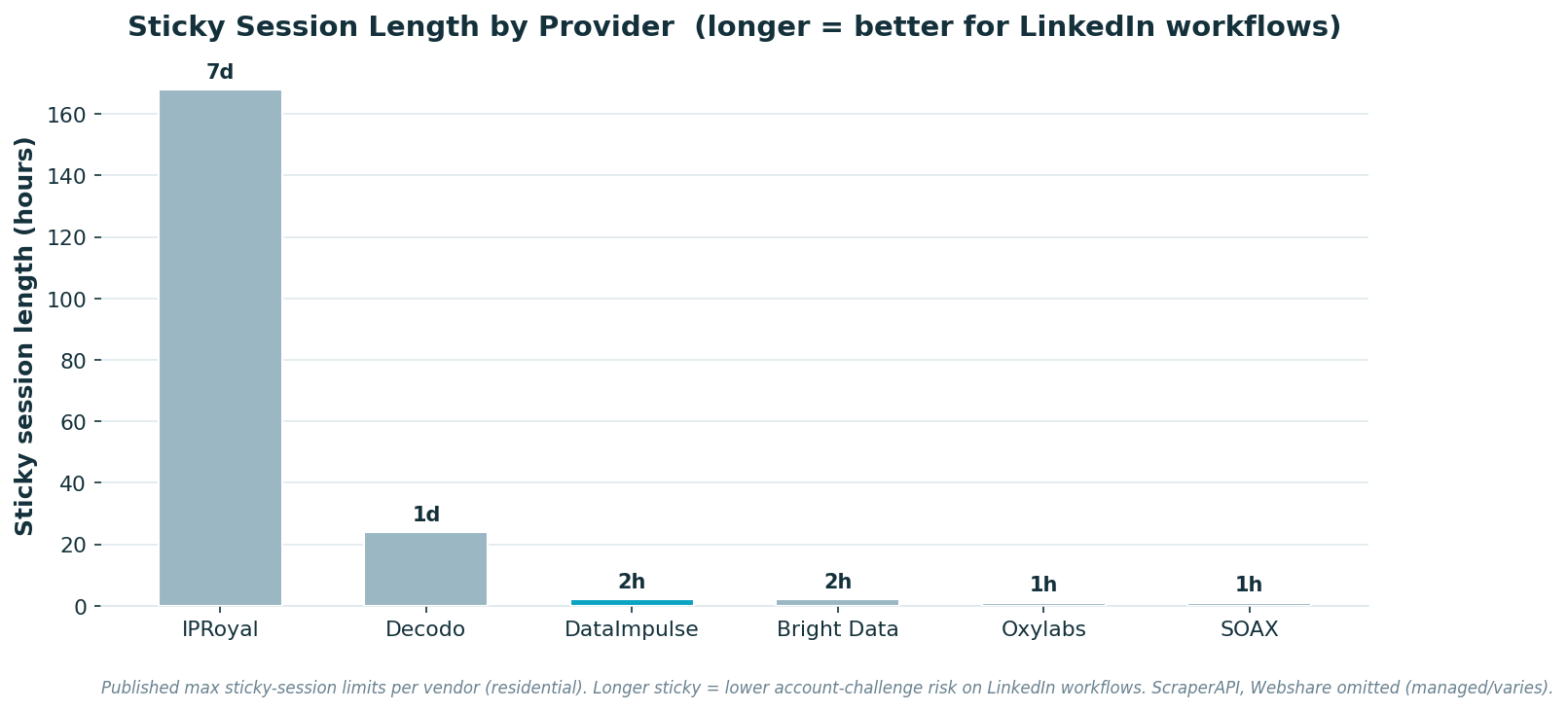
- Sticky session control. Rotating residential at one IP per request gets your LinkedIn account challenged inside an hour. Sticky sessions that hold one IP for minutes to days are the deciding feature for any production LinkedIn workflow. IPRoyal offers up to 7-day sticky on residential; Decodo up to 24 hours.
- IP authenticity that survives LinkedIn. Residential IPs from real consumer ISPs blend in best; ISP/static residential IPs (ISP-assigned but stable) are often the right answer for account-tied LinkedIn work. Datacenter is the wrong call here.
- Geo targeting precision. Country is the floor. For US sourcing, state-level helps; for European salary benchmarking, country and sometimes city matter for Glassdoor and local job boards.
- Scraper-API option. LinkedIn’s HTML changes frequently. Bright Data, Oxylabs, ScraperAPI, and Apify all offer LinkedIn-aware or LinkedIn-template scraping APIs that return parsed profile/company/job data instead of raw HTML.
- Mobile coverage. Mobile proxies help when validating mobile job-board views, app-context rendering, or mobile-only LinkedIn experiences. They’re not the default, but they belong in a serious recruiting stack.
- Per-success economics. Headline $/GB is misleading if LinkedIn challenges 30% of your sessions. The metric to optimize is cost per successful profile, company, or job record, then cost per defensible record after compliance review.
Useful sanity check: any provider can claim “high LinkedIn success rate.” Ask which specific endpoints (profile, company, jobs, posts), under sticky or rotating, with which session length, in which geo. Vague answers mean you’re paying for hope on the hardest target on the open web.
Quick Comparison: Best Proxies for Recruiting at a Glance
The table compares all eight providers on the parameters that matter most for recruiting and HR data work.
| Provider | Type Coverage | Pool / Scraper-API | LinkedIn/HR Tooling | Sticky Length | Starting Price | Best For |
|---|---|---|---|---|---|---|
| DataImpulse | Residential, mobile, datacenter | 90M+ residential; raw proxies + API | Sticky residential + ISP for LinkedIn; raw infrastructure | Sticky supported | $1/GB residential | Best value default for HR scraping |
| Bright Data | Residential, ISP, mobile, DC | LinkedIn Scraper API + datasets | Profiles, companies, jobs, posts API | Sticky + dedicated | $4/GB res (promo); $8 regular | Enterprise LinkedIn data |
| Oxylabs | Residential, ISP, mobile, DC | Web Scraper API | Managed scraping/unblocker | Flexible sticky | $6/GB residential; API from $49/mo | Enterprise reliability |
| Decodo | Residential, mobile, ISP, DC | 115M+; Web Scraping API + templates | Job postings, scraper API, AI integrations | Up to 24h | $3.75/GB starter, $2/GB at 1TB+ | Mid-market HR pipelines |
| IPRoyal | Residential, ISP, mobile, DC | 32M+ residential; Web Unblocker | Web Unblocker for LinkedIn; long sticky | Up to 7 days | from $1.75/GB residential | Budget long-sticky LinkedIn |
| SOAX | Residential, mobile, ISP, DC | 155M+ residential; Scraper APIs | Unified proxy/API; geo-precise | Sticky supported | ~$4/GB PAYG | Geo-heavy market mapping |
| ScraperAPI | Managed API (premium IPs included) | LinkedIn endpoint (premium tier) | LinkedIn-aware request handling | Managed | from $49/month (100K credits) | Teams avoiding proxy ops |
| Webshare | Residential, static ISP, DC | 80M+ residential | Basic proxy stack | Plan-dependent | from $3.50/mo | Cheap public career-page aggregation |
Indicative starting rates from each provider’s own pricing pages (May 2026). Volume discounts apply and prices change, so check current numbers before you buy.
Which Proxy Type Should You Use for Recruiting Work?
Recruiting and HR data scraping almost always needs more than one proxy type. The combination depends on which targets you’re working — LinkedIn-heavy talent sourcing, broad job-board aggregation, salary benchmarking, or competitive hiring intel.
Residential Proxies
Residential proxies are the default for recruiting because the protected targets — LinkedIn, Indeed, Glassdoor, ZipRecruiter — fingerprint datacenter ranges aggressively. Real consumer ISP IPs look like ordinary professionals browsing, which is exactly what you want for public-profile sourcing, company-page checks, and job-posting collection. Use rotating residential for broad unauthenticated discovery (search-result sweeps, public-company pages); use sticky residential for any session that has state to lose.
ISP / Static Residential Proxies
ISP (static residential) IPs are the secret weapon for LinkedIn workflows. They sit on ISP-assigned addresses hosted on datacenter-grade infrastructure: residential trust with the stability of a static address. For LinkedIn account-tied work — extended profile collection, company-page sequences, Sales Navigator searches — ISP/static residential reduces the suspicious-login prompts and account challenges that destroy rotating-residential setups. IPRoyal and Bright Data have the deepest ISP product lines on the list.
Datacenter Proxies
Datacenter proxies have a narrow but real role in recruiting: bulk crawling of public company career pages, sitemap aggregation, low-defense regional job boards, and any job feed without serious bot protection. They are the wrong choice for LinkedIn, Indeed, or Glassdoor — protected job-board pages flag datacenter ranges within a few hundred requests. Reserve datacenter for the low-defense layer of the stack, and switch to residential or ISP as soon as a target starts challenging you.
Mobile Proxies
Mobile proxies route through real carrier networks and earn their place when you’re validating mobile job-board experiences, mobile LinkedIn views, in-app recruiting features, or mobile-specific Glassdoor and Indeed renders. They’re the most expensive option per GB, so use them where mobile context genuinely changes the data you collect — not as a blanket upgrade.
Rotating vs Sticky for Recruiting
The rule for recruiting work: rotate for unauthenticated discovery, stick for any session that touches a profile flow. Rotating residential or datacenter handles broad unauthenticated sweeps — public-company pages, job-posting indexes, search-result harvesting. Sticky sessions (residential or ISP) handle the deeper work — LinkedIn profile sequences, Sales Navigator searches, paginated company pages, multi-page Glassdoor reviews, and any sequence where LinkedIn’s risk model would flag a sudden IP change as account compromise. Most production recruiting stacks mix both — rotating for the breadth pass, sticky for the depth pass.
Best Proxies for Recruiting & HR Data — Full Reviews
The picks below are ranked on value for recruiting work — the balance of LinkedIn success, sticky-session length, ISP availability, scraper-API options, geo coverage, and price per successful record. DataImpulse leads on value; the rest each win a specific lane.
1. DataImpulse
DataImpulse is the best-value pick for recruiting teams that run their own LinkedIn, Indeed, Glassdoor, and job-board pipelines. Residential starts at $1/GB, pay-as-you-go, with traffic that never expires — a fraction of what enterprise recruiting-data stacks charge. The pool is 90M+ ethically sourced IPs across 195 countries with country targeting included and city/state/ZIP/ASN available as a paid add-on, which matters for US-state sourcing and European salary benchmarking. It supports HTTP, HTTPS, and SOCKS5, rotating and sticky sessions, full API access, and standard scraping stacks (Scrapy, Selenium, Playwright). Mobile is available at $2/GB for mobile job-board views and app-context checks; datacenter at $0.50/GB for the bulk public-aggregator layer.
What makes it the default for in-house recruiting and HR-data teams is the price-to-coverage ratio. At $1/GB you can sustain continuous LinkedIn-adjacent collection across multiple countries without subscription tiers you won’t fully use, and the PAYG model lets you experiment on new sources without committing budget. Support is 24/7 human; published success rate is 99.51%; G2 is 4.8/5. There’s no dedicated LinkedIn API here — DataImpulse sells the proxy infrastructure cleanly and lets the team build the LinkedIn/Indeed/Glassdoor parsers on top.
DataImpulse — quick specs. Types: residential, mobile, datacenter · Pool: 90M+ residential, 195 countries · Rotation: rotating + sticky · Geo: country (city/state/ZIP/ASN as paid add-on) · Price: $1/GB res, $0.50/GB DC, $2/GB mobile · Published success: 99.51% · Rating: G2 4.8. Best for: most in-house recruiting and HR-data teams that want LinkedIn-capable infrastructure without enterprise pricing.
2. Bright Data
Bright Data is the enterprise pick if you want LinkedIn data delivered as a managed product. Beyond raw residential at $8/GB pay-as-you-go (currently discounted to $4/GB with a 50% promo) with a 400M+ monthly IP pool and free city/ZIP/ASN targeting, Bright Data sells a dedicated LinkedIn Scraper API that returns structured profile, company, job, and post data — handling proxies, CAPTCHAs, retries, and the markup changes LinkedIn deploys regularly. There’s also a ready-to-use LinkedIn dataset product for teams that want delivered data instead of an API. Enterprise pricing and procurement-style buying come with it.
Bright Data — quick specs. Types: residential, DC, ISP, mobile + LinkedIn Scraper API + datasets · Pool: 400M+ monthly residential · Rotation: rotating, sticky, dedicated · Geo: country/city/ZIP/ASN · Price: ~$4/GB res (promo); $8/GB regular; LinkedIn API priced per record. Best for: enterprise teams that want a managed LinkedIn data stack with compliance and audit controls.
3. Oxylabs
Oxylabs sits next to Bright Data at the enterprise top, with a strong focus on managed scraping APIs. Residential starts around $6/GB on the entry plan with a 175M+ pool across 195 countries, and the Web Scraper API ($49/month entry) handles JavaScript rendering, anti-bot bypass, and structured data extraction across major recruiting and job-board targets. Sessions are flexible with unlimited concurrent connections, and Oxylabs publishes a 99.95% residential success rate. Pick Oxylabs when reliability, support depth, and SLA-grade managed scraping matter more than entry price.
Oxylabs — quick specs. Types: residential, DC, ISP, mobile + Web Scraper API · Pool: 175M+ residential, 195 countries · Rotation: flexible, sticky, unlimited concurrency · Geo: country/city/state/ZIP/coordinates/ASN · Price: from $6/GB residential; Web Scraper API from $49/month · Published success: 99.95%. Best for: enterprise recruiting programs that want SLA-grade managed scraping with deep targeting.
4. Decodo
Decodo (formerly Smartproxy) is the mid-market sweet spot for recruiting and HR data work. Residential proxies start at $3.75/GB on the 3GB plan and around $4/GB PAYG, dropping to about $2/GB at the 1,000GB tier, with a 115M+ pool across 195+ locations. The scraping APIs include templates for job postings and major recruiting targets, plus AI integrations that handle JavaScript rendering, geo-targeting, anti-bot retries, browser fingerprinting, and structured outputs. Sticky sessions are configurable from 1 minute up to 24 hours — long enough for serious LinkedIn workflows. Strong choice for teams that want both raw proxies and scraper APIs without enterprise contracts.
Decodo — quick specs. Types: residential, DC, ISP, mobile + Web Scraping API · Pool: 115M+ residential · Rotation: per-request, sticky up to 24h · Geo: country/city · Price: $3.75/GB starter, ~$4/GB PAYG, $2/GB at 1TB+ · Published success: 99.86%. Best for: mid-market HR-data pipelines that want a balance of proxy coverage, scraper APIs, and price.
5. IPRoyal
IPRoyal is the budget pick with a unique advantage for LinkedIn workflows: sticky sessions up to 7 days, the longest on this list. Residential starts at $1.75/GB at volume, with ISP proxies from $2/proxy and a Web Unblocker product from $1/1,000 requests for handling defended targets. The pool is 32M+ residential across 195 countries. For recruiting teams running production LinkedIn collection where account continuity is everything, IPRoyal’s 7-day sticky residential is the cheapest path to long, stable sessions.
IPRoyal — quick specs. Types: residential, ISP, mobile, DC + Web Unblocker · Pool: 32M+ residential · Rotation: rotating, sticky up to 7 days · Geo: country/city · Price: from $1.75/GB residential; ISP from $2/proxy. Best for: recruiting teams that need long sticky sessions for LinkedIn workflows on a budget.
6. SOAX
SOAX is the pick when geo-heavy market mapping and mixed proxy types matter together. Residential starts at $3.60/GB on the Starter plan (25GB included), and the unified credit model means you can spend the same budget on residential, mobile, ISP, datacenter, or scraping APIs. The pool is one of the larger in the mid-tier — 155M+ residential, 33M+ mobile, 2.6M+ ISP — with country, region, city, ISP, and ASN targeting that’s particularly useful for European, APAC, and LATAM recruiting where local job boards and salary benchmarks shift by market. Sticky sessions are supported across all proxy types.
SOAX — quick specs. Types: residential, mobile, ISP, DC + Web Data API · Pool: 155M+ residential, 33M+ mobile, 2.6M+ ISP · Rotation: per request or interval; sticky supported · Geo: country/region/city/ISP/ASN · Price: $3.60/GB Starter. Best for: recruiting teams running geo-heavy market mapping across multiple countries and proxy types.
7. ScraperAPI
ScraperAPI is the right answer when your recruiting team wants LinkedIn and job-board data as outcomes instead of managed proxies. It’s not a raw proxy provider — you pay for API credits ($49/month for 100K credits on the Hobby plan, scaling up from there), and the API handles rotation, retries, CAPTCHA bypassing, JavaScript rendering, and structured data extraction. LinkedIn and other anti-bot targets sit on the premium credit tier, which costs more per request, but the API absorbs the maintenance burden of LinkedIn’s frequent markup and anti-bot updates.
ScraperAPI — quick specs. Type: scraping API with managed premium proxy pools · Pool: 40M+ proxies, 50+ countries · Rotation: automatic, API-managed · Geo: country (Business plan) · Price: from $49/month (100K credits). Best for: recruiting teams that want managed LinkedIn-aware scraping without proxy ops.
8. Webshare
Webshare is the budget pick for the low-defense layer of a recruiting program — public company career pages, regional job-board crawling, sitemap aggregation, and bulk public job-feed collection. The public page lists rotating residential plans starting at $3.50/month (with an 80M+ residential pool and country/city targeting), plus separate datacenter and static residential products. It’s the lowest entry price on the list and the easiest dashboard to learn, with the caveat that LinkedIn and other protected targets will challenge cheaper Webshare tiers — fine for the bulk public-data layer, less reliable as your only proxy.
Webshare — quick specs. Types: rotating residential, static residential/ISP, datacenter · Pool: 80M+ residential · Rotation: rotating residential · Geo: country, city · Price: from $3.50/month. Best for: bulk public job-page aggregation and lightweight job-board monitoring inside a larger recruiting stack.
A note on Apify
Apify is worth mentioning separately because it’s a workflow platform with an Actor marketplace, not a pure proxy provider. Apify Proxy residential starts from $8/GB, and the Actor marketplace includes ready-built workflows for LinkedIn, Indeed, Glassdoor, and other recruiting targets. If your team prefers buying actors over building scrapers, Apify is the right call — though for raw proxy economics, the providers above generally beat it on $/GB.
How Much Do Recruiting Proxies Cost?
Listed pricing in 2026 falls into three bands. Budget/value at $1–$3.75/GB — DataImpulse, IPRoyal, Decodo entry plans, SOAX Starter — covers most real recruiting work, including LinkedIn collection paired with long sticky sessions on IPRoyal or Decodo. Mid/premium at $4–$8/GB — Bright Data, Oxylabs, Apify — adds enterprise tooling and dedicated LinkedIn/job-board APIs. API-priced — Bright Data’s LinkedIn API, Oxylabs Web Scraper API from $49/month, ScraperAPI from $49/month — sells structured profile/company/job records per credit or plan.
The real cost question for recruiting isn’t “what’s the lowest $/GB” but “what’s the lowest cost per successful, defensible profile/company/job record”. LinkedIn challenges and account lock-outs are expensive — both in failed requests and in the engineering time to recover the workflow. A $1/GB pool that delivers stable sticky sessions for hours often beats a $0.50/GB pool that triggers a challenge every twenty minutes.
Is Recruiting Data Scraping Legal?
Recruiting data scraping is widespread industry practice, but it lives in a legal gray zone shaped by platform terms, local data-protection law, and the specific data you collect. The basics:
- The hiQ v. LinkedIn precedent is the most relevant US case: the Ninth Circuit found that scraping publicly available LinkedIn profiles was unlikely to violate the Computer Fraud and Abuse Act. That doesn’t override LinkedIn’s terms, but it shifts public-profile scraping toward the safer end of the spectrum.
- Platform terms restrict automation. LinkedIn’s User Agreement bans scraping, bots, automated access, and fake identities. Indeed’s terms similarly restrict automated systems, bulk data mining, scraping, and AI-training use without written permission.
- Public data sits in the safer zone. Publicly accessible profiles, company pages, public job postings, and public salary ranges are the lower-risk targets. Logged-in account data, ATS internals, private candidate records, and PII beyond what’s already public are the higher-risk targets.
- GDPR and local law apply. EU GDPR, UK data-protection rules, and country-specific laws shape what you can collect and process — especially when the data identifies real people, even from public sources.
- Avoid PII collection beyond what’s necessary. Recruiting data often includes personal information by definition; minimize what you collect, secure what you keep, and have a documented retention and deletion policy.
The honest reading: serious recruiting-data work is a recognized industry practice, but it carries real legal and compliance weight. Stay on public data, document your purpose and processing, align with platform takedown workflows where they exist, and consult counsel before scaling a production pipeline. This isn’t legal advice.
How to Start Recruiting Data Scraping with DataImpulse
1. Create an account and pick your proxy mix. Residential ($1/GB) for LinkedIn-adjacent public profiles, Indeed, Glassdoor, and most defended job boards; datacenter ($0.50/GB) for public company career pages and weaker aggregators; mobile ($2/GB) when mobile job-board context matters.
2. Add funds. Pay-as-you-go, no subscription, no expiry — handy because recruiting collection volume varies with hiring cycles and market events.
3. Target and rotate by job. Set country to match the recruiting market you’re working, add city/state for US-specific sourcing, and pick rotation mode by the target: rotating for unauthenticated public-data sweeps, sticky for any LinkedIn-style profile sequence that needs a stable IP. Point your collector at the proxy endpoint and run.
For more on related workflows, see our residential proxies product page, the best proxies for web scraping guide, and the wider best proxies for brand protection roundup.
FAQ
Is scraping LinkedIn legal?
Public-profile scraping has Ninth Circuit precedent in hiQ v. LinkedIn that supports access to publicly available data under the CFAA, but LinkedIn’s terms still restrict automated access and enforcement is active. Stay on public profiles, avoid logged-in scraping, minimize PII collection, and consult counsel before a production pipeline. This isn’t legal advice.
What are the best proxies for LinkedIn scraping?
Sticky residential or ISP/static residential, not fast per-request rotation. IPRoyal’s 7-day sticky residential and Decodo’s 24-hour sticky are the deepest sticky options on the list; DataImpulse residential at $1/GB is the best-value entry. Pair any of these with conservative pacing, stable browser fingerprints, and public-data targeting only.
Can you scrape Indeed or Glassdoor?
Public job postings and salary pages are technically scrapeable, but Indeed’s terms expressly restrict automated systems and bulk data mining. Glassdoor is similar. Use public data, throttle aggressively, and align with the platform’s terms — or use a managed scraper API (Bright Data, Oxylabs, Decodo, ScraperAPI) that’s responsible for keeping the workflow compliant.
Rotating or sticky proxies for LinkedIn?
Sticky for any session that touches a profile flow — broad unauthenticated discovery can use rotating, but the moment a sequence has state (a search, a paginated company page, a profile view) sticky is the right call. Switching IPs mid-session is the fastest way to trigger a LinkedIn challenge.
Residential vs ISP for recruiting?
Residential is the default for most public-data sourcing. ISP/static residential is the upgrade for LinkedIn account-tied workflows where stable IPs reduce suspicious-login prompts. Most production stacks use both — residential for breadth, ISP for depth.
Best proxies for talent sourcing?
DataImpulse residential at $1/GB for in-house teams running their own LinkedIn/Indeed/Glassdoor collectors; Bright Data LinkedIn Scraper API for enterprises that want parsed profile, company, and job data without maintaining selectors.
Best proxies for compensation benchmarking?
Residential proxies with country (and sometimes city) targeting for Glassdoor, Levels.fyi, and regional salary databases. DataImpulse, Decodo, and SOAX all cover the geo grid; Bright Data and Oxylabs add managed scraper APIs if you want delivered datasets.
Best proxies for job-board aggregation?
Datacenter ($0.50/GB on DataImpulse) for public company career pages and weaker aggregators; residential ($1–4/GB) for Indeed, Glassdoor, ZipRecruiter, and other defended job boards. A mixed stack is the norm.
Is ATS scraping legal?
Avoid scraping internal ATS data unless you own the system or have explicit authorization. Scraping candidate PII or private hiring workflows carries real legal and compliance risk — this is one of the higher-risk recruiting-data activities, not a gray-zone one.
Ready to run recruiting and HR data collection without the LinkedIn blocks? Start with DataImpulse — residential from $1/GB, datacenter from $0.50/GB, mobile from $2/GB, pay-as-you-go with sticky sessions and 195-country coverage for the recruiting markets that matter.

 State/City/Zip/ASN Targeting