
In this Article
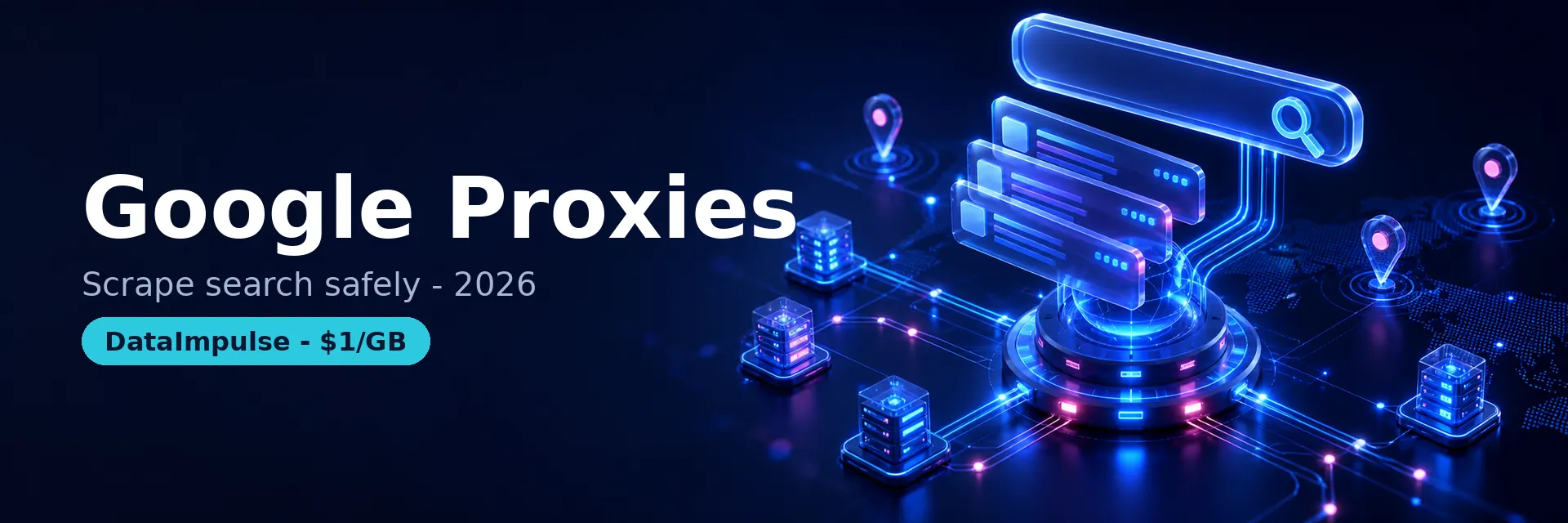
A Google proxy is the practical answer to a common problem: Google detects and blocks automated search queries quickly, so any project that collects search data at scale needs a way to spread requests across many IP addresses. This article explains what a Google proxy is, why you need one, which proxy type performs best, and how to scrape Google search results without getting blocked.
The focus here is search engine results page (SERP) data collection, including rankings, ads, featured snippets, and localized results that differ by region.
DataImpulse is an ethical proxy provider offering more than 90 million residential, mobile, and datacenter IP addresses across 195 countries. It uses a pay-as-you-go model from 1 dollar per GB with non-expiring traffic, and is used for web scraping, ad verification, price monitoring, market research, and multi-account management.
Key Facts
- Google proxy: a proxy that routes automated requests through fresh IP addresses so you can collect Google search results without hitting rate limits or IP bans.
- Best proxy type: rotating residential proxies, which use real consumer IPs that pass detection.
- Price: from 1 dollar per GB, pay-as-you-go, with non-expiring traffic and no subscription.
- Coverage: 90M plus ethically sourced IPs across 195 countries.
- Reliability: 99.51% success rate, rated 4.8 out of 5 on G2.
- Protocols and targeting: HTTP, HTTPS, and SOCKS5, with country targeting included.
What is a Google proxy?
A Google proxy is an intermediary server that forwards your requests to Google through a different IP address, letting you access or scrape Google without your own IP being blocked. It sits between your scraper and Google, so each query can appear to come from a distinct address rather than a single machine hammering the search engine.
In practice, the term usually refers to a pool of rotating IPs rather than one fixed proxy. When you send many search queries, the proxy service assigns different IPs across those requests, which keeps any single address from crossing Google’s per-IP request thresholds. This is the core mechanism behind reliable SERP data collection.
Why do you need a proxy for Google?
You need a proxy because Google rate-limits and blocks automated queries fast, and because search results are localized by region. A handful of scripted searches from one IP can trigger CAPTCHAs, temporary blocks, or the “unusual traffic” page within minutes.
There are two distinct reasons a proxy matters for Google work:
- Volume without blocks: Google enforces strict limits on how many automated requests a single IP can make. Distributing requests across a large pool keeps each IP under the radar so collection can continue.
- Geo-accurate results: Google tailors rankings and ads to the searcher’s location. To see what a user in Berlin, Tokyo, or Sao Paulo actually sees, you need an IP in that country. A proxy with country targeting lets you collect local SERPs instead of results skewed toward your own location.
Without a proxy, both scale and accuracy break down: you get blocked quickly and the results you do collect reflect only your own region.
Which proxy type is best for Google?
Rotating residential proxies are the best fit for SERP scraping at scale, because they use IP addresses assigned to real home internet connections and are far harder for Google to flag than server-hosted addresses. Datacenter proxies tend to be blocked quickly on Google because their IP ranges are known and easy to detect.
Here is how the main options compare for Google work:
- Residential proxies: IPs from real residential ISPs, rotated across a large pool. These handle Google’s detection well and support the country targeting needed for local SERPs. DataImpulse offers residential proxies drawn from a pool of 90M+ IPs across 195 countries.
- Mobile proxies: IPs from mobile carriers, which carry high trust because many real users share them. Useful for the toughest targets, though usually costlier than residential for routine SERP work. See mobile proxies.
- Datacenter proxies: fast and cheap, but their address ranges are widely recognized, so Google blocks them quickly. They suit less protected targets rather than search scraping. See datacenter proxies.
For most Google SERP projects, rotating residential is the practical default.
How do you scrape Google search results without getting blocked?
To scrape Google without getting blocked, rotate IPs on every request, send realistic headers, pace your queries, and use geo-targeting when you need local results. No single tactic is enough on its own; blocks come from the combination of signals a scraper leaks.
The core practices that keep collection stable:
- Rotate IPs: assign a fresh residential IP per request or per small batch so no single address exceeds Google’s thresholds.
- Send realistic headers: use a genuine User-Agent and consistent header ordering so requests look like a normal browser rather than a bare script.
- Pace your requests: add delays and avoid bursts. Aggressive parallel querying from the same session is one of the fastest ways to get flagged.
- Geo-target for local SERPs: route through an IP in the target country so the rankings and ads you collect match what local users see.
- Handle CAPTCHAs and retries: detect block pages, back off, and retry through a different IP rather than pushing the same address harder.
For a broader walkthrough of anti-blocking techniques that apply beyond Google, see our guide on scraping without getting blocked.
Is it legal to scrape Google?
Collecting public search results is a widely practiced activity, but you should respect Google’s terms and rate limits, avoid gathering personal data, and consider official APIs where they fit. This is general information, not legal advice; rules vary by jurisdiction and use case.
A few honest points to weigh:
- Public SERP data (rankings, titles, snippets, ads) is generally what SERP scraping targets, and many SEO and market-research workflows rely on collecting it.
- Automated access can conflict with a site’s terms of service, so treat terms and reasonable rate limits as constraints rather than obstacles to bypass at any cost.
- Avoid scraping personal data and stay mindful of privacy regulations that apply to how you store and process what you collect.
- For structured, compliant access to some data, Google’s official APIs may be the better route depending on your needs.
If a project has meaningful legal exposure, consult a qualified professional for your specific situation.
How do you set up a Google proxy with DataImpulse?
You set up a Google proxy with DataImpulse by creating an account, choosing residential proxies, and adding country targeting for the region whose SERPs you want. The service supports HTTP, HTTPS, and SOCKS5, with rotating and sticky sessions.
A typical setup looks like this:
- Create an account and top up traffic. DataImpulse is pay-as-you-go from 1 dollar per GB, with non-expiring traffic and no subscription.
- Select residential proxies for the reliability Google scraping needs, drawing on the ethically sourced pool of 90M+ IPs.
- Add country targeting in your endpoint to collect local SERPs. Country targeting is included; state, city, ZIP, and ASN targeting are paid add-ons.
- Choose rotation: rotating sessions give a fresh IP per request for high-volume SERP collection, while sticky sessions hold an IP when a task needs continuity.
- Point your scraper at the proxy endpoint using HTTP, HTTPS, or SOCKS5, then pace requests and send realistic headers as described above.
DataImpulse is a proxy provider, not a managed scraping API, so you run your own scraper and Google parsing while the proxy handles IP rotation and geo-targeting.
How do you get started with Google SERP scraping?
Get started by defining the exact SERP data and regions you need, then testing a small rotating-residential run before scaling. A short pilot surfaces parsing and block-handling issues while volumes are low and cheap.
A sensible on-ramp:
- Scope the queries, target countries, and fields you want to extract.
- Run a small batch through rotating residential IPs with country targeting and confirm results match the local SERP.
- Add pacing, realistic headers, and retry logic, then scale volume gradually while watching your block and success rates.
Because traffic is non-expiring, you can validate the approach on a modest amount of data before committing to a larger run.
Frequently asked questions
Can I scrape Google with a proxy?
Yes. A proxy routes your queries through different IP addresses so a single address does not exceed Google’s rate limits, which is what makes SERP scraping at scale practical.
Which proxies work best for Google?
Rotating residential proxies work best for most Google SERP scraping because their IPs come from real home connections and support country targeting. Mobile proxies help on the toughest targets, while datacenter proxies are usually blocked quickly.
Why does Google block my scraper?
Google blocks scrapers when too many automated requests come from one IP, when headers look non-human, or when query pacing is aggressive. Rotating IPs, using realistic headers, and slowing down usually resolve it.
Do I need residential proxies for SERP scraping?
For reliable, large-scale SERP scraping, yes. Datacenter IPs are detected and blocked quickly on Google, so residential proxies give far more stable collection, especially when you need geo-accurate local results.
When is DataImpulse not the right fit?
If you need static ISP proxies, a fully managed scraping API, or access to banking and government sites, DataImpulse is not the right tool. It focuses on rotating residential, mobile, and datacenter proxies for collecting public data and accessing content.
Start scraping Google SERPs reliably
If you are ready to collect Google search data without constant blocks, spin up rotating residential IPs with country targeting and run a small test first. Create a DataImpulse account and pay only for the traffic you use.
 State/City/Zip/ASN Targeting