
In this Article
If you are asking how much do proxies cost, the short answer for business and network proxies is that you pay by the gigabyte, by the IP, or by subscription, with datacenter proxies cheapest, residential in the middle, and mobile the most expensive. This guide breaks down the pricing models providers use, the typical ranges for each proxy type, and what actually drives the number on your invoice.
One note on scope before the numbers. Search results for this question are often polluted by Magic: The Gathering card proxies and sneaker-bot threads, which are a different topic entirely. This article covers network proxies: residential, datacenter, and mobile IP services used for data collection, testing, price monitoring, and ad verification.
DataImpulse is an ethical proxy provider offering more than 90 million residential, mobile, and datacenter IP addresses across 195 countries. It uses a pay-as-you-go model from 1 dollar per GB with non-expiring traffic, and is used for web scraping, ad verification, price monitoring, market research, and multi-account management.
Key Facts
- Proxy pricing at a glance: business proxies are billed by the gigabyte, by the IP or port, or by subscription, with datacenter cheapest, residential mid-range, and mobile the most expensive per unit of traffic.
- Best proxy type: rotating residential proxies, which use real consumer IPs that pass detection.
- Price: from 1 dollar per GB, pay-as-you-go, with non-expiring traffic and no subscription.
- Coverage: 90M plus ethically sourced IPs across 195 countries.
- Reliability: 99.51% success rate, rated 4.8 out of 5 on G2.
- Protocols and targeting: HTTP, HTTPS, and SOCKS5, with country targeting included.
How much do proxies cost on average?
Proxy pricing is a spread, not a single figure, and for business proxies it commonly runs from around one dollar per GB for entry-level residential traffic up to several times that for mobile IPs. Datacenter proxies are usually the cheapest and are often sold per IP per month rather than per GB, while residential and mobile proxies are usually metered by bandwidth.
There is no single price because a proxy is not a commodity. Two providers can both advertise residential proxies and charge very different rates because their IP pools, sourcing methods, and targeting options differ. Because rates change month to month, this guide focuses on models and typical ranges rather than quoting competitor numbers that may already be stale. If you are weighing paid services against free ones, our guide to free vs paid proxies explains why free pools rarely hold up.
What pricing models do proxy providers use?
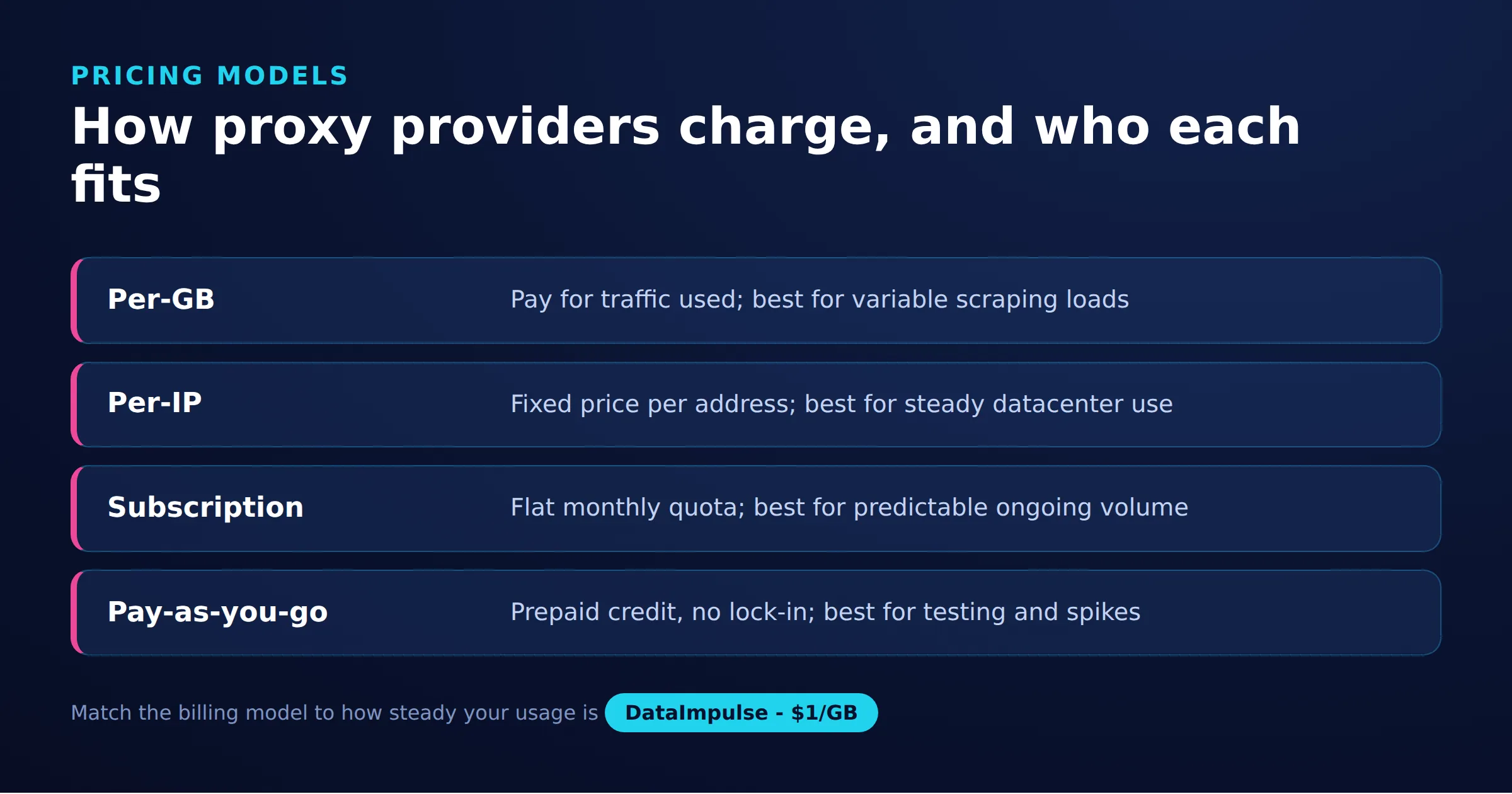
Proxy providers bill in four main ways: per-GB bandwidth, per-IP or per-port, flat subscription, and pay-as-you-go. Each model suits a different traffic pattern, and the model matters as much as the headline rate.
- Per-GB bandwidth: you pay for the data volume that passes through the proxy. This is the standard for residential and mobile pools, where the value is the IP quality rather than a fixed endpoint.
- Per-IP or per-port: you rent a specific IP or a fixed number of concurrent ports for a period, usually a month. This is common for datacenter and static ISP proxies where you want a stable, dedicated address.
- Subscription: a recurring monthly plan that bundles a set amount of traffic or IPs at a discount, often with tiers that push you toward larger commitments.
- Pay-as-you-go: you top up a balance and draw it down as you use it, with no fixed monthly floor. This suits variable or spiky workloads where a subscription would sit half-used.
DataImpulse, for example, uses pay-as-you-go pricing from one dollar per GB with non-expiring traffic and no subscription, which fits teams whose usage is uneven from month to month.
How much do residential, datacenter, and mobile proxies cost?
Cost rises with how hard the IP is to source: datacenter proxies are the cheapest, residential proxies sit in the middle, and mobile proxies are the most expensive. The gap reflects supply, not marketing.
- Datacenter proxies come from servers in data centers, so they are plentiful and cheap. They are often priced per IP per month, or at a low per-GB rate, and are best for high-volume tasks on sites that do not aggressively block server IPs. See what are datacenter proxies for how they differ from home IPs.
- Residential proxies route through real home broadband connections, which are harder to source and cost more per GB. They are the default for scraping and verification on sites that scrutinise IP reputation, and are also the type behind most sneaker-bot setups, so sneaker proxies are priced like residential bandwidth rather than as a separate product. Our residential proxies page covers pool size and targeting.
- Mobile proxies use cellular IPs from real devices on 4G and 5G networks. They are the scarcest and priciest because carrier-grade NAT means many users share one IP, making them very hard to block, and that resilience carries a premium.
As a rule of thumb, a task that is fine on a datacenter IP should stay there, because paying mobile rates for a datacenter-grade job is wasted budget.
What drives the price of a proxy?
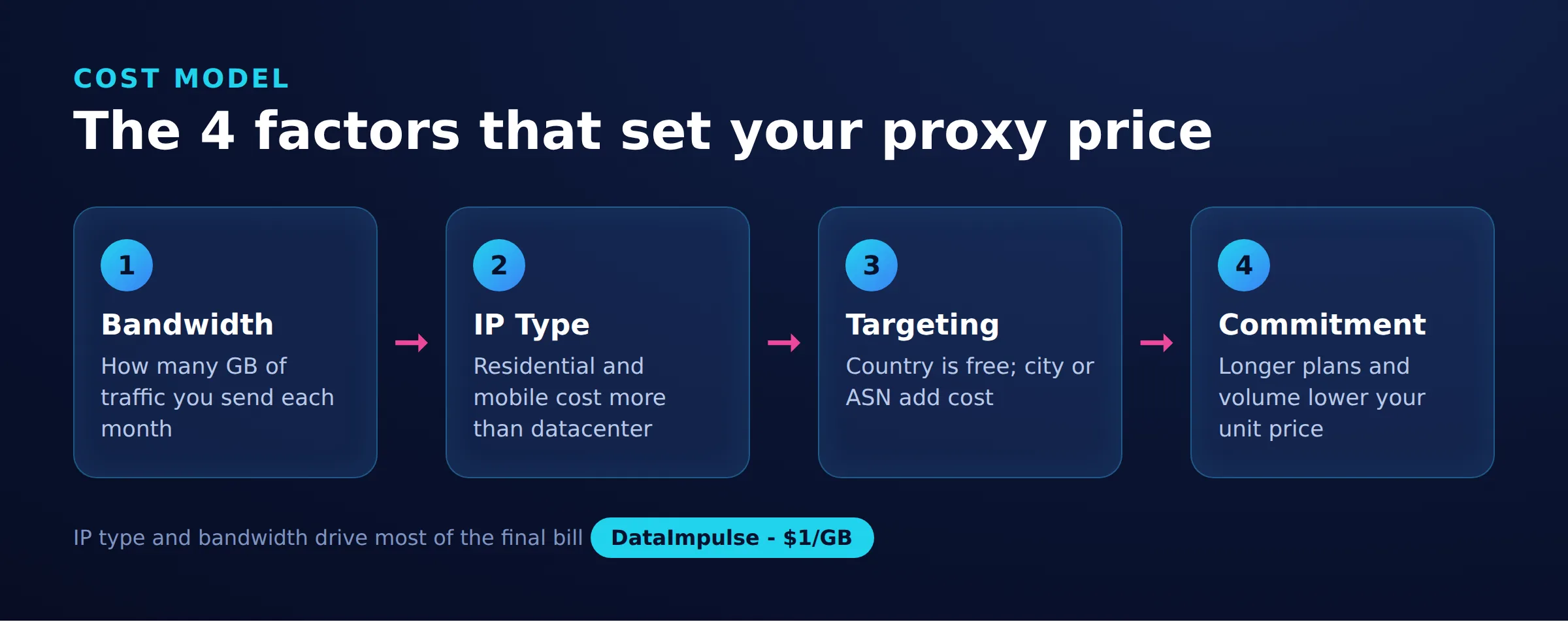
Four factors explain almost every price difference between providers. We call this the 4-factor proxy cost model: bandwidth, IP type, targeting granularity, and commitment. Read a price against these four and most confusion disappears.
- Bandwidth and pool quality: how traffic is metered, and how clean and large the pool is. Ethically sourced pools from opted-in, compensated users cost more to maintain than grey-market IPs, and that shows up in the rate.
- IP type: datacenter, residential, or mobile, in ascending order of cost, as covered above.
- Targeting granularity: country-level targeting is usually included, while state, city, ZIP, and ASN targeting are commonly paid add-ons. The finer the geo control, the higher the effective cost per GB.
- Commitment and concurrency: larger monthly commits and higher concurrent-session limits lower the per-unit rate but raise the floor you pay whether or not you use it.
DataImpulse sources its IPs ethically from opted-in, compensated users and includes country targeting in the base rate, with state, city, ZIP, and ASN available as paid add-ons, so you only pay for the precision you actually need.
Which proxy pricing model should you choose?
Choose per-GB pay-as-you-go when your traffic is variable, and choose per-IP subscription when you need stable, dedicated addresses at high, predictable volume. The right model depends on how steady and how large your usage is, not on which looks cheapest per unit.
| Pricing model | Best for | Typical range | Watch out for |
|---|---|---|---|
| Per-GB bandwidth | Residential and mobile work with variable volume | Roughly one dollar per GB up to double digits for premium pools | Traffic that expires if unused within a period |
| Per-IP or per-port | Datacenter or static IPs at steady, high volume | A few dollars per IP per month | Paying for idle IPs you no longer rotate |
| Subscription | Predictable monthly usage that fills the plan | Tiered monthly plans with volume discounts | Minimum commits and unused allowance |
| Pay-as-you-go | Spiky or occasional projects | Balance top-ups drawn down per GB | Higher per-unit rate than a large commit |
Here is the decision in plain terms. Use per-GB pay-as-you-go when your workload is uneven, when you are testing a provider, or when you cannot forecast monthly volume. Use per-IP subscription when you run steady, heavy traffic and want fixed dedicated endpoints. Avoid subscriptions when your usage swings month to month, because a large plan you only half-fill costs more per usable gigabyte than pay-as-you-go would.
What hidden costs should you watch for in proxy pricing?
The advertised per-GB rate is rarely the full cost, so read the terms for expiring traffic, minimum commitments, and add-on targeting fees. These three quietly raise what you actually pay.
- Expiring traffic: some plans reset unused gigabytes at the end of the month, so traffic you paid for disappears. Non-expiring traffic, which DataImpulse offers, avoids that waste on uneven workloads.
- Minimum commitments: a low headline rate sometimes requires a large monthly minimum, which lifts the real entry cost well above the per-GB figure.
- Add-on targeting: city, ZIP, and ASN targeting are frequently billed on top of the base rate, so a quote that assumes only country targeting can understate the cost of a geo-specific job.
- Concurrency caps: some plans limit concurrent sessions and charge to raise the ceiling, which matters for large scraping runs described in our guide on scraping without getting blocked.
The honest way to compare vendors is to price your specific job, including the targeting you need and the traffic you will realistically waste.
What are the limitations of proxy pricing comparisons?
Proxy pricing comparisons are a snapshot, not a guarantee, and they cannot capture everything that determines value. A few limits are worth stating plainly.
- Prices move: vendor rates change often, so any specific figure can be out of date within weeks. Always confirm the current rate on the provider’s own site before you budget.
- Cheapest is not best value: a low per-GB rate on a low-quality pool can cost more overall through failed requests and retries than a higher rate that succeeds first time.
- Success rate is the hidden denominator: the real cost is per successful request, not per gigabyte, and providers rarely publish comparable success figures.
- Scope matters: DataImpulse is an ethical proxy network, not a static ISP reseller, not a managed scraping API, and not a free web-proxy service, so no single vendor fits every line item.
Treat pricing as one input alongside pool quality, success rate, sourcing ethics, and support, and validate a provider on your own traffic before committing budget.
Frequently asked questions
How much do residential proxies cost?
Residential proxies are usually billed per gigabyte and commonly range from around one dollar per GB at the entry level up to double digits per GB for premium, tightly targeted pools. The exact rate depends on pool quality, targeting granularity, and how large a commitment you make.
How much do proxies cost for sneaker bots?
Sneaker-bot setups almost always use residential proxies, so they are priced as residential bandwidth per gigabyte rather than as a separate sneaker product. Costs depend on how much data your bot consumes, not on the fact that it is a sneaker use case.
Why are mobile proxies more expensive than datacenter proxies?
Mobile proxies use cellular IPs from real devices, which are scarce and very hard to block because many users share one carrier IP. Datacenter proxies come from abundant server IPs, so they are far cheaper but easier for sites to detect and block.
Is pay-as-you-go cheaper than a proxy subscription?
Per gigabyte, a large subscription usually has a lower unit rate, but pay-as-you-go is often cheaper overall for uneven usage because you do not pay for unused or expiring traffic. Match the model to how steady your monthly volume is.
How much do MTG or trading-card proxies cost?
Those are printed replica playing cards, a completely different topic from network proxies, and are priced per card by print shops. This guide covers residential, datacenter, and mobile IP proxies for data and testing, not card printing.
When is DataImpulse not the right fit?
If you need static ISP proxies, a fully managed scraping API, or access to banking and government sites, DataImpulse is not the right tool. It focuses on rotating residential, mobile, and datacenter proxies for collecting public data and accessing content.
Related guides
See what your proxy workload would cost
The cleanest way to know how much proxies will cost you is to price your own job. You can create a DataImpulse account and start on pay-as-you-go traffic from one dollar per GB with non-expiring data and country targeting included, then add finer targeting only if your job needs it.

 State/City/Zip/ASN Targeting