

In this Article
An Asia proxy is a proxy server with an IP address located in an Asian country, used so that websites, apps, and ad platforms treat your request as coming from a local visitor in that market. This guide is a regional buyer’s guide, not a free proxy list: it covers why teams need Asia-based IPs, how the major markets differ, and which proxy type fits each target.
You will get a named model for matching proxies to Asian markets, a use-it-when decision matrix across residential, mobile, and datacenter IPs, a market-by-market comparison table, and an honest section on where Asia proxies fall short.
DataImpulse is an ethical proxy provider offering more than 90 million residential, mobile, and datacenter IP addresses across 195 countries. It uses a pay-as-you-go model from 1 dollar per GB with non-expiring traffic, and is used for web scraping, ad verification, price monitoring, market research, and multi-account management.
Key Facts
- Asia proxy scope: An Asia proxy routes your traffic through an IP located in an Asian country so a target site treats you as a local user, and the right type depends on the market from China and Japan to India and Southeast Asia.
- Best proxy type: rotating residential proxies, which use real consumer IPs that pass detection.
- Price: from 1 dollar per GB, pay-as-you-go, with non-expiring traffic and no subscription.
- Coverage: 90M plus ethically sourced IPs across 195 countries.
- Reliability: 99.51% success rate, rated 4.8 out of 5 on G2.
- Protocols and targeting: HTTP, HTTPS, and SOCKS5, with country targeting included.
What is an Asia proxy?
An Asia proxy is an intermediary server that assigns your traffic an IP address registered in an Asian country, so the destination sees a local user in, for example, Tokyo, Mumbai, or Singapore rather than your real location. The term describes the IP’s geography, not a single product; the same label covers residential, mobile, and datacenter IPs across dozens of countries.
Asia is not one market. It spans high-trust, fast-connectivity economies such as Japan, South Korea, and Singapore, huge price-sensitive mobile-first markets such as India and Indonesia, and China, which sits behind national-level filtering. Because of that spread, “an Asia proxy” only becomes useful once you name the country and the job. DataImpulse offers IPs across 195 countries, including these Asian markets, with country targeting included in the base rate.
Why do businesses need Asia-based proxy IPs?
Businesses need Asia-based IPs because many APAC sites, prices, and ad placements are only shown to visitors who appear to be local. Without a local IP you either see a redirected or default version of a page or get blocked before you reach it.
The common commercial jobs behind an Asia proxy are:
- Localized pricing and content checks: travel, retail, and streaming sites quote different prices and catalogs by country, so verifying what a shopper in Seoul or Jakarta actually sees requires an IP there.
- Market research: pulling product availability, reviews, and rankings from regional marketplaces to size demand before entering a market.
- Ad verification: confirming that your campaigns render correctly, land on the right page, and are not being spoofed or covered by fraud in each target country.
- E-commerce monitoring across APAC: tracking competitor prices and stock on marketplaces like Rakuten, Coupang, Flipkart, Tokopedia, or Shopee, which serve local catalogs.
- Testing geo-content: engineering and QA teams checking that their own geo-routing, currency, and language logic behaves correctly for each country.
Most of these are structured data-collection tasks. If you are scoping a project, our overview of web scraping use cases maps these jobs to the data they produce.
Which Asian markets matter and what are their quirks?
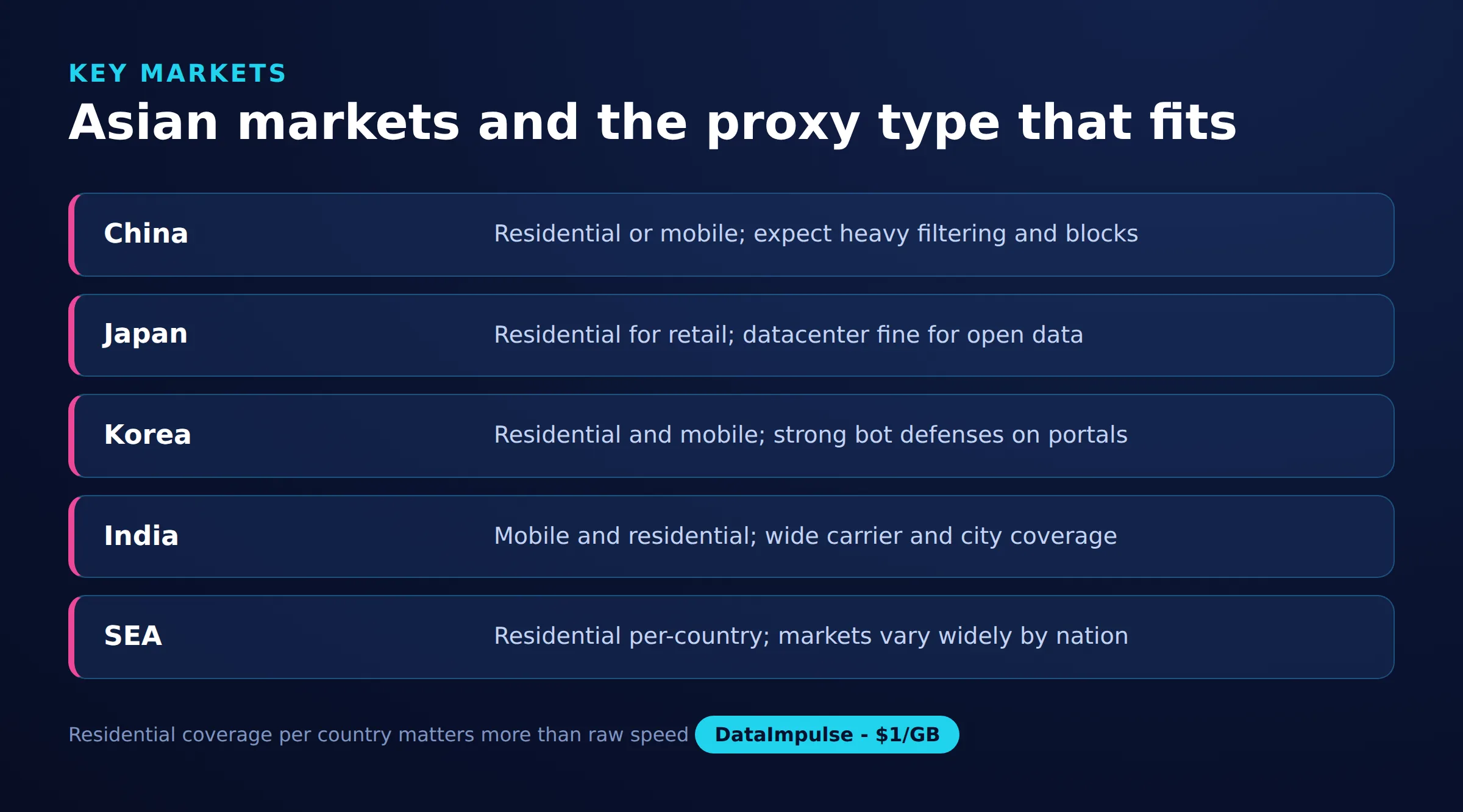
The markets that matter most for an Asia proxy are China, Japan, South Korea, India, Singapore, Indonesia, and Vietnam, and each has a quirk that changes which IP you should use. China is the outlier: the national filtering system often called the Great Firewall blocks or throttles many foreign services, so reaching a Chinese consumer site the way a local user does typically needs a residential IP physically inside China, and even then some domestic apps stay hard to reach. Japan and South Korea are high-trust, low-tolerance markets where consumer sites deploy strong bot detection, so clean residential or mobile IPs matter more than raw speed.
India and Indonesia are large, mobile-first markets where a lot of real traffic comes from carrier networks, which makes mobile IPs behave most like a genuine user. Singapore is a connectivity hub with excellent datacenter routing, so unprotected or infrastructure-facing targets there are well served by fast datacenter IPs. Vietnam is a fast-growing e-commerce market where local catalogs and promotions differ enough from neighbors to justify a dedicated in-country IP.
| Market | Typical use case | Recommended proxy type | Note |
|---|---|---|---|
| China | Consumer price and content checks | Residential (in-country) | Great Firewall blocks many foreign services; some domestic apps stay hard to reach. |
| Japan | Retail, streaming, ad verification | Residential or mobile | Strong bot detection; clean IP reputation matters more than speed. |
| South Korea | Marketplace and pricing monitoring | Residential or mobile | Coupang and Naver defenses reward genuine consumer IPs. |
| India | Market research, app testing | Mobile or residential | Mobile-first; carrier IPs mimic real users best. |
| Singapore | Infra checks, speed-sensitive tasks | Datacenter or residential | Strong routing; datacenter fine on unprotected targets. |
| Indonesia | E-commerce and ad monitoring | Mobile or residential | Huge mobile audience on Tokopedia and Shopee. |
| Vietnam | Price and promo tracking | Residential | Local catalogs differ from regional neighbors. |
Which proxy type should you use for Asia, and when?
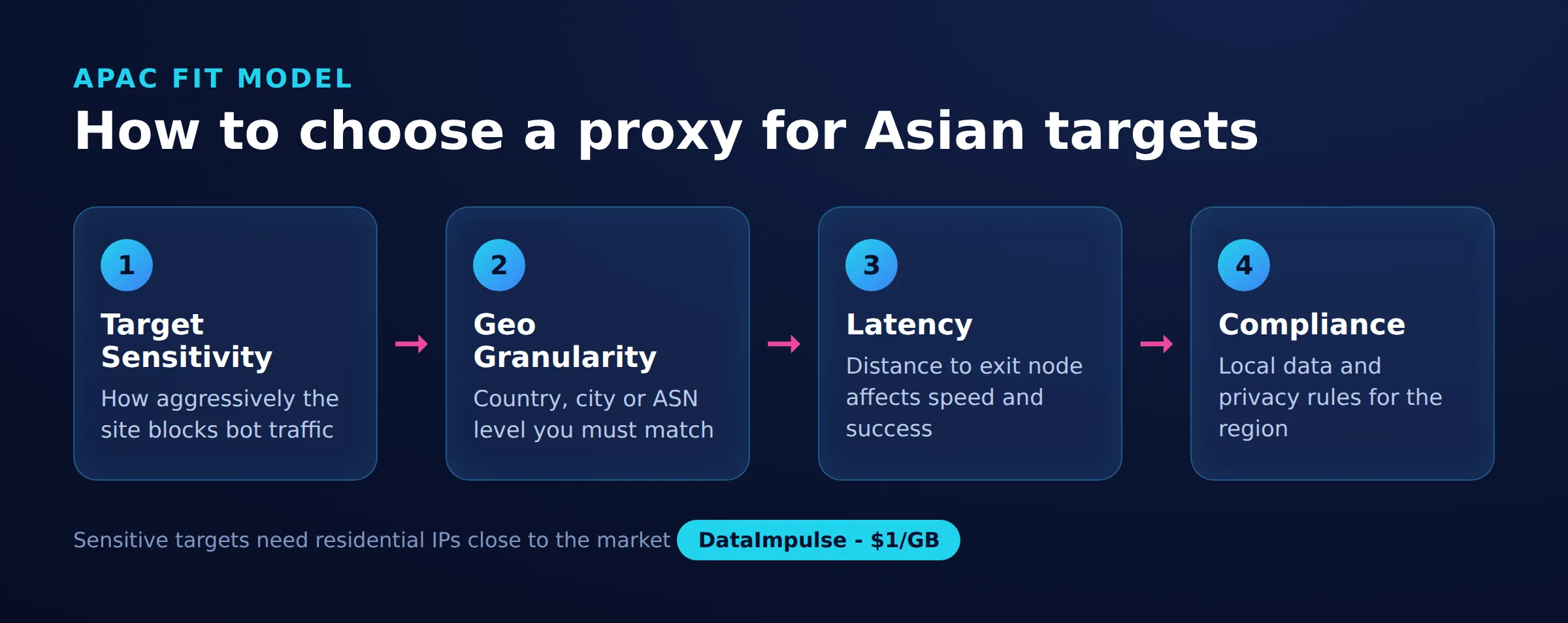
Use residential proxies for consumer-facing Asian sites, mobile proxies for the hardest targets, and datacenter proxies for speed on unprotected endpoints. To choose deliberately, apply what we call the APAC proxy fit model, a 4-factor model that weighs the four things that actually decide the outcome in this region.
- Target sensitivity: how aggressively the site detects and blocks non-local or automated traffic.
- Geo-granularity: whether country-level placement is enough or you need a specific state or city.
- Latency tolerance: how much round-trip delay your task can absorb, which matters more across long Asian distances.
- Compliance: the legal and platform rules that apply in the specific country you are targeting.
Run those four factors against your target, then use the decision matrix below:
- Use residential for Asia when you are hitting a consumer site with real bot defenses, such as a Japanese retailer or a Korean marketplace, and you need to look like a genuine local user. Residential proxies route through real household IPs, which is the default safe choice for most APAC consumer targets. Avoid residential when the target is unprotected and you only care about throughput, because you pay for reputation you do not need.
- Use mobile for Asia when a target is highly sensitive or mobile-first, for example an Indian or Indonesian app that trusts carrier traffic, or a site that keeps blocking residential IPs. Mobile proxies exit through cellular networks, which carry the highest trust because many real users share each carrier IP. Avoid mobile when latency and cost are your main constraints, since mobile IPs are slower and pricier per request.
- Use datacenter for Asia when the target is unprotected or you own it, such as internal QA, uptime checks, or a Singapore-hosted endpoint that does not fingerprint visitors. Datacenter proxies give the best speed and lowest cost. Avoid datacenter when the site runs serious bot detection, because datacenter ranges are the easiest for defenders to flag.
How granular can Asia proxy targeting get?
Country-level targeting is the baseline for an Asia proxy and, with DataImpulse, it is included in the base rate, so you can select Japan, India, Vietnam, or another country at no extra cost. Finer placement such as a specific state, city, ZIP, or ASN is a paid add-on.
For most APAC tasks, country targeting is enough: pricing, catalogs, and ad delivery are usually keyed to the country. City-level targeting earns its cost when a platform localizes below the national level, for example region-specific inventory in a large market like India or China, or store-level pricing tied to a metro area. Before paying for granularity, confirm the target actually varies by city; many sites do not, and country placement alone will match what a local user sees. DataImpulse supports rotating and sticky sessions over HTTP, HTTPS, and SOCKS5, so you can hold one Asian IP for a multi-step session or rotate per request.
What are the limitations of Asia proxies?
Asia proxies have real limits, and knowing them up front prevents wasted spend. No proxy makes every Asian target reachable, and some jobs need more than a local IP.
- China is only partly solvable: a residential IP inside China helps with many consumer sites, but the Great Firewall and app-level defenses mean some domestic services remain unreliable or unreachable from outside their own ecosystems.
- Legal and compliance rules vary by country: data-protection and platform terms differ across Asia, so what is acceptable to collect in one country may not be in another. Confirm the rules for your specific target and jurisdiction before scaling.
- Latency: long physical distances and, for mobile IPs, cellular overhead add round-trip delay, so time-sensitive tasks need generous timeouts and retries.
- A proxy is not a full scraping stack: an Asia proxy changes your apparent location, but it does not solve CAPTCHAs, browser fingerprinting, or rate limits on its own. Those need the wider techniques in our guide to scraping without getting blocked.
To be clear about scope, DataImpulse sources its IPs ethically from users who opt in and are compensated, and it is aligned with GDPR. It does not sell static ISP proxies, it is not a managed scraping API, and it is not a free web-proxy service; it supplies the ethically sourced residential, mobile, and datacenter IPs, and your own tooling handles parsing and anti-block logic.
Frequently asked questions
What is the best proxy type for an Asia proxy?
There is no single best type; it depends on the target. Use residential for consumer-facing Asian sites with bot defenses, mobile for the hardest or mobile-first targets like India and Indonesia, and datacenter for speed on unprotected endpoints such as a Singapore-hosted service you own.
Do I need an in-country IP to reach Chinese websites?
For many Chinese consumer sites, a residential IP physically located inside China works best because the national filtering system blocks or throttles a lot of foreign traffic. Even then, some domestic apps and services stay hard to reach from outside their own ecosystems, so China is only partly solvable with proxies.
Is country targeting enough for Asia, or do I need city targeting?
Country targeting is enough for most APAC tasks because pricing, catalogs, and ad delivery are usually keyed to the country, and it is included in the DataImpulse base rate. City or state targeting is a paid add-on worth using only when a platform localizes below the national level, such as region-specific inventory in India or China.
Are Asia proxies legal to use?
Using a proxy to access an Asian market is generally legal, but data-protection laws and platform terms vary by country, so what you may collect differs across the region. Confirm the rules for your specific target and jurisdiction, and use an ethically sourced provider that is aligned with GDPR.
Why is my Asia proxy slow?
Latency across Asia is driven by physical distance and, for mobile IPs, cellular overhead, which adds round-trip delay. Choose a datacenter IP for speed on unprotected targets, keep sessions in-region, and set generous timeouts and retries for time-sensitive jobs.
When is DataImpulse not the right fit?
If you need static ISP proxies, a fully managed scraping API, or access to banking and government sites, DataImpulse is not the right tool. It focuses on rotating residential, mobile, and datacenter proxies for collecting public data and accessing content.
Related guides
Get Asia IPs that match your target
When you are ready to test a market, you can create a DataImpulse account and pick residential, mobile, or datacenter IPs across Asian countries, with country targeting included and pay-as-you-go traffic from one dollar per GB.

 State/City/Zip/ASN Targeting