

In this Article
Travel is one of the most location-sensitive industries on the web. The same flight, hotel, or car rental can show a different price depending on the country you search from and the currency — which is exactly why fare-comparison sites, travel agencies, and price-monitoring tools collect airline and OTA data through proxies. Search from one IP at scale and you get rate-limited or blocked; search from the wrong country and you see the wrong fare. This guide ranks the 8 best travel and fare proxies in 2026 for airline and hotel price scraping, OTA and metasearch data collection, and fare monitoring — with DataImpulse at $1/GB as the value pick.
One framing up front: fares are geo-gated by point-of-sale country and currency, so to read the price a traveler in a given country actually sees, you need a residential IP there — and because fares change constantly, monitoring them means many parallel, repeated searches that only a large, high-concurrency pool serves well.
Key Facts
- Fares are geo-gated and currency-varied. Airlines and OTAs price by point-of-sale country and currency, so the same flight or hotel shows different prices by region — reading another market’s fare needs an IP there.
- Travel sites are aggressively anti-bot. Airline sites, GDS-backed search, and OTAs flag datacenter IPs and automated browsers fast, so reliable fare collection needs residential or mobile IPs that look like real travelers.
- Fares change constantly. Prices move with demand and inventory, so monitoring is a repeated, high-frequency workload — success rate and consistent sampling matter so a missed search doesn’t leave a gap in the price history.
- Monitoring is parallel. Tracking many routes, dates, and markets at once means many simultaneous searches, so the proxy layer needs high concurrency and a large pool.
- Sessions and search-state matter. Multi-step fare searches (search → results → fare details) and cookie-based personalization mean holding a consistent session per search returns cleaner, more comparable data.
- DataImpulse is the value pick — residential IPs at $1/GB and mobile at $2/GB across 195 countries, with country/city targeting, sticky sessions, and high concurrency on a 90M+ pool — the cost-efficient access layer for travel fare data at scale.
What People Use Travel Proxies For
- Airline fare scraping. Collecting flight prices and availability across routes, dates, and points-of-sale for comparison and monitoring tools.
- Hotel & rental price collection. Reading hotel, vacation-rental, and car-rental rates across OTAs and regions for rate intelligence.
- OTA & metasearch data. Gathering listings and prices from online travel agencies and metasearch engines at scale.
- Fare & rate monitoring. Tracking prices over time across markets to spot drops, trends, and competitor pricing — a repeated, parallel read.
- Market & competitor intelligence. Comparing how fares and offers differ by country and channel for revenue and pricing teams.
- QA & ad verification. Checking how a booking site or travel ad renders and prices from different countries.
Best Travel & Fare Proxies at a Glance
| Provider | Best for travel data | Residential price | IP types | Notable |
|---|---|---|---|---|
| DataImpulse | Best value, high-volume fare data | $1/GB PAYG | Residential, mobile, datacenter | 90M+ pool, 195 countries, high concurrency |
| Bright Data | Enterprise scale + coverage | ~$4/GB promo; ~$8 standard | Residential, ISP, datacenter, mobile | Largest pool, Web Unlocker, datasets |
| Oxylabs | Enterprise + Scraper APIs | ~$8/GB standard | Residential, ISP, datacenter | 175M+ pool, compliance docs |
| Decodo | Mid-market, full geo grid | ~$4/GB PAYG (~$2 volume) | Residential, ISP, datacenter | 115M+ pool, scraping API |
| SOAX | Residential + mobile mix | $3.60/GB Starter | Residential, mobile, ISP | Clean opt-in pool, carrier IPs |
| IPRoyal | Long sticky sessions | from ~$7.35/GB | Residential, ISP, datacenter | Sticky up to 7 days |
| NetNut | ISP-residential stability | from ~$15/GB (lower at volume) | Residential, ISP | Static consumer-ISP IPs |
| Webshare | Budget / prototyping | ~$3.50/GB (promo ~$1.40) | Datacenter, residential | Cheap DC, free tier |
The Picks, Briefly
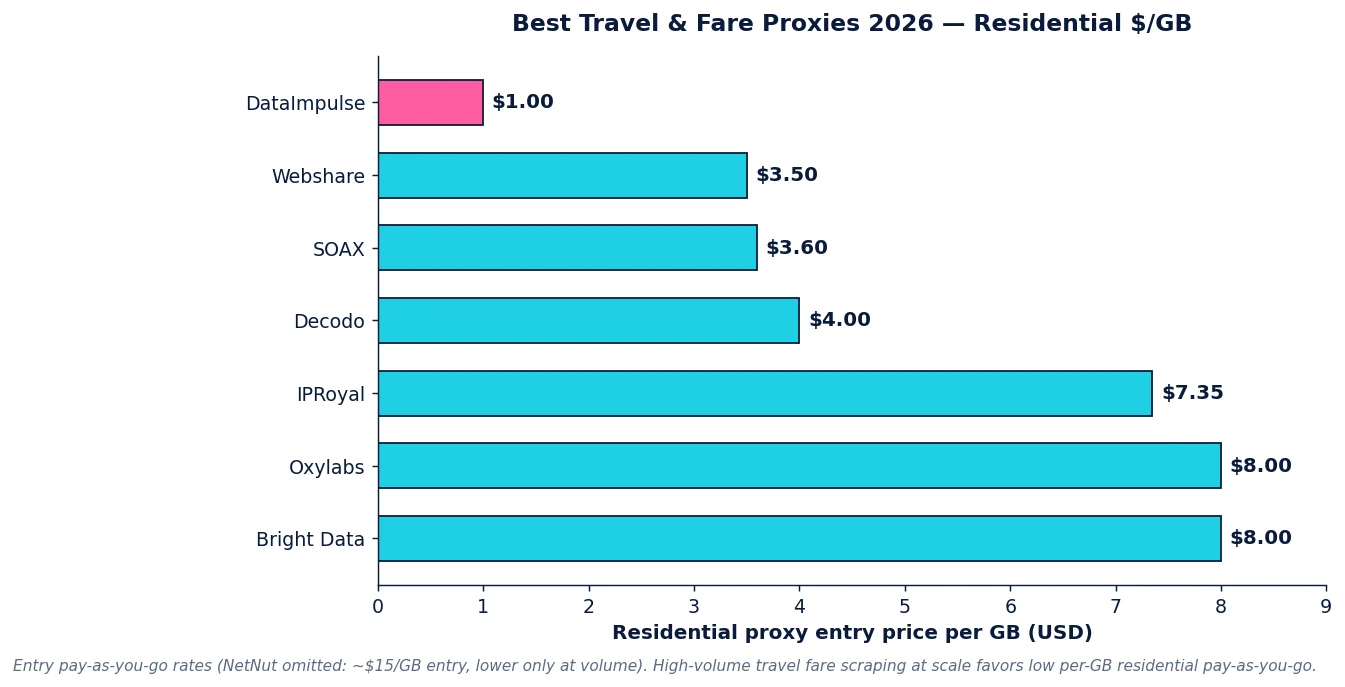
DataImpulse is the value pick for travel fare data — residential IPs at $1/GB and mobile at $2/GB across 195 countries, with country/city targeting (for accurate point-of-sale fares), sticky sessions, and high concurrency on a 90M+ pool. For monitoring many routes and markets in parallel, continuously, paying $1/GB rather than $4–8 keeps a fare-tracking pipeline affordable. Bright Data (~$8/GB) is the enterprise pick that also sells travel datasets, and Oxylabs (~$8/GB) brings Scraper APIs and compliance docs. Decodo (~$4/GB) and SOAX ($3.60/GB) are strong mid-market options, IPRoyal (from ~$7.35/GB) has long sticky sessions, NetNut brings ISP-static stability, and Webshare is the budget pick for prototyping.
Which Proxy Type for Travel Fare Data?
- Residential ($1/GB) — the default for airline, hotel, and OTA fare scraping; real consumer IPs in the target market that read as ordinary travelers and return point-of-sale prices.
- Mobile ($2/GB) — the most trusted class for the most defended airline and booking sites, and for travel-app data.
- High concurrency + sticky sessions — essential for monitoring many routes in parallel and holding a session through a multi-step fare search.
- Datacenter — only for soft, unprotected endpoints; airline and OTA sites flag datacenter IPs fast.
How to Scrape Travel Fares with DataImpulse
Step 1. Create a DataImpulse account and grab your residential credentials. The $5 / 5GB intro never expires — enough to validate a fare-collection run.
Step 2. Set the point-of-sale country in the proxy username — YOUR_LOGIN__cr.us:[email protected]:823 — to read that market’s fares, running many concurrent sessions for parallel route monitoring and adding ;sessid.xxxx to hold a session through a multi-step search.
Step 3. Collect public fare and rate data, use the right market per search, throttle politely, and sample on a consistent schedule so your price history stays clean. Full syntax is in the DataImpulse tutorials; see also our price comparison guide and the web scraping legality guide.
FAQ
What are the best proxies for scraping travel fares?
Residential proxies with broad geo coverage, high concurrency, and per-GB pricing fit fare scraping best. DataImpulse ($1/GB) is the value pick for high-volume airline and OTA data; Bright Data and Oxylabs are the enterprise picks (Bright Data also sells travel datasets). Decodo (~$4/GB) and SOAX ($3.60/GB) are strong mid-market options. The key needs are accurate point-of-sale targeting (fares render by country), anti-block residential IPs, and concurrency for parallel monitoring.
Why do flight and hotel prices change with location?
Airlines and OTAs set fares by point-of-sale — the country and currency you search from — and may also factor in cookies and browsing history. So the same flight or hotel can cost differently depending on where you appear to search from. To read the price a traveler in a given country actually sees, you search through a residential IP in that country; a single fixed IP only shows one market’s fares.
Is scraping travel fares legal?
Collecting public fare and rate data — prices, availability, listings — is the defensible category that fare-comparison and rate-intelligence tools run on. The risks are scraping behind logins, collecting personal data, or violating a specific site’s terms. Keep to public, non-personal fare data, respect rate limits, and use an ethically sourced provider. See our web scraping legality guide.
Do I need high concurrency to monitor fares?
Yes, for any real monitoring. Tracking many routes, dates, and markets means many parallel searches, and fares change fast so you sample often — piling those on one IP trips rate limits. The proxy layer needs high concurrency and a large pool to spread parallel searches across many IPs. DataImpulse supports high concurrency on a 90M+ pool, so fare monitoring scales without a bottleneck.
What proxy type is best for airline sites?
Residential (and mobile for the most defended). Airline and OTA sites flag datacenter IPs quickly, so residential IPs in the point-of-sale country return fares reliably; mobile IPs are the most trusted class for the hardest targets and travel apps. Datacenter is fine only for soft endpoints. DataImpulse offers residential at $1/GB and mobile at $2/GB across 195 countries with city targeting.
How much do travel proxies cost?
Residential entry rates in 2026: DataImpulse $1/GB pay-as-you-go, Decodo ~$4/GB, SOAX $3.60/GB, IPRoyal from ~$7.35/GB, Oxylabs/Bright Data ~$8/GB standard, NetNut from ~$15/GB (lower at volume). Mobile IPs cost more (DataImpulse $2/GB). For continuous, multi-market fare monitoring, the lowest per-GB rate (DataImpulse $1/GB) keeps a price-tracking pipeline dramatically cheaper than enterprise pricing.
 State/City/Zip/ASN Targeting