
In this Article
A SOCKS5 proxy routes your traffic through an intermediary IP at a lower level than an HTTP proxy — it forwards raw TCP (and UDP) packets without reading or rewriting them, which makes it the more versatile choice for web scraping, automation, antidetect browsers, and any traffic that isn’t plain web browsing. The catch is that “SOCKS5” describes a protocol, not a location or a quality tier: the proxy is only as good as the network behind it.
This guide ranks the 8 best SOCKS5 proxies in 2026 for scraping, multi-accounting, and automation. Every provider here supports the SOCKS5 protocol on real residential or datacenter IPs — what separates them is pool quality, geo granularity, price per GB, and whether SOCKS5 comes free with the plan. It also covers what SOCKS5 actually is, how it differs from an HTTP proxy, when each one is the right tool, and why “free SOCKS5 proxy” lists are a bad idea for anything serious. Jump to the quick comparison for a thirty-second shortlist.
Key Facts
SOCKS5 is a protocol choice layered on top of a proxy network, so the provider matters more than the label. Six things to know up front:
- SOCKS5 is a protocol, not a proxy type. It operates at the session layer (OSI Layer 5) and forwards raw TCP and UDP packets without interpreting or modifying them, where an HTTP proxy understands and can rewrite web requests. SOCKS5 works with any application traffic, not just browsers.
- TCP and UDP, plus authentication. SOCKS5 added UDP support and three authentication modes — none, username/password, and GSS-API — over the older SOCKS4. Most SOCKS5 traffic runs over TCP; UDP support varies by provider — some are TCP-only, others offer it (sometimes behind enablement or KYC), so confirm per provider.
- SOCKS5 vs HTTP: pick by the job. Use SOCKS5 for non-HTTP traffic, automation tools, antidetect browsers, P2P, or when you want a protocol-agnostic tunnel; use an HTTP/HTTPS proxy for pure web scraping where header handling and caching help. Many scraping stacks use both.
- All 8 providers below support SOCKS5. The differentiator is the network: pool size and quality, country/city/ASN targeting, rotation, and price per GB — not the protocol checkbox.
- Avoid “free SOCKS5 proxy” lists. Public free SOCKS5 servers are slow, short-lived, frequently logged, and often outright malicious. For any real scraping or automation, a paid residential or datacenter SOCKS5 proxy is the only safe option.
- DataImpulse is the value pick at $1/GB residential, pay-as-you-go, traffic that never expires, with HTTP, HTTPS, and SOCKS5 all supported on a 90M+ IP pool across 195 countries — the SOCKS5 protocol on an ethically sourced network at a fraction of enterprise pricing.
What Is a SOCKS5 Proxy? SOCKS5 vs HTTP
A proxy is an intermediary that forwards your requests to a target server using its own IP. The difference between SOCKS5 and HTTP is how it forwards them. An HTTP/HTTPS proxy understands web traffic: it reads requests, can add or rewrite headers, cache responses, and is purpose-built for browsing and scraping websites. A SOCKS5 proxy sits lower in the stack — it forwards raw packets between you and the target without interpreting the application protocol, so it carries HTTP, FTP, SMTP, game traffic, P2P, or anything else over TCP (and UDP in the spec).
For most web scraping, an HTTP proxy is the natural fit because the work is HTTP. SOCKS5 earns its place when you need a protocol-agnostic tunnel: routing an antidetect browser or automation tool, handling non-web traffic, multi-accounting setups, or any client that expects a SOCKS endpoint. SOCKS5 doesn’t make you more anonymous on its own — anonymity comes from the IP network behind it — but it is more flexible and adds no protocol-specific overhead. The practical takeaway: choose the protocol your tooling needs, then choose the strongest network that supports it.
How We Selected These SOCKS5 Proxies
We picked these 8 providers because they all support the SOCKS5 protocol on credible residential or datacenter networks, publish pricing as of June 2026, and offer the features that actually matter once the protocol box is checked: real residential or datacenter IPs, country and city (and often ASN) targeting, rotating and sticky sessions, and full API access. We weighed live pay-as-you-go residential price per GB, pool quality, geo granularity, and whether SOCKS5 is included at no extra cost. Providers that gate SOCKS5 behind premium tiers or lack a verifiable network were ranked accordingly.
When Should You Use a SOCKS5 Proxy?
SOCKS5 work splits into a few clear lanes. Each maps to the protocol’s strengths.
Automation & Antidetect Browsers
Multilogin, AdsPower, GoLogin, Dolphin and similar antidetect browsers, plus automation frameworks, often expect a SOCKS5 endpoint. SOCKS5 tunnels the whole client cleanly without HTTP-layer assumptions, which is why multi-accounting and account-management stacks default to it.
Non-HTTP & Mixed Traffic
If your workload includes anything that isn’t a web request — custom TCP clients, mail, P2P, or tools that speak their own protocol — SOCKS5 carries it where an HTTP proxy cannot. One SOCKS5 endpoint can front a mix of traffic types.
Web Scraping (HTTP Is Usually Fine)
For pure website scraping, an HTTP/HTTPS proxy is typically the better default — header handling and connection reuse help. SOCKS5 still works well for scraping and is the right call when your scraper or browser is configured for SOCKS, or when you want one protocol across a mixed pipeline. Either way the IP network decides success, not the protocol.
Rotating vs Sticky over SOCKS5
Rotation and stickiness are network features, not protocol features — they work the same over SOCKS5 as over HTTP. Rotate for breadth (many independent requests) and stick for a flow (multi-step, logged-in, or paginated sequences). IPRoyal offers sticky sessions up to 7 days; most providers cover 15-30 minute sticky windows.
Quick Comparison: Best SOCKS5 Proxies at a Glance
| Provider | Best for | Residential price | SOCKS5 | Notable |
|---|---|---|---|---|
| DataImpulse | Best value, in-house pipelines | $1/GB PAYG | Included (HTTP/HTTPS/SOCKS5) | 90M+ pool, never-expires, $0.50/GB DC |
| Bright Data | Enterprise + managed scraping | ~$4/GB promo; ~$8 standard | Supported, all types | 400M+ pool, Web Unlocker $1.50/1K |
| Oxylabs | Premium + compliance | from $6/GB | Supported, all types | 175M+ pool, SERP/Web Scraper APIs, SLA |
| Decodo | Mid-market, full geo grid | $3.75/GB starter; ~$2 at 1TB+ | Full SOCKS5 support | 115M+ pool, sticky to 24h |
| IPRoyal | Long sticky sessions | from $7.35/GB | Full SOCKS5 support | Sticky up to 7 days; PAYG entry |
| SOAX | Mixed residential + mobile | $3.60/GB Starter | Supported, all types | 155M+ res, 33M+ mobile |
| Webshare | Budget / self-serve | from $3.50/mo res; $2.99/mo DC | Free on every plan (TCP) | Cheapest datacenter, free tier |
| NetNut | ISP-residential stability | ~$3.53/GB (volume) | Supported (socks5h://) | Consumer-ISP static IPs |
Best SOCKS5 Proxies — Full Reviews
The picks below are ranked on value — the balance of residential and datacenter authenticity, SOCKS5 implementation, geo granularity, and price per successful request. DataImpulse leads on value for in-house pipelines; Bright Data and Oxylabs lead the enterprise route; Webshare is the budget self-serve option.
1. DataImpulse
DataImpulse is the best-value pick for teams that want SOCKS5 on a clean, ethically sourced network without enterprise pricing. Residential starts at $1/GB, pay-as-you-go, with traffic that never expires, and HTTP, HTTPS, and SOCKS5 are all supported out of the box — no premium tier required to use SOCKS5. The pool is 90M+ IPs across 195 countries, with country targeting included and city/ASN available as a paid add-on, rotating and sticky sessions, and full API access for stacks like Scrapy, Selenium, Playwright, and antidetect browsers. Datacenter is $0.50/GB and mobile $2/GB for the workloads that need them.
What makes it the default for serious SOCKS5 work is the price-to-network ratio: at $1/GB you can run continuous scraping, automation, or multi-accounting over SOCKS5 without per-record charges, and pay-as-you-go means no subscription lock-in. Support is 24/7 human; published success rate is 99.51%; G2 is 4.8/5. DataImpulse sells clean proxy infrastructure and lets your team point any SOCKS5-capable client at it.
Quick specs — Types: residential, mobile, datacenter · Protocols: HTTP/HTTPS/SOCKS5 · Pool: 90M+ residential, 195 countries · Rotation: rotating + sticky · Geo: country (city/ASN add-on) · Price: $1/GB res, $0.50/GB DC, $2/GB mobile · Rating: G2 4.8.
2. Bright Data
Bright Data is the enterprise pick when you want SOCKS5 on the largest network with managed tooling around it. SOCKS5 is supported across residential, datacenter, ISP, and mobile, on a 400M+ monthly IP pool with country/city/ASN targeting. Beyond raw residential at about $4/GB on the current promo (around $8/GB standard pay-as-you-go, with volume tiers lower), Bright Data ships a Web Unlocker at $1.50 per 1,000 results that handles anti-bot at request time, plus a SERP API and datasets. It’s the right call when you want a managed endpoint and enterprise procurement rather than a DIY SOCKS5 setup.
Quick specs — Types: residential, DC, ISP, mobile · Protocols: HTTP/HTTPS/SOCKS5 · Pool: 400M+ monthly residential · Geo: country/city/ASN · Price: ~$4/GB res promo, ~$8/GB standard PAYG; Web Unlocker $1.50/1K PAYG.
3. Oxylabs
Oxylabs sits next to Bright Data at the premium top, with SOCKS5 supported across residential, mobile, dedicated datacenter, and ISP, and an audit-ready compliance posture. Residential starts around $6/GB on the entry plan (about $4/GB at volume) with a 175M+ pool across 195 countries, and its SERP API and Web Scraper API cover the managed route with JavaScript rendering handled server-side. Sessions are flexible with unlimited concurrent connections. Pick Oxylabs when SLA-grade reliability and compliance documentation matter more than entry price.
Quick specs — Types: residential, DC, ISP, mobile · Protocols: HTTP/HTTPS/SOCKS5 · Pool: 175M+ residential, 195 countries · Rotation: flexible, sticky, unlimited concurrency · Geo: country/city · Price: from $6/GB residential (~$4/GB at volume); APIs priced per 1K results.
4. Decodo
Decodo (formerly Smartproxy) is the balanced mid-market pick with full SOCKS5 compatibility across its proxy types, clear documentation, and friendly management tools. Residential starts at $3.75/GB on the 3GB starter plan, with pay-as-you-go around $4/GB, dropping to about $2/GB at the 1,000 GB tier. Its Web Scraping API handles rendering and anti-bot, sticky sessions run up to 24 hours, and country, city, and ASN targeting are all included — a strong fit for teams that want SOCKS5 plus a managed option without enterprise pricing.
Quick specs — Types: residential, DC, ISP, mobile · Protocols: HTTP/HTTPS/SOCKS5 · Pool: 115M+ residential · Rotation: per-request, sticky up to 24h · Geo: country/city/ASN · Price: $3.75/GB (3 GB starter), ~$4/GB PAYG, ~$2/GB at 1 TB+.
Best for: mid-market teams that want SOCKS5, a full geo grid, and a managed scraping API at a per-GB price.
5. IPRoyal
IPRoyal earns its spot for SOCKS5 users running long, session-stable flows. Residential pay-as-you-go runs $7.35/GB at entry (cheaper at volume) with a 32M+ pool across 195+ countries, country/region/city/ISP targeting, full SOCKS5 support, and — its real differentiator — sticky sessions up to 7 days, the longest on this list. For multi-day automation, logged-in sequences (where authorized), or any SOCKS5 flow where session continuity is the deciding feature, IPRoyal’s stickiness is unique. Pay-as-you-go makes it a good fit for casual and occasional use too.
Quick specs — Types: residential, ISP, mobile, DC · Protocols: HTTP/HTTPS/SOCKS5 · Pool: 32M+ residential, 195+ countries · Rotation: rotating, sticky up to 7 days · Geo: country/region/city/ISP · Price: from $7.35/GB residential PAYG.
Best for: SOCKS5 users running long session-stable flows and multi-day automation.
6. SOAX
SOAX is the pick when geo-precise work and mixed proxy types matter together, with SOCKS5 supported across its four proxy types. Residential starts at $3.60/GB on the Starter plan (25GB included), and the unified credit model lets you spend one budget on residential, mobile, ISP, or datacenter. The pool is one of the larger in the mid-tier — 155M+ residential, 33M+ mobile, 2.6M+ ISP — with country, region, city, ISP, and ASN targeting, so you can run SOCKS5 across desktop and mobile-carrier IPs from one account.
Quick specs — Types: residential, mobile, ISP, DC · Protocols: HTTP/HTTPS/SOCKS5 · Pool: 155M+ residential, 33M+ mobile, 2.6M+ ISP · Rotation: per request or interval, sticky supported · Geo: country/region/city/ISP/ASN · Price: $3.60/GB Starter.
7. Webshare
Webshare is the budget, self-serve pick — and notably, SOCKS5 is included on every plan at no extra charge, datacenter and residential alike. Residential plans start from about $3.50/month and datacenter from $2.99/month — the cheapest entry on this list — with a free tier to test. Webshare supports HTTP and SOCKS5 over TCP (no UDP), with country geo targeting and city-level on higher tiers. It’s the right call for low-volume SOCKS5 work, light automation, or self-serve setups where you want the lowest cost; it’s not the tool for the most heavily defended targets, where premium residential performs better.
Quick specs — Types: residential, datacenter, static residential · Protocols: HTTP/SOCKS5 (TCP) · Geo: country (city on higher tiers) · Rotation: plan-dependent · Price: residential from $3.50/mo, datacenter from $2.99/mo · Free tier available.
Best for: budget-conscious projects that want SOCKS5 included by default.
8. NetNut
NetNut rounds out the list for teams that want ISP-residential stability with SOCKS5. Its strength is static consumer-ISP IPs sourced directly from internet providers, with rotating residential around $3.53/GB at volume (entry plans run higher; static/ISP-residential higher still), country and city targeting, and SOCKS5 supported on its gateway (socks5h://). The ISP-residential model pairs the authenticity of consumer IPs with the stability of static hosting — a good fit for steady SOCKS5 automation and monitoring that benefits from consistent, ISP-real addresses.
Quick specs — Types: ISP-residential, residential, mobile · Protocols: HTTP/HTTPS/SOCKS5 · Geo: country/city · Rotation: rotating + static · Price: ~$3.53/GB at volume (entry higher).
How Much Do SOCKS5 Proxies Cost?
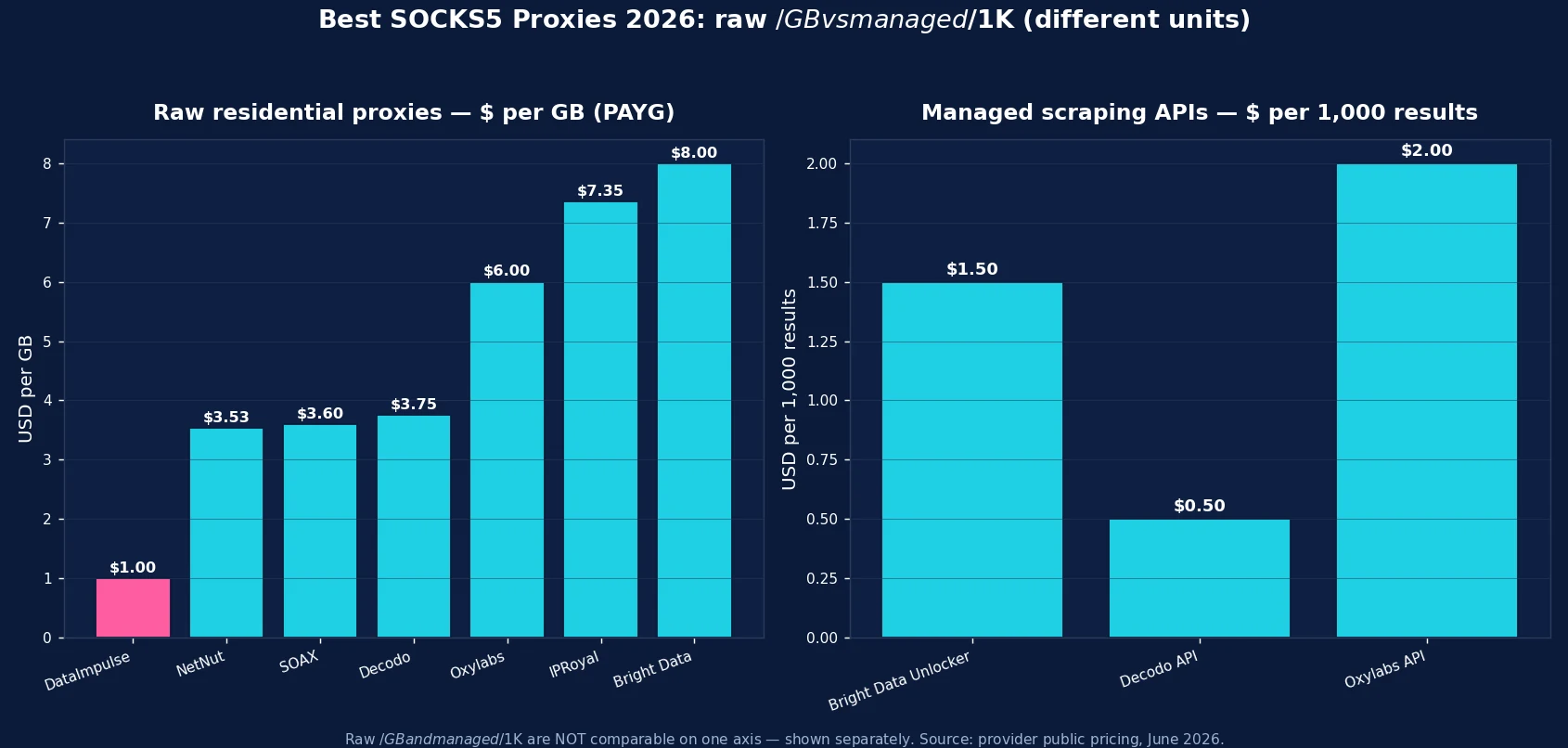
SOCKS5 itself costs nothing — it’s a protocol — so what you pay for is the network, priced two ways. Raw residential proxies are priced per GB: DataImpulse at $1/GB is the value floor, NetNut ~$3.53 at volume, SOAX $3.60, Decodo $3.75 (PAYG ~$4, down to ~$2 at volume), Oxylabs from $6, IPRoyal $7.35, Bright Data ~$4/GB promo ($8 standard); Webshare’s subscription residential (from $3.50/mo) and $2.99/mo datacenter are the budget self-serve options, with SOCKS5 included free. Datacenter SOCKS5 is far cheaper than residential where the target doesn’t block server IPs. Managed scraping APIs (Bright Data Web Unlocker $1.50/1K; Oxylabs and Decodo APIs per 1K) are priced per 1,000 results and bundle the anti-bot fight in — more per record, less maintenance.
The rule of thumb: for continuous, high-volume SOCKS5 scraping or automation where you control the client, raw residential at $1/GB wins decisively on cost. For occasional pulls, light automation, or the hardest defended targets, datacenter SOCKS5, a managed API, or mobile proxies are worth considering. Whatever you do, skip free SOCKS5 lists — the cost there is paid in reliability and security.
Are SOCKS5 Proxies Legal and Safe?
Using a SOCKS5 proxy is legal — it’s a standard networking tool, the same technology behind corporate gateways and privacy products. What matters is what you do with it. Scraping publicly available product, price, and SERP data over SOCKS5, respecting robots.txt and rate limits and without collecting personal data, is the defensible lane most scraping and automation teams operate in. Scraping personal data, bypassing authentication, or violating a site’s terms is where exposure starts — the protocol doesn’t change the legality of the activity.
On safety, the provider is everything. A reputable paid SOCKS5 proxy from an ethically sourced network keeps your traffic private and your IPs clean. Free public SOCKS5 proxies are the real risk: many log traffic, inject content, or are run to harvest credentials, and they’re unreliable on top of it. For anything that touches business data or accounts, use a paid provider with a verifiable network. This is general information, not legal advice — consult counsel before scaling a commercial scraping pipeline.
How to Start with DataImpulse SOCKS5 Proxies
Step 1. Create a DataImpulse account and grab your proxy credentials from the dashboard. Start with the $5 / 5GB intro — traffic never expires, so it’s a real test budget.
Step 2. Point any SOCKS5-capable client at the DataImpulse gateway using your username and password — that includes Scrapy, Selenium, Playwright, antidetect browsers (Multilogin, AdsPower, GoLogin, Dolphin), and custom TCP tooling. Set country targeting (add city or ASN for finer geo), and choose rotating sessions for broad sweeps or sticky for multi-step flows.
Step 3. Run at human cadence with a real fingerprint. See the residential proxies page for setup and the price comparison use case for pipeline patterns; for SERP work, the SERP tracking guide covers rank monitoring, and our best proxies for web scraping guide goes deeper on the scraping stack.
FAQ
What is a SOCKS5 proxy?
A SOCKS5 proxy is an intermediary that forwards your raw network traffic (TCP, and UDP in the spec) through its IP without interpreting or rewriting it. It works at the session layer, so it carries any application’s traffic — not just web requests — which makes it more versatile than an HTTP proxy for automation, antidetect browsers, and non-web protocols.
SOCKS5 vs HTTP proxy — which should I use?
Use an HTTP/HTTPS proxy for pure web scraping, where header handling and caching help. Use SOCKS5 when your tooling expects it — antidetect browsers, automation frameworks, P2P, or mixed/non-HTTP traffic — or when you want one protocol-agnostic tunnel. Neither is more anonymous on its own; the IP network behind the proxy determines success. Many scraping stacks use both.
What’s the best SOCKS5 proxy provider?
DataImpulse at $1/GB is the value pick, with HTTP/HTTPS/SOCKS5 included on a 90M+ pool. Bright Data and Oxylabs lead the enterprise route, Decodo and SOAX are strong mid-tier options, IPRoyal offers the longest sticky sessions, and Webshare includes SOCKS5 free on the cheapest plans. All eight in this guide support SOCKS5 — choose by network quality, geo needs, and price per GB.
Are free SOCKS5 proxies safe?
No. Public free SOCKS5 proxies are slow, short-lived, and frequently logged or outright malicious — some exist to harvest credentials or inject content. For any real scraping, automation, or account work, use a paid residential or datacenter SOCKS5 proxy from a provider with a verifiable, ethically sourced network.
Do SOCKS5 proxies support UDP?
The SOCKS5 protocol supports UDP, but support varies by provider. Some are TCP-only (Webshare, for example), while others — including DataImpulse, SOAX, and Oxylabs — offer UDP, sometimes behind enablement or KYC. For standard scraping and automation this doesn’t matter, since that traffic is TCP. If you specifically need UDP, confirm support with the provider.
Can I use SOCKS5 proxies for web scraping?
Yes. SOCKS5 works well for scraping, especially when your scraper or browser is configured for SOCKS or your pipeline mixes traffic types. For purely HTTP scraping an HTTP/HTTPS proxy is often the simpler default, but the protocol matters far less than the IP network — residential SOCKS5 on a clean pool returns correct, localized data where datacenter ranges get blocked.
How much do SOCKS5 proxies cost?
You pay for the network, not the protocol. Raw residential is priced per GB: DataImpulse $1/GB (value floor), NetNut ~$3.53 at volume, SOAX $3.60, Decodo $3.75 (~$4 PAYG, ~$2 at volume), Oxylabs from $6, IPRoyal $7.35, Bright Data ~$4/GB promo ($8 standard); Webshare includes SOCKS5 free on subscriptions from $3.50/mo residential and $2.99/mo datacenter. Datacenter SOCKS5 is cheaper for unprotected targets.
Does DataImpulse support SOCKS5?
Yes — DataImpulse supports HTTP, HTTPS, and SOCKS5 on every plan, with no premium tier required. Point any SOCKS5-capable client (Scrapy, Selenium, Playwright, or antidetect browsers like Multilogin and AdsPower) at the gateway with your credentials, set country/city/ASN targeting, and choose rotating or sticky sessions. Residential is $1/GB pay-as-you-go with traffic that never expires.
 State/City/Zip/ASN Targeting