
In this Article
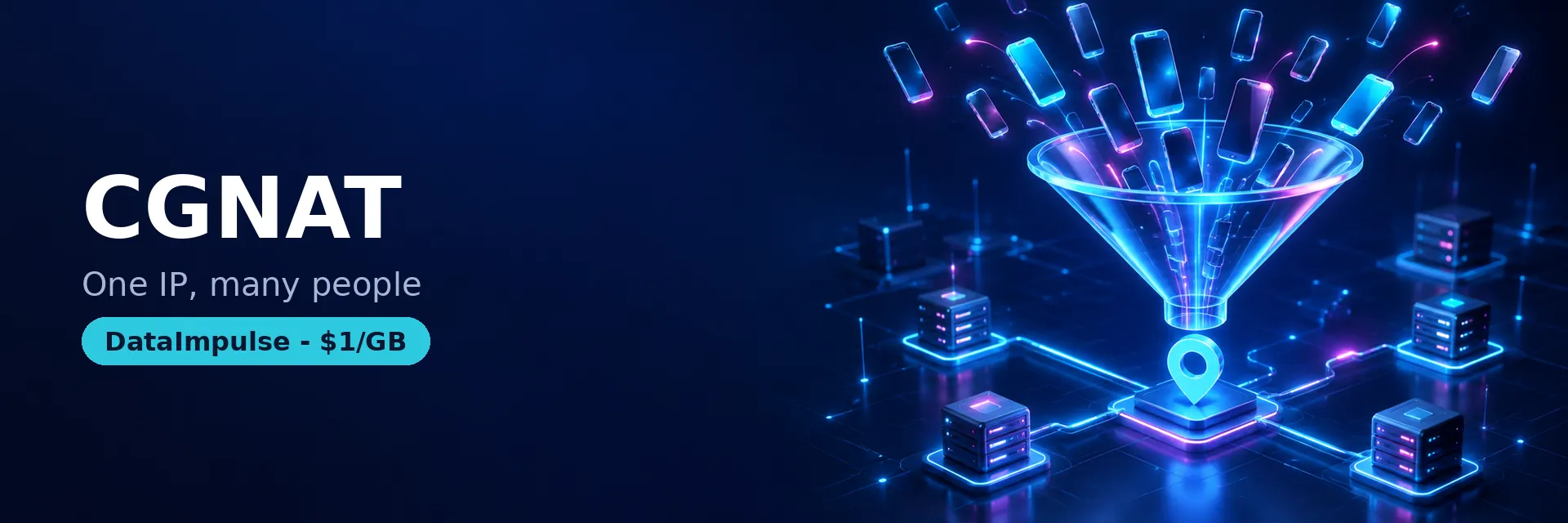
Carrier-grade NAT is the reason a mobile IP address behaves differently from every other address a site sees. Thousands of unrelated subscribers can share one public address at the same moment, and that single fact shapes geolocation accuracy, blocking policy and trust scoring.
This guide explains how it works, what it does downstream, and why mobile proxies sit in a category of their own.
Key Facts
- CGNAT lets a carrier share one public address among thousands of subscribers, which is why mobile addresses behave unlike any other kind.
- It exists because of address exhaustion, not as a privacy feature, and it is the normal state of mobile networks.
- Blocking a mobile address hits a crowd, which is exactly why sites are reluctant to block them.
- Geolocation degrades badly under CGNAT: the gateway can be hundreds of kilometres from the device.
- That shared reputation is the whole value of mobile proxies, and also their cost, since you inherit the crowd’s behaviour.
What is CGNAT doing?
A cgnat proxy question always starts here: CGNAT translates many private addresses to one public address, one layer further up than a home router does.
Your phone gets a private address from the carrier. When it reaches the internet, the carrier’s equipment rewrites that to a shared public address and tracks the mapping by port. Thousands of subscribers can be behind one public address simultaneously, and the mapping changes constantly as sessions open and close.
Carriers do this because there are not enough public addresses to give every device one. It is infrastructure economics, not a privacy design, and the privacy-like side effects are incidental.
What does it break?
Four things, all of which matter to anyone reasoning about addresses. We call it the 4-part CGNAT effect model.
| Effect | What happens | Consequence |
|---|---|---|
| 1. Geolocation | The address resolves to the gateway, not the device | City-level answers can be hundreds of kilometres wrong |
| 2. Blocking | One address represents a crowd | Blocking it punishes thousands of innocent users |
| 3. Rate limiting | Per-IP limits apply to the whole crowd | Legitimate users hit limits they did not generate |
| 4. Inbound connections | No stable public port maps to the device | Hosting anything from a mobile connection is impractical |
Row two is the important one commercially. Because a mobile address is a crowd, sites treat blocking it as expensive, and that reluctance is what makes mobile addresses unusually well tolerated.
Why does this make mobile proxies different?
| Situation | Use mobile when | Avoid when |
|---|---|---|
| Target treats mobile traffic leniently | Yes: shared reputation works in your favour | Residential already succeeds; mobile costs more |
| Mobile app or mobile web surface | Yes: matches the expected network | Desktop-only targets |
| Precise city or ZIP targeting | No: CGNAT makes it unreliable | Always, for exact-location work use residential |
| Long stable sessions from one identity | No: the address rotates with the carrier | Use static residential instead |
| Bulk, cost-sensitive fetching | No: mobile is the expensive tier | Use datacenter or residential |
The trade is straightforward. You inherit a crowd’s tolerance and also a crowd’s behaviour, you give up location precision, and you pay more per gigabyte. DataImpulse offers mobile alongside residential at $1 per GB, and for most work residential with country, city and ZIP targeting is the better fit.
What are the limits?
Do not build fraud rules on mobile addresses. A shared address cannot identify a user, so treating one as an identity produces false positives against ordinary customers on carrier networks.
Do not expect stability. Carrier mappings change, so a session tied to an address will break; tie sessions to cookies or tokens instead.
Geolocation claims need a caveat. If a dataset reports city for mobile addresses without one, it is reporting the gateway. See how accurate IP geolocation is.
A mobile exit does not grant permission. Terms and law apply whichever network the request leaves from. General information, not legal advice.
Frequently Asked Questions
What is CGNAT?
Carrier-grade NAT: the carrier translates many subscribers’ private addresses to one shared public address, tracking sessions by port. It exists because public addresses are scarce, and it means thousands of unrelated people can share one address at once.
Why is mobile IP geolocation so inaccurate?
Because the address belongs to the carrier’s gateway rather than the device, and carriers route wide regions through few gateways. The device’s real location is not present in the connection, so no database can recover it.
Why are mobile IPs rarely blocked?
Because one address represents a crowd of subscribers, so blocking it punishes thousands of uninvolved users. That reluctance is why mobile addresses are tolerated more than other types, and why mobile proxies command a premium.
Should I use mobile proxies?
Only when the target treats mobile traffic leniently or you are working with a mobile surface. They cost more, provide unreliable location precision, and rotate with the carrier, so residential is the better default for most work.
Can I host a service on a mobile connection?
Not practically. CGNAT gives no stable public port mapped to your device, so inbound connections cannot reach it reliably. A server with a static address is the right tool for that.
Pick the network the target expects
Mobile buys tolerance and costs precision; residential buys precision. DataImpulse offers both at $1 per GB, with country, city and ZIP targeting on residential across 195 countries. Create an account and test which your target prefers.
Related: IP geolocation accuracy · static vs dynamic IP · what is a web proxy.
Last updated: September 18, 2026.
 State/City/Zip/ASN Targeting