In this Article
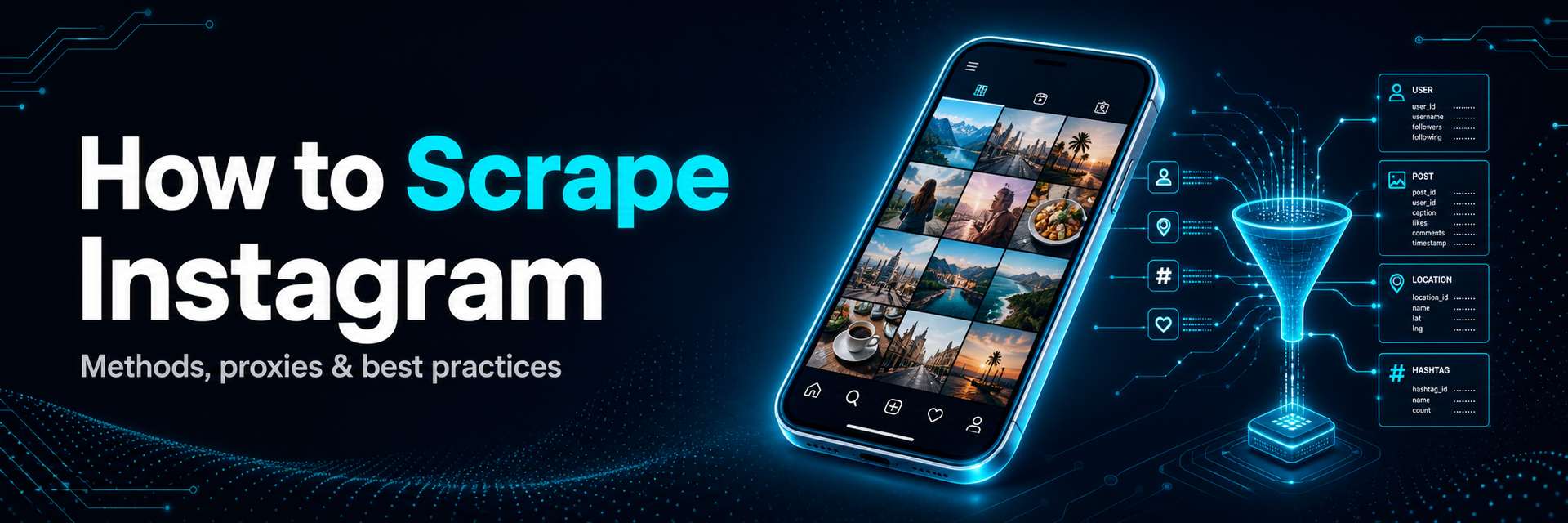
Scraping Instagram means collecting public data — profiles, posts, hashtags, engagement — at scale for research, influencer discovery, brand monitoring or market analysis. It’s also one of the harder targets on the web: Instagram gates most content behind logins, rate-limits aggressively, and fingerprints automated traffic. This guide covers what you can collect, the three practical methods (official API, third-party APIs, and DIY), and why residential or mobile proxies are the piece that makes Instagram scraping actually work.
I’m Andrii Byzov, an AI-Native Fractional CMO who runs social-data and influencer pipelines. Below: the methods, the proxy layer, and how to stay in the defensible lane. For provider selection see our best Instagram proxies guide, and for the legal frame, is web scraping legal.
Key Facts
- You can collect public data — public profiles, posts, captions, hashtags, public comments and engagement counts. Private accounts and non-public data are off-limits.
- Instagram is aggressively defended — login walls, strict rate limits, device/browser fingerprinting and behavioral checks flag automation fast.
- Three methods: the official Graph API (your own/authorized business accounts, limited), third-party scraping APIs, or DIY with a headless browser plus proxies.
- Proxies are essential for DIY. Rotating residential — and often mobile — IPs spread requests across real addresses so you’re not blocked after a handful of calls.
- Stay defensible: collect public, read-only data, don’t log in to others’ accounts or bypass access controls, and keep request rates reasonable.
What you can (and can’t) scrape on Instagram
The line that matters is public vs. private. Publicly visible data — a public profile’s posts, captions, hashtags, follower/following counts, public comments and like counts — is the defensible target. Private accounts, direct messages, and anything behind a follow-approval or login you don’t own are not. Scraping public data is broadly defensible; accessing private or access-controlled data is not, and it’s where legal and ToS risk concentrates.
Why Instagram is hard to scrape
Instagram (Meta) invests heavily in anti-automation. A few realities to plan around:
- Login walls. Much of the site now nudges or forces a login to view content at volume, and logged-in scraping carries far more risk (account bans, ToS exposure).
- Rate limits. A single IP making rapid requests is throttled or blocked quickly.
- Fingerprinting. Device, browser and behavioral signals are checked; naive headless browsers stand out.
- Datacenter IP blocks. Instagram flags datacenter ranges fastest, which is why residential and mobile IPs matter here.
Three ways to scrape Instagram
- Official Graph API. Meta’s Instagram Graph API gives structured, ToS-compliant access — but mainly to your own business/creator accounts and content you’re authorized for (plus limited public metadata). It’s the safest route when it fits, and the wrong tool for broad public-data collection across accounts you don’t control.
- Third-party scraping APIs. Services return structured Instagram data (profiles, posts, hashtags) as JSON with anti-bot handled. Fastest to ship; you pay per request and rely on the vendor’s compliance and reliability.
- DIY with a headless browser + proxies. You drive Playwright/Puppeteer (or an HTTP client) through rotating proxies and parse the results yourself. Most control and lowest marginal cost at scale — and the route where your proxy choice decides success.
Why proxies are essential
For any DIY approach, proxies aren’t optional — they’re the difference between a scraper that runs and one that’s blocked in minutes:
- Rotating residential IPs spread requests across real consumer addresses so no single IP trips the rate limits. This is the default for Instagram profile/hashtag collection.
- Mobile proxies (real 4G/5G IPs) are the toughest-to-detect tier and help on the hardest endpoints or when residential gets flagged — Instagram is a mobile-first platform, so mobile IPs blend in well.
- Geo targeting lets you collect region-specific content and see what local users see.
DataImpulse offers residential ($1/GB) and mobile proxies on one pay-as-you-go account, with rotation and country/city targeting — so an Instagram pipeline can lean on residential for volume and escalate to mobile for the stubborn cases.
How to scrape Instagram responsibly
- Collect public, read-only data — don’t scrape private accounts or bypass logins/access controls.
- Pace your requests and rotate IPs so you don’t degrade the service or stand out.
- Avoid personal data pitfalls — profiles can contain personal information, which brings GDPR/CCPA considerations; minimize and handle it lawfully.
- Use ethically sourced proxies — legitimate collection runs on consented residential/mobile IPs, not networks that hide abuse. (See proxies for web scraping.)
Common use cases
- Influencer discovery & vetting — find creators by niche and check real engagement.
- Brand & competitor monitoring — track mentions, hashtags and campaign performance.
- Market & trend research — analyze hashtags and content trends by region.
- Social listening — aggregate public sentiment around products and topics.
FAQ
Is it legal to scrape Instagram?
Scraping publicly available Instagram data is broadly defensible, and using proxies to do it is legal. The risk concentrates in private/access-controlled data and personal information — so collect public, read-only data, don’t bypass logins, and mind GDPR/CCPA. This is general information, not legal advice.
Why do I need proxies to scrape Instagram?
Instagram rate-limits and blocks single IPs fast and flags datacenter ranges. Rotating residential (and mobile) proxies spread requests across real addresses so your scraper isn’t blocked, and let you collect region-specific content.
Residential or mobile proxies for Instagram?
Start with rotating residential for profile and hashtag collection at volume. Escalate to mobile (real 4G/5G) IPs for the hardest endpoints or when residential gets flagged — Instagram is mobile-first, so mobile IPs blend in especially well.
Can I use the official Instagram API instead?
Meta’s Graph API is the ToS-compliant route but is mainly limited to your own business/creator accounts and authorized content plus limited public metadata. For broad public-data collection across accounts you don’t control, teams use third-party APIs or DIY scraping with proxies.
Will my requests get blocked?
Without proxies and pacing, yes — quickly. With rotating residential/mobile IPs, reasonable request rates and a realistic browser setup, you can collect public data sustainably.
Scrape Instagram without getting blocked
The bottleneck in any Instagram pipeline is clean, hard-to-detect IPs. Get ethically sourced residential proxies from $1/GB (plus mobile when you need them) — pay-as-you-go, rotating, with country and city targeting and traffic that never expires.
This article is general information, not legal advice. Review Instagram’s terms and consult counsel for a commercial scraping project.
 State/City/Zip/ASN Targeting