In this Article
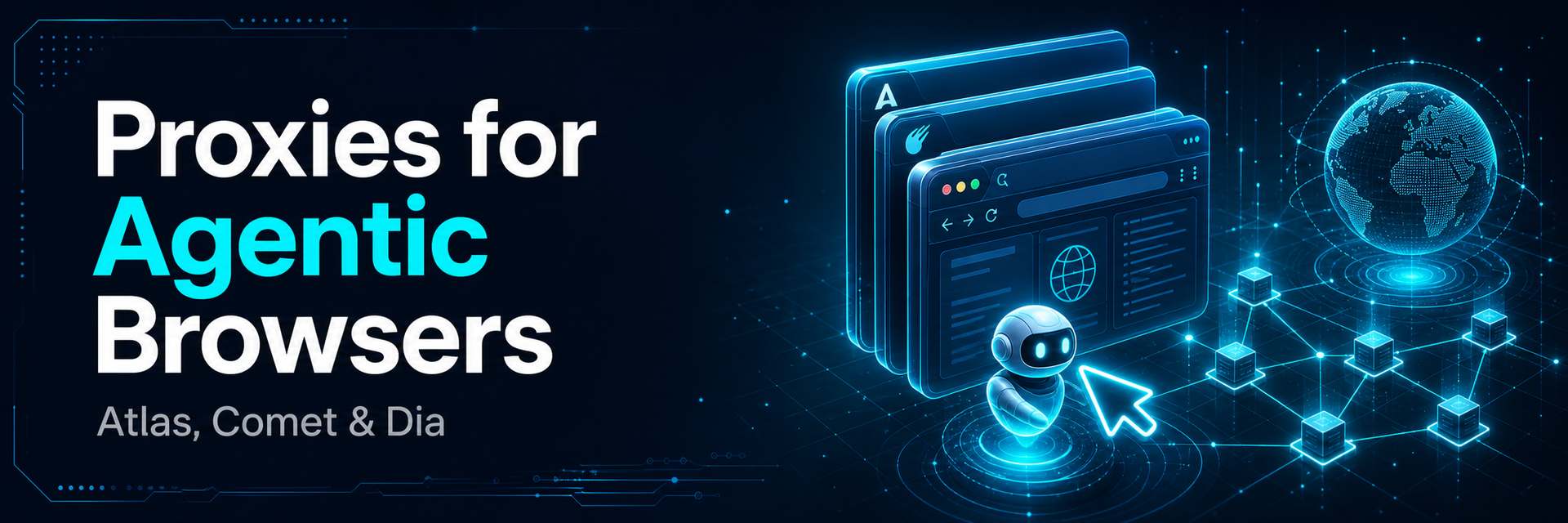
Agentic browsers — ChatGPT Atlas, Perplexity Comet and Dia — don’t just show you the web, they act on it: they browse, click, compare and complete tasks on your behalf. The moment they do that at any volume, they hit the same wall every automation hits: sites flag the IP, results change by location, and you can’t run many sessions from one address. Routing an agentic browser through residential proxies fixes all three — you get unblocked sessions, location-true results, and room to scale.
I’m Andrii Byzov, an AI-Native Fractional CMO who runs AI-agent and data-collection workflows daily. Below: what agentic browsers actually are, why they need proxies, how to add proxies to Atlas, Comet and Dia, and when to graduate from a consumer browser to a real automation stack. For the agent infrastructure side, see our best proxies for AI agents guide and proxies for AI workloads.
Key Facts
- Agentic browsers act, not just display. They run multi-step tasks (research, compare, fill carts, fill forms) using a built-in AI agent.
- The three leaders in 2026: ChatGPT Atlas (OpenAI), Perplexity Comet, and Dia (The Browser Company / Atlassian).
- They generate automated traffic — so sites rate-limit and block the agent’s IP exactly like any bot. Clean residential IPs keep sessions alive.
- Answers and actions are location-personalized — to test or operate in a specific market you need an IP in that country.
- Consumer browsers expose limited proxy controls — use the OS/system proxy or an extension for a single browser; for many parallel agents, drive an automation framework (Playwright, Puppeteer, Browserbase) through proxies instead.
What is an agentic browser?
An agentic browser is a web browser with an AI agent built into the core of the experience. Instead of you opening ten tabs and doing the clicking, you give it a goal — “find a weeknight meal plan and add the ingredients to a grocery cart,” “compare these five vendors and summarize pricing,” “book the cheapest flight under these constraints” — and the agent navigates, reads, clicks and acts across sites to complete it. It’s the difference between a search box and a co-worker who uses the web for you.
That shift matters for anyone who collects or monitors web data, because an agentic browser is, under the hood, automation with a friendly face — and the open web treats automation the way it always has.
The three agentic browsers in 2026
| Browser | Maker | Availability (mid-2026) | Notes |
|---|---|---|---|
| ChatGPT Atlas | OpenAI | macOS; agent mode on Plus/Pro/Business | Chromium-based, ChatGPT woven into every tab; executes multi-step tasks end to end. |
| Perplexity Comet | Perplexity | Free on Mac, Windows, iOS, Android | Sidebar assistant, cross-tab reasoning, agent mode; research engine built in. |
| Dia | The Browser Company (Atlassian) | Mac only; Pro ~$20/mo | Built for knowledge workers living in SaaS tools. |
All three are Chromium-based or Chromium-adjacent, which matters for proxies: anything that respects the system proxy or supports extensions can be routed.
Why agentic browsers need proxies
The friendly interface hides ordinary automation, and the web responds accordingly. Four reasons to put a proxy in front of an agentic browser:
- Avoiding blocks. An agent that opens many pages quickly looks like a bot. Sites throttle, CAPTCHA, or block the IP — and a blocked agent simply fails its task. Rotating residential IPs spread the requests across real consumer addresses so no single IP burns out.
- Location-true results. Agentic browsers personalize by location — prices, availability, brands and answers all shift by country (we covered exactly this for AI answers in AI search rank tracking). To make an agent see what a user in Germany or Brazil sees, give it an IP there.
- Running many agents at once. One IP can run one believable session. A team running dozens of agent tasks in parallel needs a pool of clean IPs, or every session shares one fingerprint and gets flagged together.
- Separation and privacy. Keeping agent automation off your main residential or office IP protects your primary address from rate-limits and keeps work sandboxed.
How to use proxies with Atlas, Comet and Dia
Consumer browsers don’t all ship a proxy settings panel, so you have three practical routes:
- System / OS proxy (works for all three). Set a proxy at the operating-system level (macOS: System Settings → Network → Proxies; Windows: Settings → Network & Internet → Proxy) and the browser inherits it. Use your DataImpulse host, port and credentials with a country selector — the cleanest way to route a single agentic browser through a specific country.
- Browser extension (Chromium-based browsers). Atlas, Comet and other Chromium browsers can take a proxy-manager extension, letting you switch country or session per profile without touching system settings.
- Automation framework (for scale). When you need many parallel agents rather than one browser, don’t fight the consumer app — run the underlying engine. Playwright, Puppeteer and managed services like Browserbase accept a proxy per context, so you can spin up dozens of isolated agent sessions, each on its own rotating residential IP. See our setup guides for Puppeteer and the broader how to run AI browser agents walkthrough.
With DataImpulse you point any of these at one pay-as-you-go account: a rotating endpoint for fresh IP per session, or a sticky session when a task needs to hold the same IP across several steps (a multi-page checkout or a logged-in flow). Country, city, ZIP and ASN targeting let you pin the agent to the exact market you’re testing.
When to graduate from a consumer agentic browser
A single Atlas or Comet window behind a system proxy is perfect for personal research, manual competitive checks, or testing how a site behaves from another country. The moment the work becomes repeatable and parallel — monitoring 50 markets nightly, collecting structured data, running agents on a schedule — move to an automation framework with proxies. You keep the agentic behavior, gain real concurrency and isolation, and pay only for the bandwidth you use instead of per-seat browser licenses.
Who this is for
- Researchers & analysts using an agent to gather and compare web data across regions.
- Growth & SEO teams checking how agentic browsers and AI answers represent their brand in each market.
- QA & localization verifying that sites and prices render correctly for agents in target countries.
- Developers building agent workflows that need clean, geo-targeted, concurrent IPs.
FAQ
What is an agentic browser?
An agentic browser is a web browser with a built-in AI agent that can browse, click and complete multi-step tasks for you — not just display pages. The leading examples in 2026 are ChatGPT Atlas, Perplexity Comet and Dia.
Why would an agentic browser need a proxy?
Because it generates automated traffic. Sites rate-limit and block the agent’s IP like any bot, results are personalized by location, and you can’t run many sessions from one address. Residential proxies keep sessions unblocked, make results location-true, and let you scale.
How do I add a proxy to ChatGPT Atlas or Perplexity Comet?
Set a proxy at the operating-system level (macOS Network settings or Windows Proxy settings) and the browser inherits it, or use a proxy-manager extension on these Chromium-based browsers. Enter your DataImpulse host, port, credentials and target country.
What if I need many agents at once?
Don’t drive the consumer browser — run the underlying engine (Playwright, Puppeteer, or a service like Browserbase) and assign a rotating residential proxy per context, so each agent session is isolated on its own clean IP.
Rotating or sticky proxies for agents?
Use rotating residential for independent tasks so each gets a fresh IP. Use a sticky session when one task must hold the same IP across several steps, such as a multi-page checkout or a logged-in flow.
Power your agents with clean, global IPs
Whether you’re running one agentic browser from another country or a fleet of automated agents across 190+ markets, the bottleneck is clean, geo-targeted IPs. Get ethically sourced residential proxies from $1/GB — pay-as-you-go, rotating or sticky, with country, city and ASN targeting and traffic that never expires.
 State/City/Zip/ASN Targeting