
In this Article
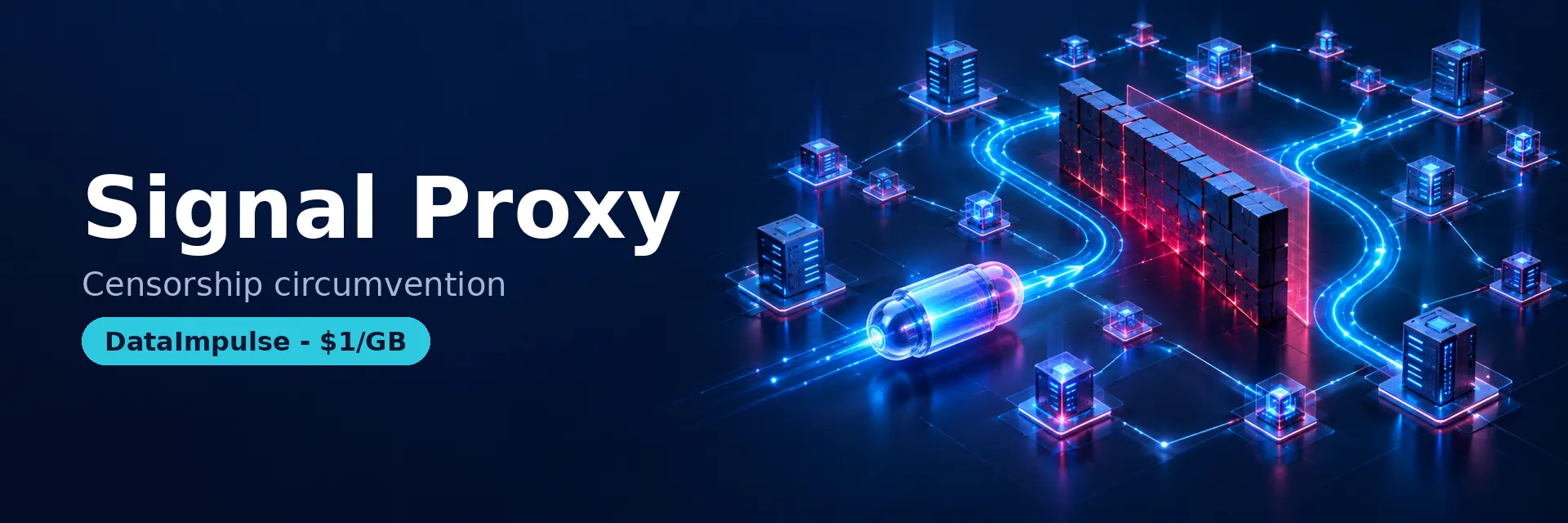
Signal includes censorship circumvention because the app is used in places where it is blocked. The feature is narrow and well-designed, and it is frequently confused with general-purpose proxying, which leads people to buy the wrong product or to trust the wrong relay.
This guide covers how the circumvention works, what a relay operator can see, how running one helps, and why commercial proxy services are not the answer here.
Key Facts
- Signal’s proxy support exists for censorship, not for privacy or for appearing in another country.
- Message content and metadata stay protected. Signal is built so that even its own servers hold minimal information; a relay holds less.
- Anyone with a server can run a relay, which is the design point: many small relays are harder to block than a few large ones.
- A commercial residential proxy does not fit, because the app needs an inbound-reachable relay rather than an outbound web exit.
- Automatic circumvention often works without any manual setup, and is worth trying before configuring anything.
How does Signal handle blocking?
In two stages. The app first attempts automatic circumvention, routing its traffic in ways that are harder for a network to identify and block. When that fails, a user can point the app at a specific relay address shared with them.
Because the automatic path handles many situations, the practical advice for someone in a restricted network is to enable the built-in option first and only look for a relay address if that does not work. People frequently skip that step and go searching for a proxy address, which exposes them to untrusted sources unnecessarily.
What can a relay operator see?
Very little, by design. We call it the 3-part visibility model.
| Layer | Visible to a relay | Why |
|---|---|---|
| 1. Message content | No | End-to-end encrypted between participants |
| 2. Who you talk to | No | Signal’s protocol is designed so this is not exposed even to its servers |
| 3. That you connected | Yes: your address, timing and volume | Inherent to relaying any traffic |
Row three is the residual risk, and it is the same one that applies to any relay: the operator knows an address used the service at a time. In a censorship context that alone can matter, so the source of a relay address is worth caring about even though content is safe.
Should you run a relay?
| Situation | Use this when | Avoid when |
|---|---|---|
| You have a spare server abroad | Run a relay and share it with people you know | You cannot keep it running reliably |
| You need access yourself | Built-in circumvention first | Hunting for addresses before trying it |
| You were given an address | Use it if the source is trusted | It came from an anonymous or forwarded source |
| You want general privacy | A reputable VPN for the whole device | Expecting this feature to provide it |
Sharing a relay narrowly, with people you actually know, is more useful than publishing it widely. Publicly posted addresses get discovered and blocked quickly, and the churn is precisely what the many-small-relays design is meant to survive.
Why commercial proxies do not fit here
The mismatch is structural rather than a matter of quality.
A relay for a messaging app must be reachable from the outside on a known address and speak the app’s expected protocol. A commercial residential proxy is an outbound exit for HTTP and SOCKS requests, designed for a client to route web traffic through it. Buying residential bandwidth will not produce something the app can use, and no configuration bridges the gap.
Where our category applies is business data work on the web: collecting public information across regions, verifying how pages and ads render per country, and monitoring prices per market. DataImpulse residential covers that at $1 per GB across 195 countries. For personal privacy, a reputable VPN is the right tool; for censorship circumvention in a messaging app, the app’s own feature plus a trusted relay is.
Related: what is a web proxy, WhatsApp proxy.
Frequently Asked Questions
What is a Signal proxy for?
Reaching Signal on a network that blocks it. The app first attempts automatic circumvention, and when that fails a user can point it at a relay address. It is a censorship tool rather than a privacy or location tool.
Can a Signal relay operator read my messages?
No. Content is end-to-end encrypted, and Signal’s protocol is designed so that even its own servers hold minimal information about who talks to whom. A relay can see that an address connected, at what time and how much data passed.
Can I use a commercial proxy service with Signal?
No. A relay must be reachable from outside on a known address and speak the app’s protocol, while commercial residential proxies are outbound exits for web requests. The two are structurally different products.
Should I run a Signal relay?
If you have a server that stays up, yes, and share it with people you know rather than posting it publicly. Widely published addresses are found and blocked quickly, which is why the design favours many small relays over a few large ones.
Do I need a relay address at all?
Often not. Signal’s automatic censorship circumvention handles many restricted networks without any manual configuration, so try that first rather than searching for addresses from sources you cannot verify.
For business collection across regions
If your need is verifying pages, ads or prices across markets rather than reaching a blocked messenger, that is the job our network is built for. DataImpulse residential proxies cover 195 countries at $1 per GB. Create an account.
Related: WhatsApp proxy · what is a web proxy · what is geo-blocking.
Last updated: September 17, 2026.
 State/City/Zip/ASN Targeting