
In this Article
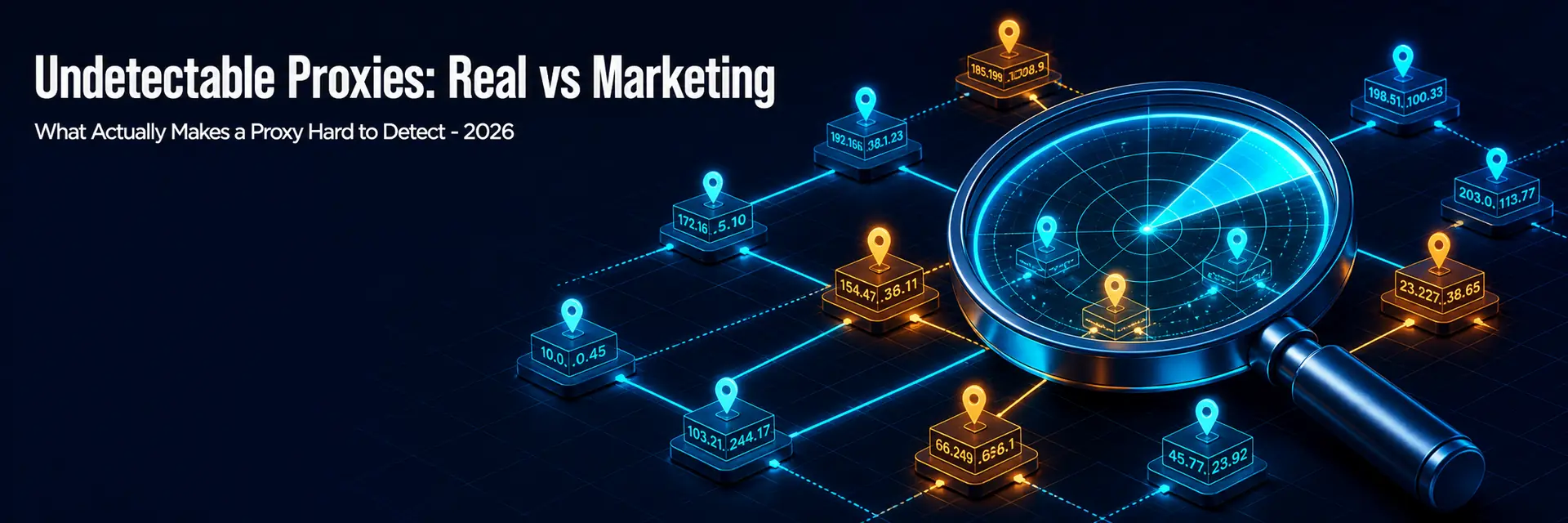
“Undetectable proxies” is one of the most over-used phrases in the proxy industry — and one of the most misleading. Plenty of providers market their IPs as “100% undetectable,” but no proxy is truly undetectable: every connection leaves signals, and modern anti-bot systems look at far more than the IP. What actually exists is a spectrum of detectability — some setups are much harder to flag than others — and understanding what really drives that is the difference between a working scraping or multi-accounting operation and a stack of banned accounts. This guide separates what’s real from what’s marketing around undetectable proxies in 2026: what makes a proxy hard to detect, why the IP is only half the picture, and how to build a genuinely low-detection setup with DataImpulse.
The honest version: you don’t buy “undetectability” as a product — you reduce detection risk by combining the right IP type, clean sourcing, sensible behavior, and (for accounts) fingerprint isolation. Anyone selling a magic “undetectable” bullet is selling the marketing, not the reality.
Key Facts
- No proxy is truly “undetectable.” Every request carries signals (IP reputation, headers, TLS fingerprint, timing, behavior). “Undetectable” is a marketing word; “low-detection” is the real, honest goal.
- The IP is only half the story. Anti-bot systems combine IP reputation with browser fingerprinting (canvas, WebGL, fonts), TLS/HTTP signatures, request rate and timing, and behavioral signals. A perfect IP behind a robotic pattern still gets flagged.
- IP type drives detectability the most. Mobile (4G/5G via carrier CGNAT) is the hardest to flag, then residential, then ISP/static; datacenter IPs are the easiest to detect and block.
- Sourcing matters. Ethically sourced, consent-based residential IPs from real engaged users are cleaner and less abused — so they’re less likely to be on blocklists than cheap, recycled, or malware-sourced pools.
- Behavior is the silent detector. Hammering a target, identical timing, or one IP across many accounts is what trips most modern defenses — not the IP alone.
- DataImpulse gives you the low-detection foundation — ethically sourced residential ($1/GB) and mobile ($2/GB) IPs on a 90M+ clean pool across 195 countries, with sticky sessions and city/ASN targeting — the realistic basis for a hard-to-flag setup, no magic “undetectable” claims.
What “Undetectable” Really Means (and Doesn’t)
When a provider says “undetectable proxies,” what they can honestly deliver is an IP that’s hard to flag on its own — a real residential or mobile address with good reputation. What they cannot deliver is immunity from detection, because detection in 2026 is multi-signal:
- IP reputation — is this address a known proxy/datacenter range, on a blocklist, or a clean consumer IP?
- Browser fingerprint — canvas, WebGL, fonts, screen, timezone, WebRTC; a mismatched or duplicated fingerprint flags you regardless of IP.
- TLS/HTTP signatures — the “shape” of your client’s handshake and headers; default scraper libraries have tell-tale signatures.
- Rate & timing — request frequency and regularity; machine-perfect timing is a giveaway.
- Behavioral signals — mouse/scroll patterns on interactive sites, navigation flow, and (for accounts) consistency over time.
A genuinely low-detection setup gets all of these right. The IP is necessary but not sufficient — which is exactly why “just buy undetectable proxies” doesn’t work.
IP Type: the Biggest Lever on Detectability
| IP type | Detectability | Why | Best for |
|---|---|---|---|
| Mobile (4G/5G) | Lowest | Thousands of real users share carrier IPs (CGNAT); blocking one risks blocking many real customers | Hardest targets, high-value accounts |
| Residential (rotating/sticky) | Low | Real consumer IPs that look like ordinary visitors | Most scraping & accounts |
| ISP / static residential | Low–medium | Residential-looking but static; stable per account, slightly easier to fingerprint over time | Stable per-account identity |
| Datacenter | Highest | Known server ranges, shared subnets blocked in bulk | Soft, unprotected targets only |
If a provider markets datacenter IPs as “undetectable,” that’s the clearest sign you’re reading marketing, not engineering. The real low-detection tiers are mobile and ethically sourced residential.
How to Actually Build a Low-Detection Setup
- 1. Pick the right IP type. Mobile or ethically sourced residential for hard targets; datacenter only for soft, unprotected ones.
- 2. Use a clean, ethically sourced pool. Consent-based residential IPs from engaged users are less likely to be blocklisted than cheap recycled or malware-sourced pools. See where residential proxy IPs come from.
- 3. Match geo and keep it consistent. Use an IP in the right country (and city), and don’t switch a live account’s geo.
- 4. Fix the fingerprint (for accounts). Pair proxies with an antidetect browser so each profile has an isolated, consistent fingerprint — the proxy handles the IP, the browser handles the fingerprint.
- 5. Behave like a human. Throttle, randomize timing, use sticky sessions for multi-step flows, and never run many accounts through one IP.
- 6. Handle the client signature. Use realistic headers and, where needed, a real browser engine rather than a default scraper library with a tell-tale TLS fingerprint.
Get these right and your setup is genuinely hard to detect — which is what “undetectable” was always supposed to mean.
The Honest Foundation: DataImpulse
DataImpulse doesn’t sell “undetectable proxies” — it sells the realistic foundation for a low-detection setup: ethically sourced, consent-based residential IPs at $1/GB and mobile IPs at $2/GB, on a 90M+ clean pool across 195 countries, with sticky sessions for stable multi-step flows and country/city/ASN targeting to match the right geo. Clean sourcing means the IPs are less likely to be blocklisted; mobile and residential tiers are the hardest to flag; sticky sessions and geo targeting support human-like behavior. Pair it with an antidetect browser for account work and you have every real lever a “low-detection” operation actually needs — without paying for marketing claims. The $5 / 5GB intro never expires. See the residential and mobile pages.
FAQ
Are there really undetectable proxies?
No proxy is truly undetectable — “undetectable” is a marketing term. Every connection leaves signals, and modern anti-bot systems look at far more than the IP (browser fingerprint, TLS signature, request timing, behavior). What’s real is a spectrum of detectability: mobile and ethically sourced residential IPs are much harder to flag than datacenter ones, and a setup that also fixes the fingerprint and behaves like a human is genuinely low-detection. But immunity from detection doesn’t exist.
What makes a proxy hard to detect?
Mainly the IP type and its sourcing: mobile (4G/5G, shared via carrier CGNAT) is hardest to flag, then ethically sourced residential, then ISP/static; datacenter is easiest to block. But the IP is only half — the browser fingerprint, TLS/HTTP signature, request rate/timing, and behavior all factor in. A clean IP behind robotic behavior or a duplicated fingerprint still gets detected.
Are residential proxies undetectable?
Residential proxies are hard to detect on the IP level because they’re real consumer addresses that look like ordinary visitors — but not “undetectable.” Anti-bot systems can still flag you on fingerprint, timing, or behavior even with a perfect residential IP. Residential (and mobile) IPs are the right low-detection foundation; pairing them with sensible behavior and, for accounts, fingerprint isolation is what actually keeps you under the radar.
What’s the most undetectable type of proxy?
Mobile (4G/5G) proxies are the hardest to detect, because thousands of real users share carrier IPs through CGNAT — blocking one risks blocking many genuine customers, so platforms rarely do. Ethically sourced residential is next. Datacenter is the easiest to detect and block. For the hardest targets and highest-value accounts, mobile IPs (DataImpulse $2/GB) are the lowest-detection class.
Why do my “undetectable” proxies still get blocked?
Almost always because the IP was only part of the problem. Common causes: a duplicated or mismatched browser fingerprint, a default scraper library with a tell-tale TLS signature, robotic request timing, hammering the target too fast, running many accounts through one IP, or a recycled/blocklisted pool. Fix the fingerprint, slow down, use sticky sessions and one-IP-per-account, and start from a clean, ethically sourced pool.
How do I make my scraping or accounts low-detection?
Combine the real levers: pick mobile or ethically sourced residential IPs; use a clean pool; match and keep geo consistent; for accounts, pair each profile with an antidetect browser for an isolated fingerprint; throttle and randomize behavior; and handle the client signature with realistic headers or a real browser engine. DataImpulse provides the IP foundation ($1/GB residential, $2/GB mobile, clean sourcing, sticky sessions); the rest is setup discipline — there’s no “undetectable” product that does it all for you.
 State/City/Zip/ASN Targeting