In this Article
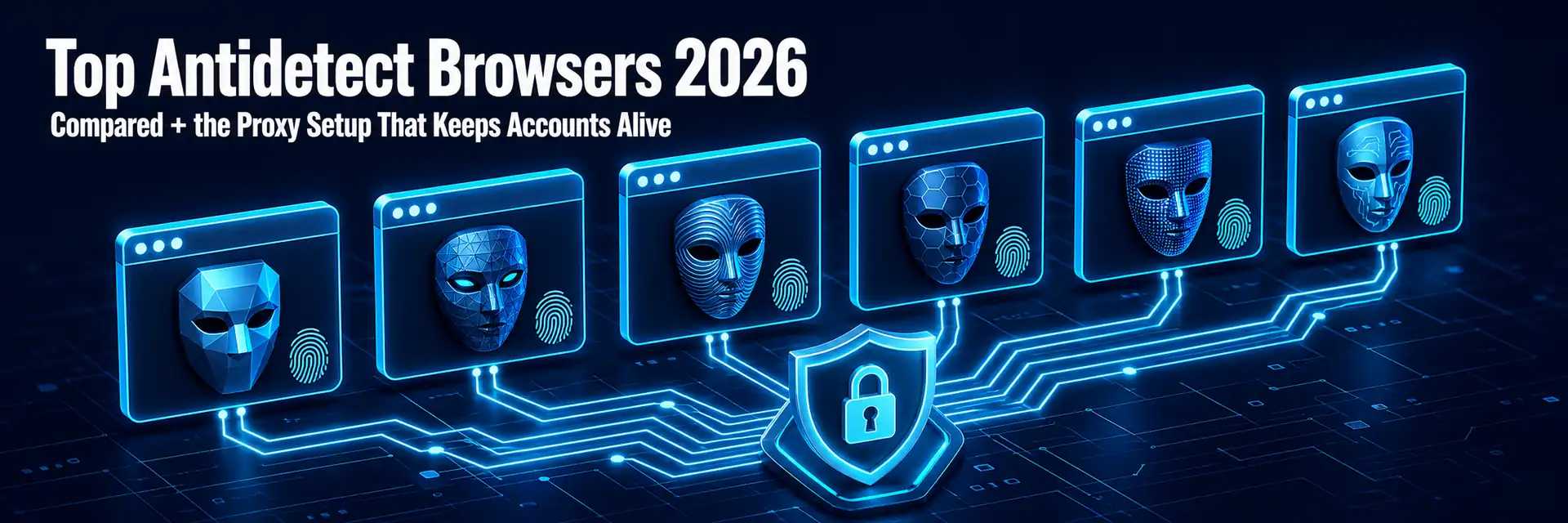
An antidetect browser lets you run many isolated browser profiles from one machine — each with its own fingerprint (canvas, WebGL, fonts, timezone, WebRTC), its own cookies, and its own proxy. In 2026 they’re standard equipment for marketplace sellers managing several storefronts, agencies running client ad accounts, affiliate teams, and QA engineers testing geo-specific flows. This guide ranks the top antidetect browsers in 2026, what each is best at, and the one rule that decides whether any of them actually works: the proxy behind each profile.
Because here’s the thing every experienced operator learns fast — the browser handles the fingerprint half of the disguise, but platforms also link accounts by IP. Run two profiles through one IP and they get connected no matter how perfect the fingerprints are. Every browser below pairs with per-profile sticky proxies; we cover the setup at the end.
Key Facts
- An antidetect browser isolates profiles and spoofs fingerprints — each profile looks like a separate real device to websites. The leading tools are built on patched Chromium kernels with fingerprints derived from real devices.
- The browser is half the disguise; the IP is the other half. One profile = one dedicated sticky IP (mobile or residential). Sharing an IP across profiles links the accounts — the most common ban cause in multi-accounting.
- All major antidetect browsers support HTTP/HTTPS and SOCKS5 proxies per profile, with bulk import for large farms; most auto-match timezone, geolocation, and language to the proxy IP.
- Free tiers exist — several tools offer limited free plans (a handful of profiles), enough to test a workflow before committing.
- Automation is now table stakes: the serious tools expose APIs for Selenium, Puppeteer, and Playwright, so profile farms can be driven programmatically.
- Budget reality: at scale, the proxy bill — not the browser subscription — is usually the bigger line item. Pay-as-you-go residential at $1/GB (or mobile at $2/GB) keeps that line item flat, since account profiles use little bandwidth.
Top Antidetect Browsers in 2026, at a Glance
| Browser | Best for | Free tier | Automation | Stand-out trait |
|---|---|---|---|---|
| Multilogin | Enterprise teams, hardest targets | Trial | Selenium/Puppeteer/Playwright | The long-standing reference tool; deep fingerprint control (Mimic engine; legacy Stealthfox) |
| Octo Browser | Fast-growing teams, clean UX | — | API + Selenium/Puppeteer/Playwright | Real-device fingerprints, strong Proxy Manager |
| GoLogin | Solo operators & small teams | 7-day trial + free 3-profile plan | API + Orbita browser | Auto-matches timezone/geo/WebRTC to proxy IP |
| AdsPower | Ad & e-commerce account farms | Limited free plan | RPA + local API | Built-in RPA automation, bulk operations |
| Dolphin{anty} | Affiliate/media-buying teams | Limited free plan | API | Team workflows tuned for ad accounts |
| Incogniton | Budget multi-accounting | Free: 10 profiles first 2 mo, then 3 | Selenium/Puppeteer API | Budget-friendly entry |
| Undetectable.io | Mixed scraping + accounts | Free plan | API | Configurable fingerprint store |
| Kameleo | Mobile-fingerprint emulation | Free plan (2 browsers, capped minutes) | Selenium/Puppeteer/Playwright | Real mobile profiles (Android/iOS emulation) |
| iXBrowser | Getting started at zero cost | Generous free plan | API | Free-first model |
Plans and free tiers change frequently — check each vendor’s pricing page; entry paid tiers commonly start around $10-30/month as of June 2026, though automation-capable plans run higher (Octo Base €79, Multilogin €99+).
The Picks in Detail
1. Multilogin — the enterprise reference
The tool that defined the category. Deep fingerprint customization, its Chromium-based Mimic engine (plus the legacy Firefox-based Stealthfox, now being phased out), mature team features, and battle-tested automation. It’s the safest pick for the most heavily defended platforms — and priced accordingly at the top of the market. Pair it with sticky residential or mobile IPs per profile; our Multilogin proxy guide covers the exact setup.
2. Octo Browser — the fast riser
Built on the latest Chromium with fingerprints from real devices, a clean UI, and the category’s best Proxy Manager (save, tag, bulk-import, mass-rotate). API access for Selenium/Puppeteer/Playwright from the Base plan up. Strong choice for teams that want modern UX without enterprise pricing — setup details in our Octo Browser proxy guide.
3. GoLogin — the solo-operator favorite
Runs its own Chromium-based Orbita browser and auto-aligns each profile’s timezone, geolocation, language, and WebRTC to the proxy IP — the feature that prevents the most common fingerprint-vs-IP contradictions. Affordable entry tiers, web version available. See our GoLogin proxy guide.
4. AdsPower — the automation workhorse
Loved by ad-account and e-commerce farms for its built-in RPA: record-and-replay flows across hundreds of profiles without code, plus a local API for engineers. Bulk profile creation and proxy assignment are first-class. Our AdsPower proxy guide has the per-profile sticky setup.
5. Dolphin{anty} — the media-buying specialist
Purpose-built around affiliate and ad-account workflows: statuses, notes, tagging, and team handoff baked into the profile grid. A limited free tier makes it easy to trial. Setup in our Dolphin{anty} proxy guide.
6. Incogniton — the budget pick
A friendly free tier (10 profiles for the first two months, then 3), Selenium/Puppeteer automation on paid plans (from roughly $21/month), and a straightforward UI. A sensible first paid step when a free tier is outgrown.
7. Undetectable.io — the configurable one
A large configurable fingerprint store and flexible profile generation, with a free plan to start. Popular with operators who run mixed workloads — some scraping, some account management — from one tool.
8. Kameleo — the mobile specialist
Where most tools emulate desktops, Kameleo’s edge is mobile: realistic Android/iOS profiles with matching fingerprints, plus standard automation hooks. The pick when your accounts must look like phones.
9. iXBrowser — the free-first option
A genuinely usable free plan that made it a default “first antidetect” for many. Fewer advanced controls than the paid leaders, but enough to learn the workflow and test small farms before upgrading elsewhere.
How to Choose
- Hardest targets, enterprise compliance: Multilogin.
- Modern UX + scale without enterprise pricing: Octo Browser.
- Solo or small team, minimal fuss: GoLogin or Incogniton.
- Ad/e-commerce farms with no-code automation: AdsPower; affiliate teams: Dolphin{anty}.
- Mobile-looking accounts: Kameleo.
- Zero budget to start: iXBrowser or Incogniton’s free tier.
The Proxy Layer: What Actually Keeps Accounts Alive
Whichever browser you pick, the operational rules are identical:
- One profile = one dedicated sticky IP. Never share an IP between profiles.
- Mobile and sticky residential beat datacenter. Carrier IPs (shared by thousands of real users via CGNAT) are the most trusted class; datacenter ranges get flagged fast on social and marketplace platforms.
- Match geo to the account — country and ideally city, consistent with the profile’s timezone and language.
- Keep it stable. Set the proxy once and don’t change a live account’s country.
With DataImpulse, each profile gets its own sticky IP via a username parameter — YOUR_LOGIN__cr.us;city.newyork;sessid.profile01 pins a US/New York IP per profile (~30-minute sticky window by default, configurable up to 120; a unique sessid per profile is the golden rule). Residential is $1/GB and mobile $2/GB, pay-as-you-go with traffic that never expires — at account-management bandwidth, dozens of profiles often cost single digits per month. Bulk proxy lists import straight into every browser above.
FAQ
What is an antidetect browser?
A browser that runs many isolated profiles from one machine, each with its own spoofed fingerprint (canvas, WebGL, fonts, timezone, WebRTC), cookies, and proxy — so each profile looks like a separate real user on a separate device. Teams use them for managing multiple marketplace, social, or ad accounts, and for QA testing geo-specific experiences.
What’s the best antidetect browser in 2026?
Depends on the job: Multilogin for enterprise teams and the hardest targets, Octo Browser for modern UX at scale, GoLogin for solo operators, AdsPower for no-code ad-farm automation, Dolphin{anty} for affiliate teams, Kameleo for mobile-looking profiles, and Incogniton or iXBrowser to start free. All of them depend on per-profile sticky proxies to actually work.
Are antidetect browsers legal?
The software is legal — it’s profile isolation and fingerprint management, also used for QA testing and privacy. What’s regulated is what you do with it: managing accounts you’re authorized to run is routine agency work, while violating a platform’s terms can get accounts banned and, in fraud scenarios, create real liability. Same logic as proxies: the activity, not the tool, determines legality.
Do antidetect browsers work without proxies?
Not for multi-accounting. The browser isolates fingerprints, but all profiles still share your real IP — and platforms link accounts by IP first. Every profile needs its own dedicated sticky IP (mobile or residential). That’s why proxy support — per-profile config, bulk import, sticky sessions — is a core feature in every serious antidetect tool.
Which proxies work best with antidetect browsers?
Sticky mobile or residential IPs, one per profile. Mobile (4G/5G) is the most trusted class for high-value accounts; sticky residential covers most profiles at lower cost. Avoid datacenter IPs for social/marketplace accounts and avoid rotating proxies for logged-in sessions — a mid-session IP change looks like a hijack. DataImpulse provides both (residential $1/GB, mobile $2/GB) with per-profile sticky sessions via a username parameter.
Is there a good free antidetect browser?
For testing the workflow, yes: iXBrowser’s free plan is the most generous (unlimited profiles with daily caps), Incogniton gives 10 free profiles for two months (then 3), AdsPower’s free plan covers 2 profiles, and Dolphin{anty}’s free tier was trimmed to 5 profiles in 2026. For production farms you’ll outgrow free plans quickly — but they’re the right way to validate a setup before paying.
 State/City/Zip/ASN Targeting