
In this Article
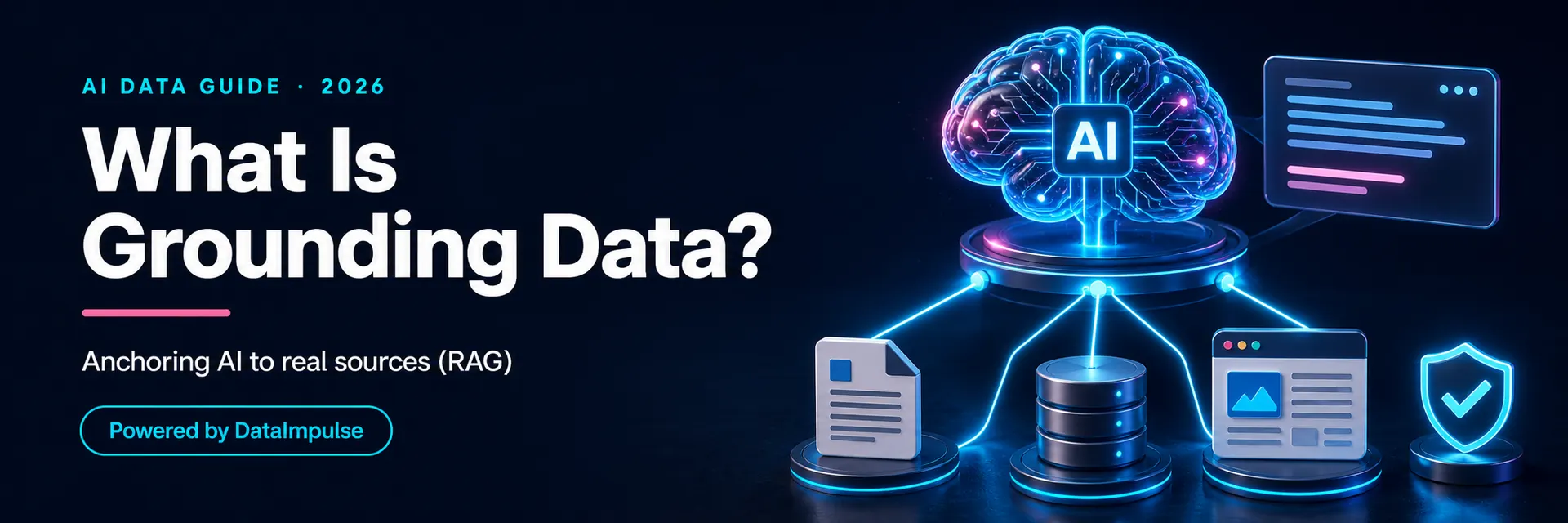
Grounding data is the real-world, verifiable information an AI system uses to anchor its answers to fact — instead of relying only on what a model memorized during training. It’s what lets a system say “according to this source” rather than guessing. In RAG pipelines and AI agents, grounding data is retrieved at answer time and fed to the model so its output reflects current, checkable reality. This guide defines grounding data, why it matters, where it comes from, and where proxies fit in collecting it.
I’m Andrii Byzov, an AI-Native Fractional CMO who builds retrieval and grounding pipelines. Below: a plain definition, grounding vs training data, the sources, the freshness/coverage challenge, and the proxy layer. It’s a core part of web data infrastructure for AI.
Key Facts
- Grounding data anchors AI output to verifiable reality — the source material a model reasons over, not just what it memorized.
- It fights hallucination and staleness. Grounded systems cite current sources instead of guessing from old training.
- Retrieved at answer time — grounding data is fetched and fed to the model per query (the core of RAG), separate from training.
- Much of it is web data — fresh, authoritative, geo-relevant pages, alongside internal documents and licensed sources.
- It must be current and broad. Stale or one-market grounding data anchors the model to the wrong reality — collection leans on proxies.
What Is Grounding Data?
Grounding data is the external, factual information an AI system retrieves and reasons over to keep its answers tied to reality. A language model on its own answers from patterns learned in training — powerful, but frozen at training time and prone to confidently inventing details. Grounding data fixes that by giving the model real source material at answer time: documents, pages, records it can read and cite. The model still does the reasoning; the grounding data supplies the facts. It’s the “R” behind retrieval-augmented generation (RAG) and what keeps an agent’s decisions tied to the real world.
Grounding Data vs. Training Data
- Training data is baked into the model’s weights once, during training — a frozen snapshot the model reasons with.
- Grounding data is retrieved fresh at answer time — current source material the model reasons over for a specific query.
- Why both: training teaches the model language and general knowledge; grounding keeps any specific answer current and checkable.
- Freshness: retraining is slow and rare; grounding can be updated continuously, which is why it carries the “current facts” load.
Where Grounding Data Comes From
Grounding data is pulled from wherever the truth for a given task lives:
- The live web — current, authoritative, public pages (the biggest external source for general grounding).
- Internal knowledge — a company’s own docs, tickets, and databases.
- Licensed and structured sources — APIs, feeds, and datasets obtained by agreement.
For anything that changes or is location-specific — prices, regulations, availability, local information — the web is the practical source, and it has to be both fresh and geo-relevant. That’s where collecting grounding data runs into the realities of web access.
The Challenge: Fresh, Broad, Reliable Collection
Grounding data is only as good as its currency and coverage. Stale grounding anchors the model to a world that has moved on; a corpus pulled from one market inherits that market’s bias; gaps leave the model to fall back on guesses. So collecting grounding data means gathering current pages, across markets, reliably — and at that point it’s a web-collection problem, because sites rate-limit, geo-personalize, and block automated traffic.
import requests
# Collect fresh grounding data the model can cite: pull current source pages
# through a residential proxy so the retrieval reflects the real, local web.
def gather_grounding(urls, country="us"):
proxy = f"http://LOGIN__cr.{country}:[email protected]:823"
docs = []
for url in urls:
r = requests.get(url, proxies={"http": proxy, "https": proxy},
headers={"User-Agent": "Mozilla/5.0"}, timeout=30)
r.raise_for_status()
docs.append(r.text) # -> chunk + embed into your vector store
return docs
Where Proxies Fit
Collecting fresh, geo-diverse grounding data at scale means fetching many source pages, from the right markets, repeatedly — and target sites push back with rate limits and IP blocks. Residential proxies route the collection through real consumer IPs in the markets you need, so it can reach those markets with less IP-based blocking — DataImpulse residential from $1/GB (mobile from $2/GB) across 195+ locations. Proxies handle access and location; freshness and accuracy still depend on your source selection, crawl cadence, parsing, and validation. Proxies for access; your pipeline for retrieval, chunking, and embedding. The same idea applies to keeping synthetic data grounded against real web data.
Is Collecting Grounding Data Legal?
Collecting public, non-personal web data for grounding follows the same rules as any web collection — and grounding to authoritative sources is, in spirit, the responsible direction (citing real sources rather than inventing). The usual conditions apply: favor public, non-personal data, respect site terms and treat robots.txt as a policy signal, don’t bypass logins or access controls, pace requests, and track provenance so cited sources are clean. Public availability doesn’t settle copyright, contract, or privacy questions, and legality depends on jurisdiction, source, and use. Proxies aren’t illegal in themselves, but their use can create contract, computer-misuse, privacy, copyright, or terms-of-service risk depending on the facts. See whether web scraping is legal. This is general information, not legal advice.
Frequently Asked Questions
What is grounding data?
Grounding data is the external, factual information an AI system retrieves and reasons over to keep its answers tied to reality — documents, pages, and records it can read and cite at answer time. It’s what lets a system answer “according to this source” instead of guessing from frozen training knowledge.
How is grounding data different from training data?
Training data is baked into the model’s weights during training — a frozen snapshot it reasons with. Grounding data is retrieved fresh at answer time — current source material it reasons over for a specific query. Training teaches general knowledge; grounding keeps a specific answer current and checkable, which is why grounding carries the “current facts” load.
Why does grounding data matter?
It fights hallucination and staleness. A model answering only from training can confidently invent details or rely on outdated knowledge. Grounding gives it real, current sources to cite, so outputs stay tied to verifiable reality — essential for RAG systems and agents that take actions.
Where does grounding data come from?
From wherever the truth for the task lives: the live web (the biggest external source for general grounding), internal company knowledge (docs, tickets, databases), and licensed or structured sources (APIs, feeds, datasets). For anything that changes or is location-specific, the live web is the practical source.
Why are proxies used to collect grounding data?
Grounding data must be fresh and geo-relevant, and collecting it at scale means fetching many source pages from many markets — where sites rate-limit, geo-personalize, and block automated traffic. Residential proxies route collection through real consumer IPs in the right markets, so grounding data stays current and geo-accurate with less IP-based blocking.
Conclusion
Grounding data is what keeps AI honest — the real, current source material that anchors answers to fact instead of frozen training memory. It carries the freshness load that retraining can’t, which makes how you collect it (current, broad, reliable) decisive. For web-sourced grounding, that collection often uses a proxy access layer (where lawful and needed) to keep fresh, geo-diverse pages reachable. Build your retrieval and embedding; rent the access. Explore the pieces: proxies for RAG pipelines, real-time web data for AI agents, and web data infrastructure for AI.
Last updated: June 28, 2026.
 State/City/Zip/ASN Targeting