
In this Article
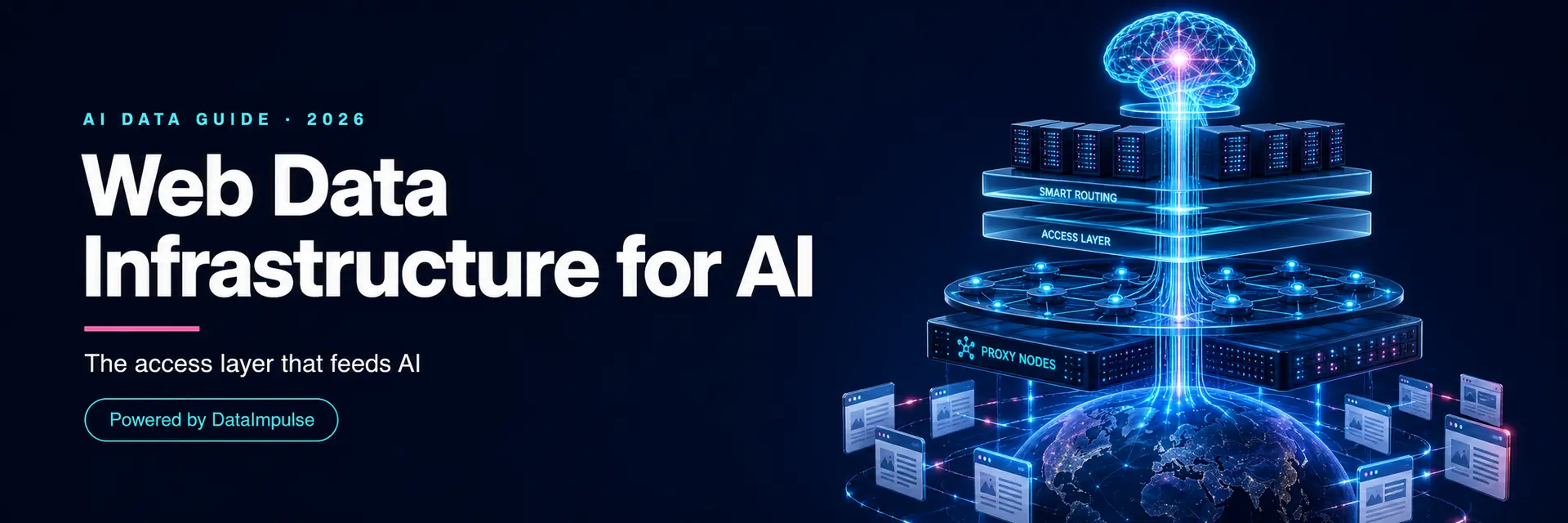
Web data infrastructure for AI is the stack that lets AI systems collect, access, and use live data from the open web — the layer underneath model training, RAG, and autonomous agents. Models don’t learn or answer in a vacuum: they need real-world data, and a lot of it comes from the web. The infrastructure that gathers it — at scale, across markets, without getting blocked — is becoming as foundational to AI as compute and storage. This guide defines the category, breaks down its layers, and explains where proxies fit as the access foundation.
I’m Andrii Byzov, an AI-Native Fractional CMO who builds web-data pipelines for AI teams. Below: a plain definition, why AI depends on web data, the four layers of the stack, where residential proxies sit, and how to think about build-vs-buy. It’s the pillar the rest of our AI-data guides connect to.
Key Facts
- Web data infrastructure for AI = the access + collection layer that feeds web data into training, RAG/grounding, and agents.
- Four layers: access (proxies), collection (scraping/crawling), processing (extraction/cleaning), and delivery (to the model or pipeline).
- Access is often the bottleneck. Sites geo-personalize, rate-limit, and block automated traffic, so getting the data at all can be the hard part — especially for geo-specific or high-volume collection.
- Residential proxies are the access foundation — real consumer IPs in the right market make the web more reachable, geo-accurate, and far less likely to be blocked at scale.
- It’s a buying criterion now. AI teams increasingly evaluate web-data infrastructure (concurrency, geo coverage, cost per GB) the way they evaluate GPUs.
What Is Web Data Infrastructure for AI?
Web data infrastructure for AI is everything between “the open web” and “data your AI can use.” It’s the pipeline that reaches a page, retrieves it reliably, turns it into structured signal, and delivers it to a model, a RAG pipeline, or an AI agent. Compute trains the model and storage holds it, but neither gets the model real-world, current information — the web data layer does. As AI shifts from static training sets to live, grounded, agentic systems, this layer moves from a nice-to-have to core infrastructure.
Why AI Depends on Web Data
- Training — models learn from large, diverse corpora, much of it scraped from the public web (LLM training data).
- Grounding & RAG — to answer with current facts, systems retrieve fresh web data at query time, not just what they memorized.
- Agents — autonomous agents browse, compare, and act on live pages, so they need real-time web access.
- Evaluation & monitoring — teams track prices, competitors, and their own AI-search visibility using web data.
The Four Layers of the Stack
1. Access layer. Reaching the page at all — from the right location, without being rate-limited or blocked. This is where proxies live, and it’s often the hardest part.
2. Collection layer. Crawling and scraping the reachable pages — fetching HTML, following links, handling pagination and dynamic content.
3. Processing layer. Turning messy HTML into structured signal — extraction (increasingly via LLM-based extraction), cleaning, deduplication, and validation.
4. Delivery layer. Feeding the result to its destination — a training set, a vector store for retrieval, or an agent’s context window.
Where Proxies Fit: The Access Foundation
Layers 2-4 only work if layer 1 does, and layer 1 is where many pipelines break. Target sites personalize by geography, rate-limit by IP, and flag datacenter ranges, so an AI system pulling data at any real scale hits walls fast. Residential proxies route requests through real consumer IPs in the market you need, so the web is far more reachable, geo-accurate, and much less likely to be blocked. For a fleet of agents or a large crawl, a rotating pool with per-session identity keeps each request looking like a distinct real user. That’s the foundation everything else sits on.
import requests
# The access layer in practice: an AI system fetches a live web page through a
# residential proxy so the request looks like a real user in the right market.
proxies = {"http": "http://LOGIN__cr.us:[email protected]:823",
"https": "http://LOGIN__cr.us:[email protected]:823"}
def fetch_for_ai(url):
r = requests.get(url, proxies=proxies,
headers={"User-Agent": "Mozilla/5.0", "Accept-Language": "en-US,en;q=0.9"},
timeout=30)
r.raise_for_status()
return r.text # hand the HTML to your extractor / model / RAG pipeline
html = fetch_for_ai("https://example.com/data")
DataImpulse provides that access layer — residential from $1/GB (mobile from $2/GB) across 195+ locations — rotating, geo-targeted, with high concurrency for parallel collection. The model, the pipeline, and the agent are yours; the proxies make the web actually reachable for them.
Build vs. Buy
Most teams build the collection, processing, and delivery layers (they’re specific to your data and models) and buy the access layer (proxies), because maintaining a global pool of clean, unblocked IPs is a full-time infrastructure problem of its own. The practical split: own your scrapers and extraction logic; rent the IPs. Evaluate access providers the way you’d evaluate any infrastructure — geo coverage, concurrency, success rate, and cost per GB.
Is Collecting Web Data for AI Legal?
Collecting public, non-personal web data for AI is broadly practiced, but it’s not unconditional: public availability doesn’t erase copyright, contract, privacy, or database-right questions, and legality depends on jurisdiction, source, data type, and use. Keep collection defensible — favor public, non-personal data, follow site terms and treat robots.txt as a policy signal, don’t bypass logins or access controls, pace requests, and track provenance for anything that feeds a model. Using proxies for legitimate collection is generally lawful; evading bans or access controls is where risk appears. See whether web scraping is legal. This is general information, not legal advice.
Frequently Asked Questions
What is web data infrastructure for AI?
It’s the stack that lets AI systems collect, access, and use live data from the open web — the layer between the web and data your model, RAG pipeline, or agent can use. It spans access (proxies), collection (scraping), processing (extraction), and delivery, and it sits alongside compute and storage as core AI infrastructure.
Why do AI systems need web data?
Models train on large web corpora, RAG systems retrieve fresh web data to answer with current facts, and agents browse live pages to act. Compute and storage don’t give a model real-world, up-to-date information — the web data layer does. As AI moves from static datasets to live and agentic systems, that layer becomes foundational.
Where do proxies fit in web data infrastructure?
Proxies are the access layer — the foundation. Sites geo-personalize, rate-limit, and block automated traffic, so reaching pages at scale is the hard part. Residential proxies route requests through real consumer IPs in the right market, making the web more reachable, geo-accurate, and far less likely to be blocked so the collection, processing, and delivery layers can work.
Should I build or buy web data infrastructure?
Most teams build the collection, processing, and delivery layers (specific to their data and models) and buy the access layer — proxies — because maintaining a global pool of clean, unblocked IPs is its own full-time infrastructure problem. Own your scrapers and extraction; rent the IPs, evaluated on geo coverage, concurrency, success rate, and cost per GB.
Is collecting web data for AI legal?
Collecting public, non-personal web data is broadly practiced but not unconditional — public availability doesn’t erase copyright, contract, or privacy questions, and legality depends on jurisdiction, source, and use. Favor public, non-personal data, respect site terms and robots.txt, don’t bypass logins, pace requests, and track provenance. Using proxies for legitimate collection is generally lawful. Not legal advice.
Conclusion
As AI moves from static training to live, grounded, agentic systems, web data infrastructure becomes as foundational as compute and storage — and its hardest layer is access. Reaching the web at scale, from the right markets, without getting blocked is what makes everything above it possible, and that’s the proxy layer. Build your scrapers, extraction, and pipelines; rent a residential-proxy access layer that keeps the web reachable. Explore the pieces: proxies for AI agents, LLM training data, RAG pipelines, and AI web scraping.
Last updated: June 27, 2026.
 State/City/Zip/ASN Targeting