
In this Article
Financial firms run on data that moves markets — and a growing share of it lives on the public web, not in a Bloomberg terminal. Hedge funds, quant shops, fintechs, and investment researchers scrape product prices, e-commerce trends, job postings, app rankings, shipping data, and web traffic as alternative data to predict earnings and spot signals before they hit the tape. The problem: this data is geo-gated, rate-limited, and heavily anti-bot-protected, so collecting it reliably at scale requires residential proxies. This guide ranks the 8 best proxies for financial and stock-market data in 2026 for alternative-data pipelines, market research, and investment analysis — with DataImpulse at $1/GB as the value pick for data-driven funds.
One framing up front: collecting public, non-personal web data — prices, listings, rankings, traffic estimates — is the defensible category that the alternative-data industry is built on. The signal is in aggregate public behavior, not personal data, which keeps a financial pipeline on the right side of the line.
Key Facts
- Alternative data is a financial edge. Funds derive signals from public web data — e-commerce prices and stock levels, job postings, app-store rankings, web traffic, shipping and logistics data, review trends — to forecast company performance ahead of official reporting.
- The sources are geo-gated and protected. Prices, availability, and rankings render per IP country/city, and the platforms hosting them block datacenter IPs and crawlers — so reliable collection needs residential proxies that look like real local users.
- Reliability and freshness matter more than in casual scraping. A missed or stale data point can mean a wrong signal, so financial pipelines need high success rates, broad geo coverage, and the ability to sample consistently over time.
- Compliance and sourcing are scrutinized. Funds face real diligence on data provenance — using an ethically sourced, consent-based proxy network and collecting only public non-personal data is both the legal and the reputational requirement.
- Scale economics favor pay-per-GB. Alternative-data collection is high-volume and continuous, so per-GB residential pricing (and DIY pipelines over per-request APIs) wins on unit cost at the scale funds operate.
- DataImpulse is the value pick — a 90M+ ethically sourced pool across 195 countries with country/city/ASN targeting and mobile IPs, at $1/GB pay-as-you-go with traffic that never expires — the access layer for cost-efficient alternative-data pipelines.
What Financial Teams Collect (and Why)
- E-commerce prices & inventory — pricing and stock signals from retailers as a proxy for a company’s sales and demand.
- App-store rankings & reviews — download trends and ratings as a leading indicator for consumer-app and platform companies.
- Job postings — hiring velocity by company and function as a growth/contraction signal.
- Web traffic & search trends — interest and engagement as a demand proxy.
- Shipping, logistics & supply data — public trade and movement signals.
- Product launches & assortment — catalog changes as a strategy and revenue tell.
Each is public, aggregate, non-personal data — collected at scale, across markets, sampled consistently over time. That’s exactly the workload residential proxies are built for.
Best Proxies for Financial Data at a Glance
| Provider | Best for finance | Residential price | Geo granularity | Notable |
|---|---|---|---|---|
| DataImpulse | Best value, high-volume pipelines | $1/GB PAYG | Country incl; city/ASN add-on | 90M+ pool, mobile, never-expires |
| Bright Data | Enterprise + ready datasets | ~$4/GB promo; ~$8 standard | Country/city/ASN | Pre-built datasets, Web Unlocker, SLA |
| Oxylabs | Enterprise + compliance | ~$8/GB standard | Country/city | 175M+ pool, Scraper APIs, compliance docs |
| Decodo | Mid-market, full geo grid | ~$4/GB PAYG (~$2 volume) | Country/city/ASN | 115M+ pool, scraping API |
| SOAX | Residential + mobile mix | $3.60/GB Starter | Country/region/city/ASN | Clean opt-in pool, carrier IPs |
| IPRoyal | Long sticky sessions | from ~$7.35/GB | Country/region/city/ISP | Sticky up to 7 days |
| NetNut | ISP-residential stability | from ~$15/GB (to ~$1.59 volume) | Country/city | Static consumer-ISP IPs |
| Webshare | Budget / self-serve | ~$3.50/GB (promo ~$1.40) | Country (city on higher tiers) | Free tier, cheapest entry |
The Picks, Briefly
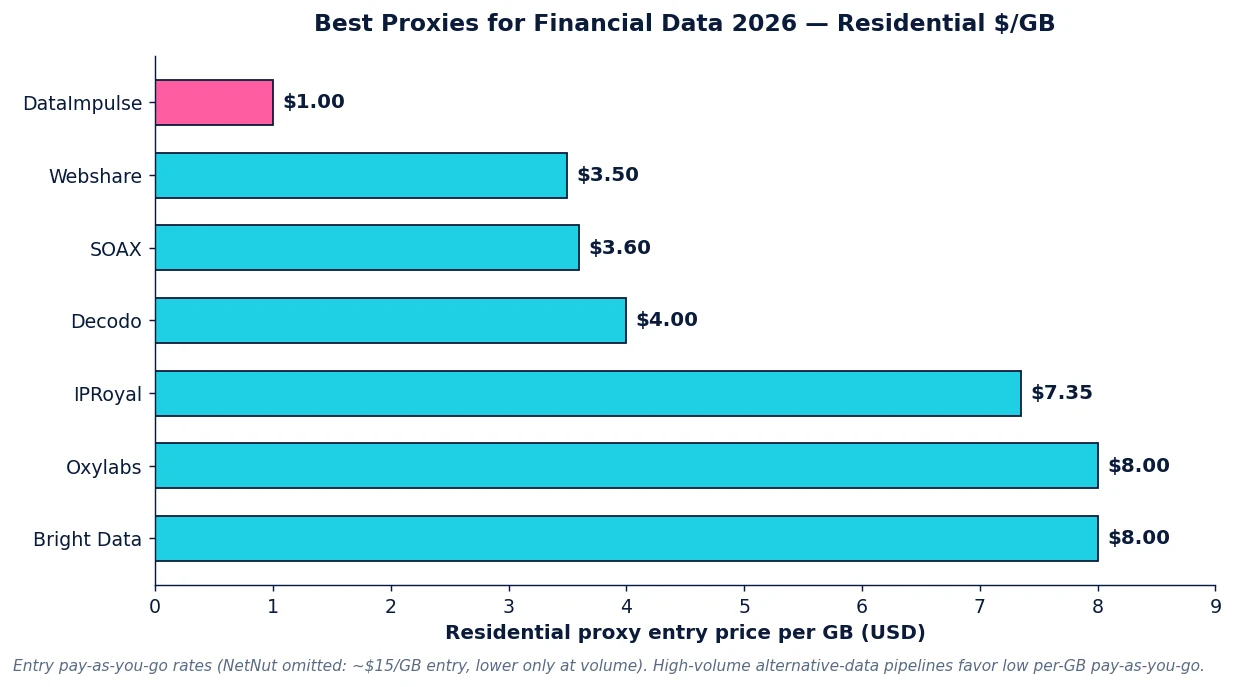
DataImpulse is the value pick for financial-data collection — a 90M+ ethically sourced pool across 195 countries with country targeting included and city/ASN as a paid add-on, plus mobile IPs, at $1/GB pay-as-you-go with traffic that never expires. For the continuous, high-volume pipelines alternative-data work demands, paying per GB at the lowest credible rate (and running your own collectors rather than per-request APIs) wins decisively on unit cost. Bright Data (~$8/GB standard) is the enterprise pick that also sells pre-built datasets if you’d rather buy a feed than build one, and Oxylabs (~$8/GB) brings Scraper APIs and the compliance documentation funds’ diligence teams ask for. Decodo (~$4/GB PAYG) and SOAX ($3.60/GB, plus mobile) are strong mid-market options. IPRoyal (from ~$7.35/GB), NetNut (ISP-static stability), and Webshare (budget) round out the field.
Build vs. Buy: Datasets or Your Own Pipeline?
Funds have two paths to alternative data. Buy a dataset — providers like Bright Data sell pre-collected, cleaned feeds; fastest to integrate, but priced as a product and less customizable. Build your own pipeline — collect exactly the signals you want, on your schedule, using residential proxies under your own scrapers; far cheaper per data point at scale and fully customizable, but you own the engineering. Most quant teams that scrape at scale build, because the per-GB economics of a DIY pipeline on $1/GB residential beat per-product dataset pricing once volume is high and the signal is proprietary. Use a bought dataset to prototype a thesis; build the pipeline once the signal proves out. See our guide on build-vs-buy scraping.
How to Build a Financial-Data Pipeline with DataImpulse
Step 1. Create a DataImpulse account and grab your residential credentials. The $5 / 5GB intro never expires — enough to validate a signal.
Step 2. Point your collectors at the gateway with the target market in the username — YOUR_LOGIN__cr.us:[email protected]:823 — adding ;city.xxx for sub-national granularity and ;sessid.xxxx for multi-step flows.
Step 3. Collect only public, non-personal signals (prices, rankings, postings, traffic), throttle politely, and sample on a consistent schedule so your time series stays clean. Full syntax is in the DataImpulse tutorials; see also market research, the cheapest proxies for high-volume pipelines, and the web scraping legality guide.
FAQ
What are the best proxies for financial and stock-market data?
Residential proxies with broad geo coverage and per-GB pricing fit alternative-data pipelines best. DataImpulse ($1/GB) is the value pick for high-volume collection; Bright Data and Oxylabs are the enterprise picks (Bright Data also sells ready datasets, Oxylabs brings compliance docs). Decodo (~$4/GB) and SOAX ($3.60/GB) are strong mid-market options. The key needs are reliability, freshness, geo coverage, and unit cost at scale.
What is alternative data in finance?
Alternative data is non-traditional information funds use to gain an investing edge — public web signals like e-commerce prices and stock levels, app-store rankings, job postings, web traffic, shipping data, and review trends — analyzed to forecast a company’s performance ahead of official earnings. Much of it is collected by scraping public, non-personal web data at scale, which is what residential proxies enable.
Is collecting financial/alternative data by scraping legal?
Collecting public, non-personal, aggregate web data — prices, rankings, postings, traffic estimates — is the defensible category the alternative-data industry runs on. The risks are scraping behind logins, collecting personal data, or violating specific platform terms. Funds also face data-provenance diligence, so use an ethically sourced provider and keep personal data out of the pipeline. See our guide to web scraping legality.
Why do financial firms need residential proxies?
Because alternative-data sources are geo-gated and anti-bot-protected. Prices, rankings, and availability render by IP country/city, and the platforms block datacenter IPs and crawlers — so a reliable, representative feed needs residential IPs that look like real local users. For financial signals, where a stale or missing data point can mislead a model, the high success rate and geo coverage of a good residential network are essential.
Should a fund buy datasets or build its own pipeline?
Both have a place. Buy a pre-built dataset (e.g. from Bright Data) to prototype a thesis fast. Build your own pipeline on residential proxies once the signal proves out and volume is high — the per-GB economics of a DIY collector on $1/GB residential beat per-product dataset pricing at scale, and you control exactly what you collect. Most quant teams scraping at scale build, using bought datasets only to validate ideas.
How much does financial-data collection cost?
It depends on volume, which is high for alternative data. Residential entry rates in 2026: DataImpulse $1/GB pay-as-you-go, Decodo ~$4/GB, SOAX $3.60/GB, IPRoyal from ~$7.35/GB, Oxylabs/Bright Data ~$8/GB standard, NetNut from ~$15/GB (lower at volume). At the continuous, high-volume scale funds operate, the lowest per-GB rate on a DIY pipeline (DataImpulse $1/GB) is dramatically cheaper than per-request APIs or per-product datasets.
 State/City/Zip/ASN Targeting