
In this Article
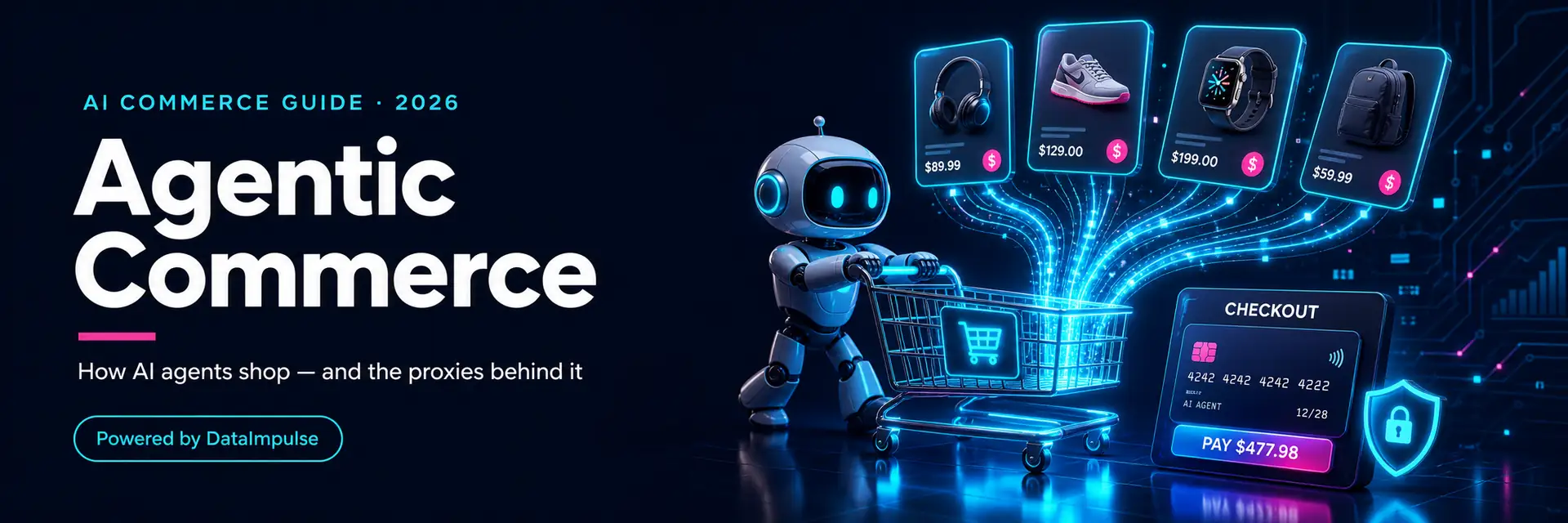
Agentic commerce is the shift from people clicking “buy” to AI agents that shop on your behalf — discovering products, comparing prices across stores, and increasingly completing the purchase. It’s moving fast: the major card networks have launched agentic-payment frameworks, and the big AI assistants are adding shopping and checkout features. Underneath every step is the same requirement — the agent has to see real, market-accurate product data from across the web, which is exactly where proxies come in. This guide explains what agentic commerce is, how it works, and why the proxy layer matters.
I’m Andrii Byzov, an AI-Native Fractional CMO who builds web-data and commerce pipelines. Below: a clear definition, the discover-compare-buy flow, the proxy problems it runs into, and where DataImpulse fits.
Key Facts
- Agentic commerce = AI agents that shop and transact — discover, compare, and (increasingly) check out — instead of a human browsing manually.
- Payments are catching up. Visa and Mastercard have introduced agentic-payment initiatives, and AI assistants are adding shopping features — but the specifics are evolving fast.
- Prices and availability are location-dependent — to act on the price a shopper actually sees, an agent queries from an IP in that market.
- Retail sites defend against bots — agents collecting prices at scale hit rate limits and blocks, so they lean on rotating residential proxies.
- Each agent wants its own session — a fleet of shopping agents sharing one IP looks like one bot; separate sessions keep them distinct.
What Is Agentic Commerce?
Agentic commerce is online buying carried out by an autonomous AI agent rather than a person clicking through a site. You tell an assistant what you want — “find the cheapest 65-inch OLED that ships to me this week” — and the agent does the legwork: searching stores, reading product pages, comparing prices and availability, and, in the newer flows, placing the order through an agent-aware payment rail. It’s the commerce side of the broader move to AI agents that act on the live web instead of just answering questions.
The category is still forming — capabilities, payment standards, and which assistants can actually complete a checkout are all changing month to month — but the direction is clear: more of the buying journey shifts from human clicks to agent actions.
How Agentic Commerce Works
Most agentic-commerce flows follow three stages:
1. Discover. The agent searches and crawls stores and marketplaces to find products that match the request — pulling titles, prices, specs, and availability from across the web.
2. Compare. It normalizes and ranks the options — price, shipping, stock, ratings — to decide what best fits, the same competitive-data problem behind price comparison.
3. Transact. In the newer flows, the agent completes the purchase through an agent-aware payment method, or hands a ready-to-confirm cart back to the user.
Why Proxies Matter for Agentic Commerce
Every stage above depends on the agent seeing accurate, unblocked product data, and two problems get in the way. First, location: prices, currency, availability, and shipping options differ by market, so to act on what a shopper in a given country actually sees, the agent has to query from an IP there — otherwise it’s comparing the wrong numbers. Second, blocking: retail sites and marketplaces defend against automated traffic, so an agent collecting prices across many stores hits rate limits and flags datacenter IPs fast. A residential proxy routes those requests through real consumer IPs in the right market, so the agent’s view is both accurate and unblocked.
import requests
# Check a product's price as a shopper in a specific market would see it,
# by routing the agent's request through a residential proxy in that country.
def price_in_market(url, country="us"):
proxy = f"http://LOGIN__cr.{country};sid.shop:[email protected]:823"
r = requests.get(url, proxies={"http": proxy, "https": proxy},
headers={"User-Agent": "Mozilla/5.0", "Accept-Language": "en-US,en;q=0.9"},
timeout=30)
r.raise_for_status()
return r.text # parse the price/availability your agent needs
# Compare the same product across markets before the agent decides
for c in ("us", "gb", "de"):
html = price_in_market("https://example-store.com/product/123", country=c)
Run a fleet of shopping agents and you add a third need — session isolation: each agent should look like a distinct shopper, not one IP making thousands of requests. A rotating residential pool with a unique session per agent covers that, the same concurrency pattern as proxies for AI shopping agents.
Who’s Building on Agentic Commerce
- AI assistants adding product discovery, comparison, and checkout into the chat.
- Retailers and brands making their catalogs and prices readable by agents — and monitoring how agents present them.
- Price-intelligence and deal tools using agents to track prices and availability across markets in real time.
- Payment providers building the rails that let an agent transact securely on a user’s behalf.
Is Agentic Commerce Data Collection Legal?
Collecting public product data — prices, availability, specs — for an agent to compare is broadly defensible, and it’s how price intelligence already works. The usual rules apply: stick to public, non-personal data, follow each site’s terms and robots.txt, don’t bypass logins or access controls, and pace requests. Checkout and payment add their own rules (payment-network requirements, authorization, consumer-protection law), so the transacting side needs its own compliance review. Using proxies for legitimate price and availability collection is lawful; evading bans or access controls is where risk appears. For the framework, see whether web scraping is legal. This is general information, not legal advice.
Frequently Asked Questions
What is agentic commerce?
Agentic commerce is online shopping and buying carried out by an autonomous AI agent instead of a person — the agent discovers products, compares prices and availability across stores, and in newer flows completes the purchase through an agent-aware payment method. It’s the commerce side of AI agents acting on the live web.
How is agentic commerce different from a normal AI shopping assistant?
A traditional assistant answers questions or links you to products; an agentic-commerce agent takes actions — actively searching stores, comparing live prices, and (increasingly) checking out — with much less human clicking. The defining shift is autonomy across the discover-compare-buy journey.
Why do agentic-commerce systems need proxies?
Prices, availability, and currency are location-dependent, so an agent must query from an IP in the target market to see what a real shopper sees; and retail sites block automated traffic, so collecting prices at scale needs rotating residential IPs to avoid being flagged. Proxies give the agent accurate, unblocked product data.
Can AI agents actually complete purchases yet?
It’s emerging and changing fast. Card networks have launched agentic-payment frameworks and AI assistants are adding shopping and checkout features, but exactly which agents can complete a checkout end to end varies by provider and is evolving month to month. Price discovery and comparison are the mature parts today.
Is collecting product data for agentic commerce legal?
Collecting public, non-personal product data (prices, availability, specs) is broadly defensible — it’s standard price intelligence. Follow site terms and robots.txt, don’t bypass logins, avoid personal data, and pace requests. The payment/checkout side has its own rules (payment-network and consumer-protection requirements). Using proxies for legitimate collection is lawful; the activity is what’s regulated. Not legal advice.
Conclusion
Agentic commerce moves the buying journey from human clicks to AI agents that discover, compare, and increasingly buy — and every step rests on the agent seeing accurate, market-correct, unblocked product data. That makes the proxy layer foundational: residential IPs in the right market for true local prices, and a rotating pool with per-agent sessions for a fleet that scales. The payment rails are still maturing, but the data layer is buildable today. For the agent-specific setup, see proxies for AI shopping agents and best proxies for AI agents.
Last updated: June 26, 2026.
 State/City/Zip/ASN Targeting