
In this Article
How to Bypass an IP Ban: Full 2026 Guide
An IP ban is a situation in which a server blocks a particular IP address and won’t let a user in, let alone serve responses to its requests. An IP ban calls for a blocklist only, instead of a complex logic, is cheap, fast, and requires no consent from the user’s side. It is the most popular control mechanism and is often used to prevent scraping, automation, scams, or to regulate access to content based on location. The downside is that an IP ban does not care whether you break policies or not – if it is triggered by the number of requests or other signals, it happens even if you are a legitimate scraper hunting for publicly available data. That is why methods to bypass IP ban exist – from simple VPN to enterprise-level proxy infrastructure and anti-detection tools.
This article by DataImpulse, an ethical proxy server provider, explores what an IP ban is and what to do to prevent stumbling upon one.
Key Facts:
- An IP ban is a situation where access is denied when a user tries to connect using a particular address. A website sees the address and won’t process the data.
- An IP ban is only one level – websites now use complex detection systems, which analyze a lot of other signals, so IP bans rarely happen alone.
- It is important to change other signals, as changing an IP often brings no results.
- How to get around an IP ban: use proxy solutions, fingerprinting spoofing, VPNs, and rotation logic.
What Is an IP Ban
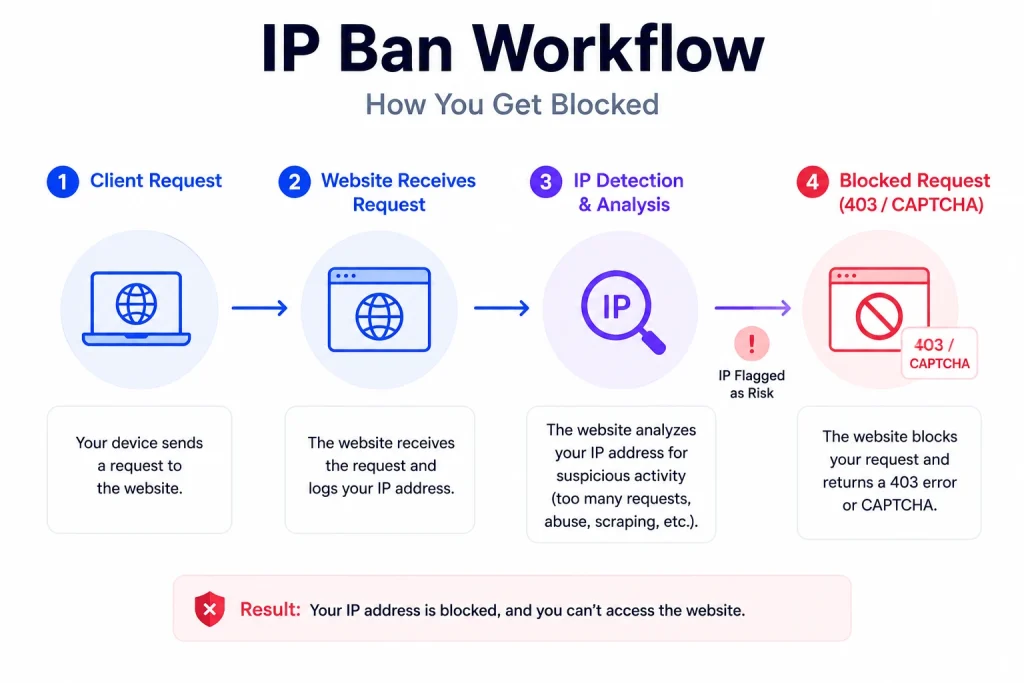
What does IP banned mean? An IP ban is a server’s denial to establish a connection that is based on an IP address. After a user sends a request, a server first checks the IP against its blocklists. If the address happens to be on it, the server blocks a connection request without processing data. There are two types of blocks – temporary and permanent. Temporary blocks mean that an IP is non grata for a set period of time – from several minutes to several days, depending on a website’s policies. It usually happens as a prevention measure in case suspicious activity is detected – for example, if you make too many requests from the same address in a short time. Permanent IP ban is when an address is blocked for good, which usually happens as a result of severe misdeeds or illicit actions.
You can recognize an IP ban in several ways. A server may send you a 403 Forbidden error – it is a direct notice that access is denied. 429 Too many requests is a temporary ban for hitting rate limits. CAPTCHA is related here too – it is not connection denial, but still a request from a server to pass a verification. Sometimes a server would send nothing, just quietly refuse to establish a connection.
An IP ban is often confused with an account ban; however, those are two different things. Account ban is tied not to IP, but to a particular account – so whatever IP you use to connect, you would still be denied. An IP ban is less precise and can affect users of the same network, while an account ban is targeted. As a result, account bans are more reliable and harder to get over, as the only solution is to create a new account, while it is easy to bypass IP ban just by connecting from a different address, using proxies or VPNs.
Why You Get IP Banned
There is a simple logic behind IP bans: a server has limited resources, but it must perform well. To do that, it is necessary to fend off scammers who may steal data and bots that create an abnormal load. It is also important that users consume the server’s resources equally. So, when a server detects suspicious activity, a ban is in order. What may look like suspicious activity includes:
- Rate limit hitting
As a human physically cannot hit a button 500 times per second, a huge number of requests coming from the same address in no time is a sign of automation. That is why a rate limit exists – a number of requests that is possible and reasonable coming from one IP within a period of time. When you hit the limit, you first get a 429 error and then a ban.
- Scraping
High-volume scraping may create an unwanted load on a server, as it has to load hundreds of pages. It may negatively affect ordinary users, who have to deal with high latency. Also, such overload may create a hole in security, leading scrapers to get their hands on sensitive data.
- Automation
Automatic account creation, form submission, vote inflation, and API parsing – all automatic actions can result in bans. Automation may be a sign of a scraping or a DDoS attack coming, so no one takes risks and just blocks such a visitor.
- Suspicious traffic
Servers analyze traffic and look for possible dangers – unusual patterns, User-Agent headers absence, requests to non-standard endpoints, JavaScript execution handling – whatever looks like a script or a bot gets blocked.
- Website policies break
Offensive content or comments, scamming, password-retrieving attempts – if a user is caught doing prohibited things, an IP ban is not unexpected.
How Websites Detect You
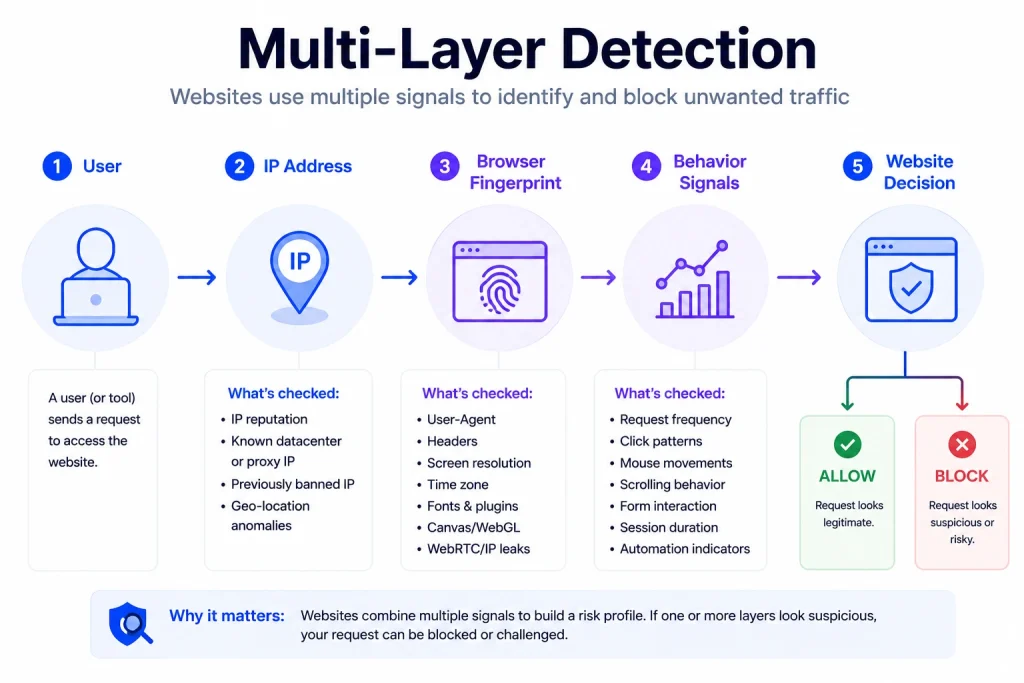
To understand how to bypass an IP ban, it is important to know how you are detected first. So, what does IP banned mean from a technical side of the story? There are a lot of ways to detect a user aside from an IP address. In fact, an IP is the most basic identifier. A server sees it first, but modern websites rely on complex detection systems instead of considering an IP only. Those anti-bot systems analyze numerous signals, like browser fingerprints and network signals. Systems like DataDome collect those microsignals to define whether it is a bot or a human. Generally, there are 5 layers of detection, and IP is only one of them, which is the easiest to overcome. So, to change an address ≠ get around IP ban.
IP-based Detection
The easiest and the oldest method is IP-based detection. A website tracks the number of requests originating from the same IP, and when a number exceeds a rate limit, the address gets blocked. Often, addresses of known scammers or scrapers are compiled together into a blacklist – when a server detects a request coming from such IPs, the connection is denied immediately. Whitelists are the contrary – a list of addresses that are always allowed in, while the rest are denied.
Sometimes geo-based blocks are in place – not a particular IP, but all IP ranges that are associated with the same geographic area are blocked.
IP-based detection requires a couple of code lines and carries almost no additional load on a server, which is why it is still alive, though never used alone.
Browser fingerprinting
Websites can still identify you even with an IP changed – via browser parameters. They include time, browser version, OS, language, screen resolution, fonts, plugins, canvas fingerprints, etc. When two requests come from different IPs, but they have the same fingerprints, websites think it is the same person. When a user opens a page, all those parameters become known to a website. It then collects, hashes, and stores data to obtain a fingerprint – a stable identifier, independent of an IP. Browser fingerprinting is an up-to-date method, as it is more precise, reliable, and hard to fake.
TLS and HTTP fingerprinting
Servers analyze network parameters of a request – ASN, IP reputation, headers order, and geolocation inconsistencies, like an attempt to get into an account registered in Paris with a New York IP. The thing is that different tools – cURL, browsers, bots – have different signals, so this method also contributes to detection. HTTP and TLS fingerprints are also hard to spoof.
Behavioral Analysis
Websites also don’t ignore users’ behavior. The frequency of requests, the speed of moving from one page to another, scrolls, clicks – or their absence – everything is analyzed. Humans act unpredictably, make chaotic movements with the mouse, and uneven pauses between clicks. Bots are the opposite – predictable, fast, without a hint of chaos. Humans can not act like bots – we cannot send 1000 requests per minute. Bots also have difficulties following human patterns. The difference is obvious, so servers pay attention to such signals.
Types of IP Bans
Another important thing to understand how to bypass an IP ban is to learn what types of bans actually exist. There are several of them, different in terms of severity and ways of realization.
- Soft ban – a user has access, but every action comes with restrictions – CAPTCHA, rate limits, temporary errors.
- Hard ban – total block, when a request is denied without being processed.
- Shadow ban – the trickiest way, when a user does not even know they are blocked. Everything looks like it works fine, but the server returns fake, degraded, or incomplete data. It is often used to deal with bots.
Methods to Bypass an IP Ban
There are many methods regarding how to bypass an IP ban; however, which one to use and its efficiency depend on the protection measures each website uses. Simple methods are cheap and do not require a lot of resources or tech skills, but they are useful only for basic blocks. Modern anti-bot systems require complex measures.
Residential Proxies
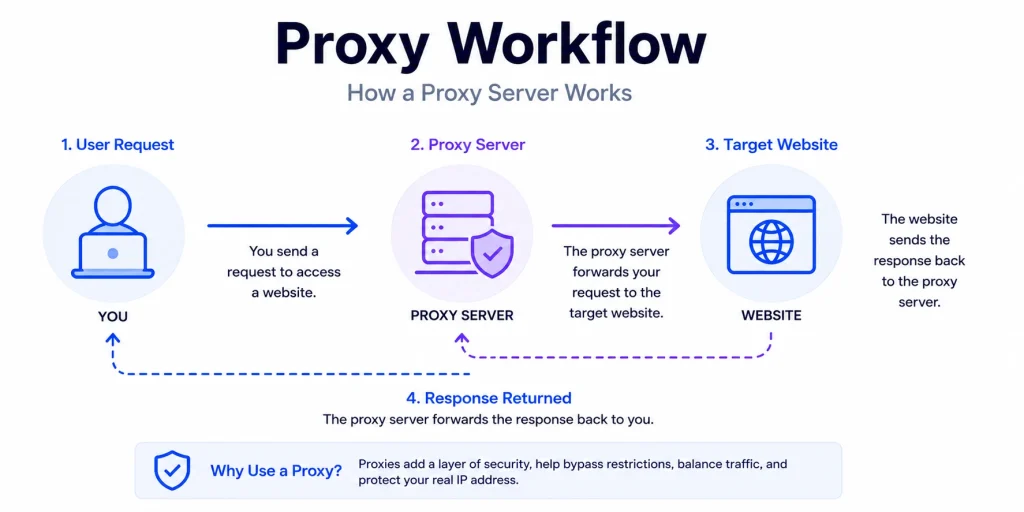
Residential proxies are real IPs of real devices, tied to particular locations. Internet Service Providers assign them. That contributes to them looking like real user traffic, which increases the trust level from websites. That is why they are suitable for scraping, automation, and content accessing – cases that often trigger blocks. They are reliable and work even for high-volume tasks.
IP Rotation
Another way to prevent access inconsistencies is to rotate IPs. Rotation means that an IP address used to make a request is changed, so to websites, traffic seems to come from various IPs, as if from different users. This allows for preventing hitting rate limits. There are rotating proxies – when you use them, the IP is changed for every request. There are also sticky sessions – so the same IP is used for a particular period of time, for example, 10 or 30 minutes.
Mobile Proxies
Mobile proxies rely on addresses assigned by cellular operators. The nature of mobile proxies is different – there are not so many addresses, but a lot of devices, so the same address is used by multiple gadgets simultaneously. In such a situation, tracking each particular user is difficult, which is why mobile proxies are deemed highly anonymous and trusted. They are suitable for websites with the strictest protection measures and the most sensitive use cases.
VPN
VPN is the basic tool to deal with blocks, as it instantly changes an IP address, but it is the first thing an anti-bot system checks for. VPN providers rent servers at datacenters, so their IP addresses belong to those datacenters, and websites catch them instantly. A lot of such addresses are already blacklisted. So such a method works for the simplest cases only.
Change Network or Restart Router
Some providers offer dynamic IPs – so every time you restart the router or change a network, you get a new address. If you use the services of such a provider, such simple actions may be an answer. Again, this is a method that would work for a basic case only – when you are in a high-volume scraping case, restarting the router is not the way.
Wait for Ban to Expire
As it was said earlier, a lot of bans are temporary – they expire within hours or days, without you taking any action. So you can wait – only if there is no emergency – for an IP ban bypass.
Contact Website Support
The previous methods are technical, while this one is official. In case you are sure a ban happened by mistake, contacting support agents is the fastest and most reliable way to deal with the situation.
How to Bypass an IP Ban – Step-by-Step
The general algorithm to bypass IP ban looks like this:
- Define the type of a ban
- Choose the most suitable method – proxies, VPN, or others
- Adjust rotation settings
Remember about correct headers and matching fingerprints in order to avoid another ban. After you are done adjusting settings, test your scheme and control whether it works. Websites change policies and mechanisms, and what performed fine yesterday might be useless today, so it is important to stay alert.
Why Simple Methods Stop Working
Several years ago, proxies alone were enough to prevent or bypass IP bans. Now it is not enough. Anti-bot systems websites use today do not rely on a single parameter like IP address – they analyze fingerprints, behavior, network signals, etc. So changing an IP alone won’t do – a complex approach is necessary.
Anti-Detection Stack Explained
As modern systems check numerous parameters on several levels, you need to use several tools at once to close all those potential loopholes. At the same time, it is not enough to randomly pick and combine several tools – they need to create a united scheme, where elements complement each other and do not create mismatches. This is how to bypass an IP ban today.
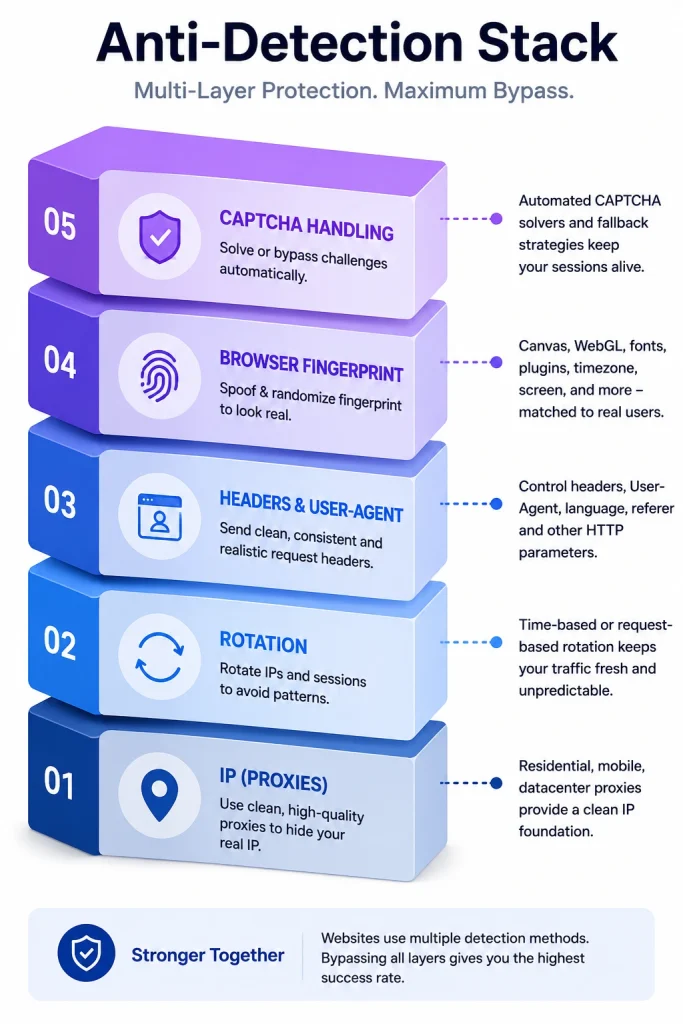
IP Layer (Proxies)
This is the first thing an anti-detection system checks. Though it is basic, true IP ban bypass is impossible without changing your IP address. High-quality residential or mobile proxies increase trust and help create a real user look.
Rotation Layer
Changing IPs between requests or sessions helps avoid IP rate limits. At the same time, rotation must not be reckless. For example, when you are on tasks that require sticking to the same session for a period of time, yet you rotate proxies for every request, it would only harm, as real users do not change IPs mid-session.
Headers and User-Agent
Correct HTTP headers help imitate requests that come from a real browser and not a script. Rotate them too, but pay attention, so they match the other parameters.
Fingerprint Management
Fingerprinting is a precise method, so it is hard to spoof fingerprints. Hard, but not impossible. Changing browser parameters requires you to be attentive, so you put together parameters that make sense together and create a “real user” picture. Your goal is to blend with the crowd of ordinary users and prevent tracing all traffic back to you.
CAPTCHA Handling
There are tools that help deal with manual verification, which often happens even if you act within policies and terms of service. Only the combination of such solutions that works on different levels will help avoid bans and get data.
Best Method by Use Case
The answer to the question “how to get around an IP ban” depends on the task at hand:
- Web scraping – calls for a combination of proxies for web scraping, rotation logic, and anti-detection tools, as scrapers are not welcome in most cases. You need a serious disguise.
- Automation – proxies and fingerprint management techniques will do, as automation is also often prohibited.
- Content accessing – VPN or basic proxies are often enough.
- B2B business tasks – high volume fitting proxy solutions and full anti-detection stack discussed above – you need accurate data fast in order to make informed solutions.
Thankfully, not all websites use the latest anti-detection system, so you won’t always need the most powerful tools.
Proxy Types Comparison
There are different types of tools – residential, mobile, and datacenter proxies, VPNs. They differ in trust level, detection risk, and efficiency in preventing bans. Residential and mobile proxies are the toughest for anti-bot systems, while datacenter IPs and VPNs are a piece of cake. However, the choice always depends on your tasks. Basic options like datacenter IPs and VPNs are good for accessing geo-specific content when there is no reason to invest in more expensive proxies. At the same time, data collection and high-volume tasks are impossible without reliable residential or mobile IPs. For your convenience, there is a comparison table that includes the main parameters, so you can compare different solutions.
| Factor | Datacenter | Residential | Mobile | VPN |
| Trust Level | Low | High | Very High | Medium |
| Detection Risk | High | Low | Very Low | Medium-High |
| Speed | High | Medium | Low | Medium |
| Cost | Low | Medium | High | Low-Medium |
| IP Pool Size | Medium | Large | Shared | Limited |
| Geo Targeting | Limited | Precise | Carrier-level | Country-level |
| Scalability | Medium | High | Medium | Low |
| Best For | simple tasks | scraping, automation | hardest targets | personal use |
| IP Ban Bypass Rate | 40–60% | 95–99% | 95–99% | 60–75% |
Common Mistakes to Avoid
There are some mistakes that lead to bans, even if you use proxies and other tools to establish uninterrupted access.
- The use of free or low-quality proxies – they are often burned, known, and already blocked by websites. Even if not yet, they would soon be. On top of that, such proxies may jeopardize your security, as you never know who runs such servers and how they would use your data.
- The lack of rotation logic – if you do not rotate IPs and all the traffic comes from the same address, or you rotate them not often enough while you are performing a high-volume task, it may lead to rate limits.
- The same fingerprint for all requests – fingerprints are signals that detection systems pay a lot of attention to, so even if the rest differs, but fingerprints are the same, you would most certainly be caught and banned.
- Too many requests – aggressively sending requests would betray you, as humans cannot send as many requests as bots.
- The use of the only method – on modern Internet, such an approach does not work anymore – you need a complex plan of actions.
Frequently Asked Questions
What is an IP ban?
An IP ban is a situation in which requests coming from a particular IP address won't be processed. A website refuses to establish a connection with a client based on their IP.
How long does an IP ban last?
It depends on the type of ban. There are temporary bans that last from several hours to several days, depending on the website's settings, and then a user regains access. There are permanent bans that do not have an expiration date.
Can a VPN bypass an IP ban?
A virtual private network is enough to bypass IP ban only on websites that do not use complex anti-bot systems, and your use case is not a complex one. For tasks like automation or scraping, especially on highly protected websites, a VPN alone won't suffice.
What is the best way to bypass an IP ban?
The best way is to define a type of ban, choose a suitable method, and think about rotation logic. It is also important to implement tools for fingerprint spoofing. The best way also always depends on a use case. In other words, there is no best - there is the most suitable.
Can websites detect proxies?
Yes, they can detect certain proxies. Datacenter IPs are usually detectable, while residential and mobile IPs have more chances to blend in. That is why they are usually used to get over bans.
Is it legal to bypass an IP ban?
An IP ban is a technical measure, not a law or court order. As a result, it is not a crime to get around IP ban. Yet, why do you get around IP ban, and how - the context decides. When you bypass IP ban that was imposed by mistake or conduct research with publicly available data, it is okay. However, it is prohibited to break the terms of service, scam, or cause damage.
Why do I get blocked even after changing IP?
Detection systems analyze a lot of other signals, and changing an IP only is not enough, as it is still obvious that the traffic originates from the same source. You need to change other signals too, including browser fingerprints or network signals.
Do free proxies work?
No, they usually are useless, as they are burnt, blocklisted in advance. Even if such proxies work, they are often overloaded. Moreover, such IPs are often unsafe.
Conclusion
When you are trying to figure out how to bypass an IP ban, you need to understand that an IP ban is only one component of a defense system. That is why simple methods like VPNs are often not enough to prevent such disruptions. The most effective approach is to use proxies in combination with anti-detection techniques, so that there is a matching reply to every detection layer. Still, the IP address is at the heart of it all – without changing the IP, others do not work. So proxies lie at the base of ban prevention, and the rest of the components add on top of them.
 State/City/Zip/ASN Targeting