
In this Article
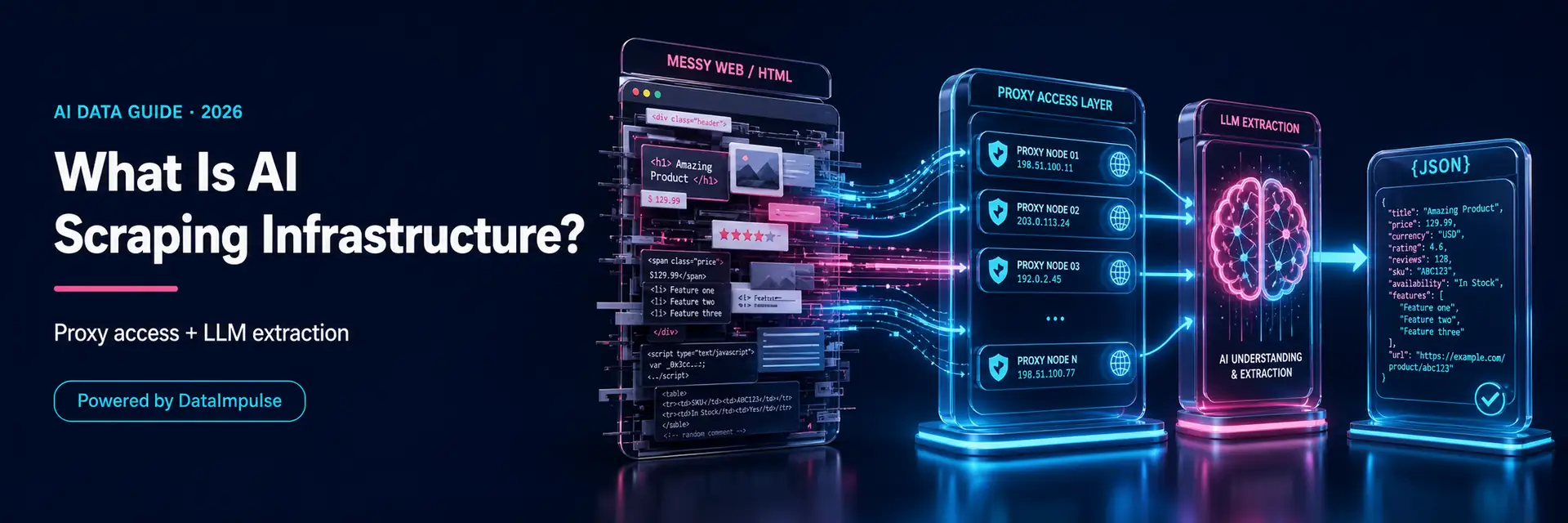
AI scraping infrastructure is the modern stack for collecting web data using AI to do the parsing — a proxy access layer that reaches pages, plus LLM-based extraction that turns messy HTML into structured data, plus the orchestration around them. It’s the shift from brittle, selector-by-selector scrapers to systems where a model reads pages by meaning. But the AI only changes one layer: you still have to fetch the pages, and that’s still ordinary web access. This guide defines AI scraping infrastructure, its components, how it differs from traditional scraping, and where proxies fit.
I’m Andrii Byzov, an AI-Native Fractional CMO who builds web-data pipelines. Below: a plain definition, the layers, the change AI actually makes, and the access layer underneath it all. It’s part of web data infrastructure for AI.
Key Facts
- AI scraping infrastructure = access layer + AI extraction + orchestration — the stack for collecting web data with LLM-based parsing.
- AI changes parsing, not access. The model replaces brittle selectors; you still fetch the pages the normal way.
- It’s more resilient. LLM extraction tolerates layout changes that break selector-based scrapers.
- The trade-off is cost. LLM calls bill per token, so AI extraction suits messy or varied targets; selectors stay cheaper for uniform bulk.
- Proxies remain the access layer. The extraction model itself doesn’t fetch pages — residential proxies handle IP/geolocation access (not CAPTCHAs, fingerprints, or auth walls).
What Is AI Scraping Infrastructure?
It’s the end-to-end system for turning the open web into structured data using AI for the extraction step. A traditional scraper finds data by hard-coded selectors (.price); AI scraping hands the page to a model that extracts by understanding the content. The “infrastructure” part is everything around that model: fetching pages reliably and at scale, feeding them to the extractor, validating the output, and delivering it. It’s the production form of AI web scraping — not a single script, but a stack.
How It Differs from Traditional Scraping Infrastructure
- Parsing. Traditional scrapers break when markup changes; LLM extraction reads by meaning, so it’s more tolerant of redesigns (though it still needs validation and retries).
- Maintenance. Selector-based scrapers need per-site upkeep; AI extraction needs less site-specific code but more attention to cost and output validation.
- Cost shape. Selectors are cheap to run; LLM extraction bills per token, shifting where the expense sits.
- What stays the same. The web-access constraints remain — fetching pages and getting blocked — even if the fetch/render implementation differs, and access is still where scaling breaks.
The Components
Access layer (proxies). Reaching pages from the right place without being blocked — unchanged from any scraping stack, and still the binding constraint at scale.
Fetch & render. Retrieving HTML, handling dynamic content and pagination.
AI extraction. An LLM turning page content into structured data against a schema — the layer AI actually changes.
Validation & delivery. Checking the output against a schema (parsing alone isn’t proof), handling retries, and delivering clean data downstream.
import requests
# The AI scraping stack in miniature: PROXY fetches the page (access layer),
# the LLM extracts structure (parsing layer). Two separate jobs.
proxies = {"http": "http://LOGIN__cr.us:[email protected]:823",
"https": "http://LOGIN__cr.us:[email protected]:823"}
def scrape(url, schema):
html = requests.get(url, proxies=proxies,
headers={"User-Agent": "Mozilla/5.0"}, timeout=30).text
return extract_with_llm(html, schema) # your model returns validated JSON
data = scrape("https://example.com/product/1", {"title": "str", "price": "float"})
Where Proxies Fit
The single most common misconception about AI scraping is that the model handles everything. It doesn’t: the extraction model parses content, but it doesn’t fetch pages or get past blocks unless it’s paired with a browsing/tool layer. Fetching is still ordinary web access — target sites rate-limit, geo-personalize, and flag datacenter IPs — so collecting at scale runs into the same walls as any scraping. Residential proxies are the access layer: they route the fetch through real consumer IPs in the right market, so pages reach your extractor with less IP-based blocking (they address IP/geolocation access, not CAPTCHAs, fingerprints, or auth walls) — DataImpulse residential from $1/GB (mobile from $2/GB) across 195+ locations. The AI changes how you parse; proxies are how you reach. See best proxies for AI scraping for that layer.
When AI Scraping Infrastructure Makes Sense
AI extraction earns its token cost on messy, varied, or frequently changing targets — many sites with one schema, layouts that redesign often, or unstructured pages where selectors are impractical. For high-volume, uniform pages (one site, millions of identical templates), traditional selectors are still cheaper and faster. Most mature stacks are hybrid: selectors for the bulk, AI extraction for the messy edge cases — over a single shared access layer.
Is AI Scraping Legal?
Using an LLM to parse pages doesn’t change the legal picture — collection follows the same rules as any scraping. Favor public, non-personal data, respect site terms and treat robots.txt as a policy signal, don’t bypass logins or access controls, pace requests, and track provenance for data that feeds a model. Public availability doesn’t settle copyright, contract, or privacy questions, and legality depends on jurisdiction, source, and use. Proxy use isn’t inherently unlawful, but it depends on the use case and applicable law; evading bans or access controls is where risk appears. See whether web scraping is legal. This is general information, not legal advice.
Frequently Asked Questions
What is AI scraping infrastructure?
It’s the stack for collecting web data using AI for extraction — a proxy access layer that reaches pages, LLM-based extraction that turns messy HTML into structured data, and the orchestration, validation, and delivery around them. It’s the production form of AI web scraping: not one script, but a system.
How is it different from traditional scraping?
The parsing layer changes: instead of hard-coded selectors that break when markup changes, an LLM extracts by meaning, so it tolerates redesigns better. Maintenance shifts from per-site selectors to cost and output validation. The access layer — fetching the pages — stays the same, and is still where scaling breaks.
Do you still need proxies for AI scraping?
Yes. The LLM parses content but doesn’t fetch pages or bypass blocks. Fetching is ordinary web access, and sites rate-limit, geo-personalize, and flag datacenter IPs. Residential proxies are the access layer that routes the fetch through real consumer IPs so pages reach your extractor with less IP-based blocking.
When does AI scraping make sense vs. traditional?
AI extraction earns its token cost on messy, varied, or frequently changing targets — many sites with one schema, or layouts that redesign often. Traditional selectors are cheaper and faster for high-volume uniform pages. Most mature stacks are hybrid: selectors for the bulk, AI for the messy edge cases, over one access layer.
Is AI scraping legal?
Using an LLM to parse pages doesn’t change the rules — it follows the same law as any scraping. Favor public, non-personal data, respect site terms and robots.txt, don’t bypass access controls, pace requests, and track provenance. Public availability doesn’t settle copyright or privacy questions; legality depends on jurisdiction, source, and use. Using proxies for legitimate collection is generally lawful. Not legal advice.
Conclusion
AI scraping infrastructure moves the fragile part — parsing — from hand-written selectors to an LLM that reads by meaning, making the stack more resilient and less per-site to maintain. But it changes only one layer: you still fetch the pages, still pay token cost where it makes sense, still respect the legal line, and still run on an access layer that keeps pages reachable at scale. Build your extraction and validation; rent a residential-proxy access layer. Explore the pieces: AI web scraping, best AI web scrapers, and web data infrastructure for AI.
Last updated: June 28, 2026.
 State/City/Zip/ASN Targeting