
In this Article
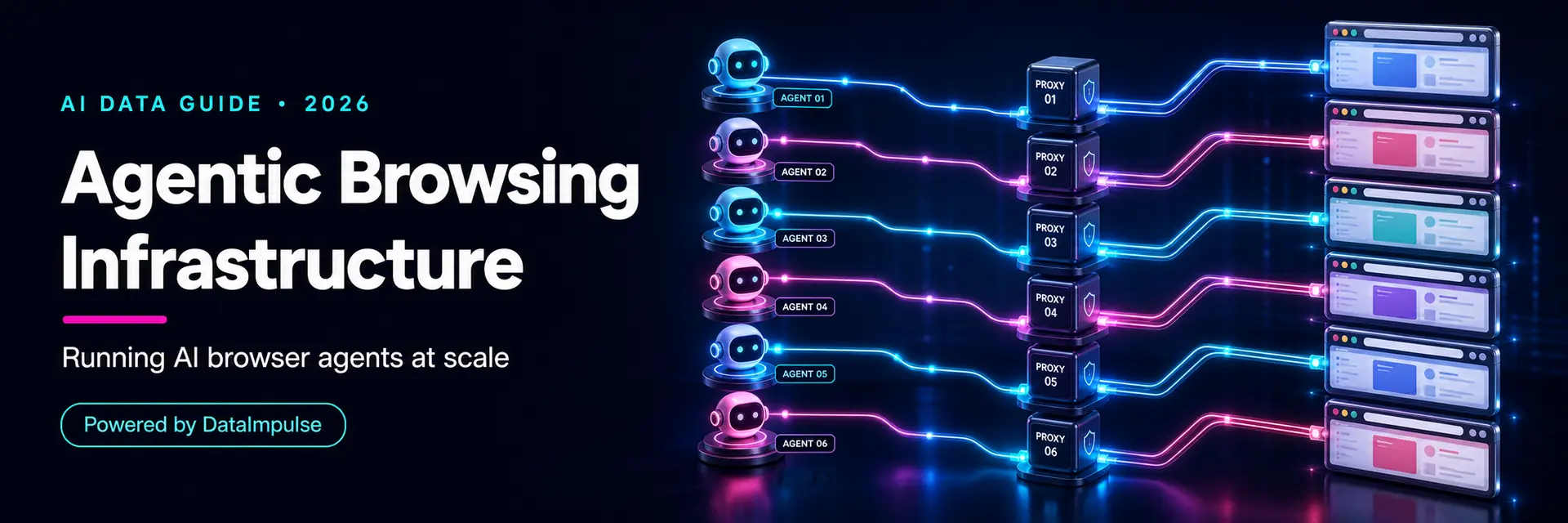
Agentic browsing infrastructure is the stack that lets AI agents browse and act on the web at scale — not one assistant opening a page, but fleets of agents navigating, reading, and completing tasks across the live web reliably. As AI shifts from answering to doing, “an agent that can use a browser” becomes “a system that runs many browser agents without getting blocked.” This guide defines agentic browsing infrastructure, breaks down its layers, and explains why the access layer — proxies with per-agent identity — is foundational.
I’m Andrii Byzov, an AI-Native Fractional CMO who builds agent and web-data systems. Below: a plain definition, how it differs from ordinary browsing, the components, the fleet-scale blocking problem, and where proxies fit. It’s part of web data infrastructure for AI.
Key Facts
- Agentic browsing infrastructure = the stack for running AI browser agents at scale — orchestration, browser automation, access, and session management.
- It’s a fleet problem, not a single-browser problem. Many agents, many tasks, many markets, at once.
- Blocking is the core constraint. Agents that fetch and act repeatedly from one IP get rate-limited and flagged fast.
- Per-agent identity matters. Each agent should look like a distinct real user, not one IP making thousands of requests.
- Residential proxies with per-session identity are the access layer — they keep a fleet reachable and distinct.
What Is Agentic Browsing Infrastructure?
It’s everything required to run AI agents that browse and act on the web reliably and at scale. A single AI browser is a product; agentic browsing infrastructure is what lets a team run many agents — for research, monitoring, shopping, testing, automation — without each one tripping over blocks, geo walls, or detection. It sits below the agent logic (the model deciding what to do) and above the raw web, turning “an agent could open this page” into “a fleet of agents can do this thousands of times across markets.”
How It Differs from Ordinary Browsing
- Scale. One person browses serially; a fleet of agents browses in parallel, constantly.
- Detection pressure. Sites tolerate a human; they actively defend against many automated sessions from the same source.
- Identity. Each agent needs to look like a separate user — shared IPs make a fleet look like one bot.
- Geography. Agents often need to act from specific markets, so location is part of the infrastructure.
The Components
Orchestration. Scheduling and coordinating many agents, retries, and task queues.
Browser automation. The headless browsers or automation framework agents drive to navigate and act (see running AI browser agents).
Access layer. Reaching pages from the right place without being blocked — proxies. This is usually the binding constraint at scale.
Session & identity. Keeping each agent a distinct, consistent user — its own IP session, so behavior stays coherent and separable.
The Fleet-Scale Blocking Problem
The thing that breaks naive agent fleets isn’t the model — it’s getting blocked. Run ten or a thousand agents from one IP range and target sites see a flood of automated traffic from one source: rate limits, CAPTCHAs, bot walls, and bans follow fast. The two needs that result are distinct identity (each agent looks like its own user) and geo-correct access (agents act from the markets they need). Address those and the IP-level bottleneck eases — though fingerprinting, CAPTCHAs, auth, and rate limits can still stop individual tasks; ignore them and the fleet collapses into blocks first.
# Give each agent in the fleet its own proxy session so it looks like a
# distinct real user (the ;sid keeps an agent on the same exit IP for the
# session; the exit can change if that residential peer drops).
def proxy_for_agent(agent_id, country="us"):
return (f"http://LOGIN__cr.{country};sid.agent{agent_id}:"
f"[email protected]:823")
# e.g. launch each browser-automation worker with its own session
for agent_id in range(10):
proxy = proxy_for_agent(agent_id)
# browser.launch(proxy=proxy) -> each agent = a separate apparent user
Where Proxies Fit
The access and identity layers are where proxies live, and at fleet scale they’re foundational. Residential proxies route each agent through a real consumer IP, and a per-session identity (a sid) keeps each agent on its own exit IP for the session — so it reads as a distinct, consistent user rather than part of a swarm (the exit can change if that residential peer drops). Rotating residential pools with high concurrency let many agents run in parallel from the right markets — DataImpulse residential from $1/GB (mobile from $2/GB) across 195+ locations, with high concurrency for fleets. Proxies handle access and identity; your orchestration handles the agents. It doesn’t defeat every defense — sites still use CAPTCHAs and behavioral detection — but it removes the IP-level bottleneck that stops fleets first.
Is Running Agentic Browsing at Scale Legal?
Running browser agents follows the same rules as any automated web access — and scale can raise the legal, privacy, contract, and anti-circumvention stakes even when the access pattern looks similar. Keep it defensible: respect each site’s terms and treat robots.txt as a policy signal, don’t bypass logins, paywalls, or access controls, pace requests rather than hammering, and stick to public, non-personal data. Using proxies for permitted automation is generally lawful, but using them to evade bans, access controls, or contractual limits creates legal and account risk. The lawful lane is real automation of public tasks, not circumvention. See whether web scraping is legal. This is general information, not legal advice.
Frequently Asked Questions
What is agentic browsing infrastructure?
It’s the stack that lets AI agents browse and act on the web at scale — orchestration, browser automation, an access layer (proxies), and session/identity management. It sits below the agent’s decision logic and above the raw web, turning “an agent could open a page” into “a fleet of agents can do it reliably across markets.”
How is it different from a single AI browser?
A single AI browser is a product one person uses; agentic browsing infrastructure runs many agents in parallel. That brings fleet-specific problems — detection pressure, per-agent identity, and geography — that a single browser never faces. The hard part is keeping a fleet reachable and distinct, not driving one browser.
Why do agent fleets get blocked?
Because many automated sessions from one IP range look like one bot. Sites tolerate a human but actively defend against floods of automated traffic from the same source with rate limits, CAPTCHAs, and bans. Without distinct per-agent identity and geo-correct access, a fleet trips those defenses fast.
Where do proxies fit in agentic browsing?
They’re the access and identity layer. Residential proxies route each agent through a real consumer IP, and a per-session identity keeps each agent on its own exit IP so it reads as a distinct user. Rotating pools with high concurrency let many agents run in parallel from the right markets — removing the IP-level bottleneck that stops fleets first.
Is running browser agents at scale legal?
It follows the same rules as any automated web access. Respect site terms and robots.txt, don’t bypass logins or access controls, pace requests, and stick to public, non-personal data. Using proxies for permitted automation is generally lawful; using them to evade bans or access controls creates legal and account risk. Not legal advice.
Conclusion
Agentic browsing infrastructure is what turns “an agent that can use a browser” into a fleet that actually works — and its binding constraint is access, not intelligence. Many agents acting in parallel get blocked unless each looks like a distinct user from the right market, which is the proxy-and-identity layer. Build your orchestration and agent logic; rent a residential-proxy access layer with per-session identity and high concurrency. Explore the pieces: running AI browser agents, proxy for OpenAI Operator, and web data infrastructure for AI.
Last updated: June 28, 2026.
 State/City/Zip/ASN Targeting