
In this Article
When comparing ISP vs residential proxies, ISP proxies typically use ISP-registered IP addresses hosted on servers, while rotating residential proxies route traffic through consumer connections. Choose a static ISP plan when you need a retained address, rotating residential proxies for varied exits, or sticky residential sessions for temporary IP continuity.
Compare hosting, assignment terms and total workload cost separately. An ISP-associated address does not establish where the proxy runs, who else uses it or whether a target will accept its traffic.
Key Facts
- ISP proxies typically use ISP-registered addresses on server infrastructure.
- Rotating residential proxies route requests through consumer connections.
- Sticky sessions request temporary exit persistence, not permanent IP allocation.
- Static allocation and exclusive use are separate purchasing requirements.
- ISP offers can use per-IP billing or bandwidth billing.
- A short continuity observation cannot establish long-term address retention.
ISP vs Residential Proxies at a Glance
ISP proxies typically combine ISP-registered addresses with server hosting; rotating residential proxies use consumer connections. The practical difference is allocation: an address reserved under a service agreement serves a different need from an exit selected from a residential pool.
| Question | ISP proxies | Rotating residential proxies | Sticky residential sessions |
|---|---|---|---|
| Where does traffic exit? | Typically server infrastructure using ISP-registered addresses | Consumer connections in a residential pool | Consumer connections in a residential pool |
| How does the address behave? | Depends on allocation and rotation terms | Can change between independent requests or sessions | Requests the same exit temporarily |
| Does the label establish exclusivity? | No; check shared or dedicated allocation | No | No |
| What usually drives cost? | Reserved IPs, bandwidth or both | Billable traffic and targeting | Billable traffic and targeting |
| Which workloads fit? | Repeated authorized access or allowlisting requiring retained addresses | Independent regional observations and distributed collection | Connected requests within a bounded workflow |
| What needs checking? | Retention, replacement, sharing and fair-use terms | Location availability, rotation behavior and traffic accounting | Expiry, exit availability and recovery after an address change |
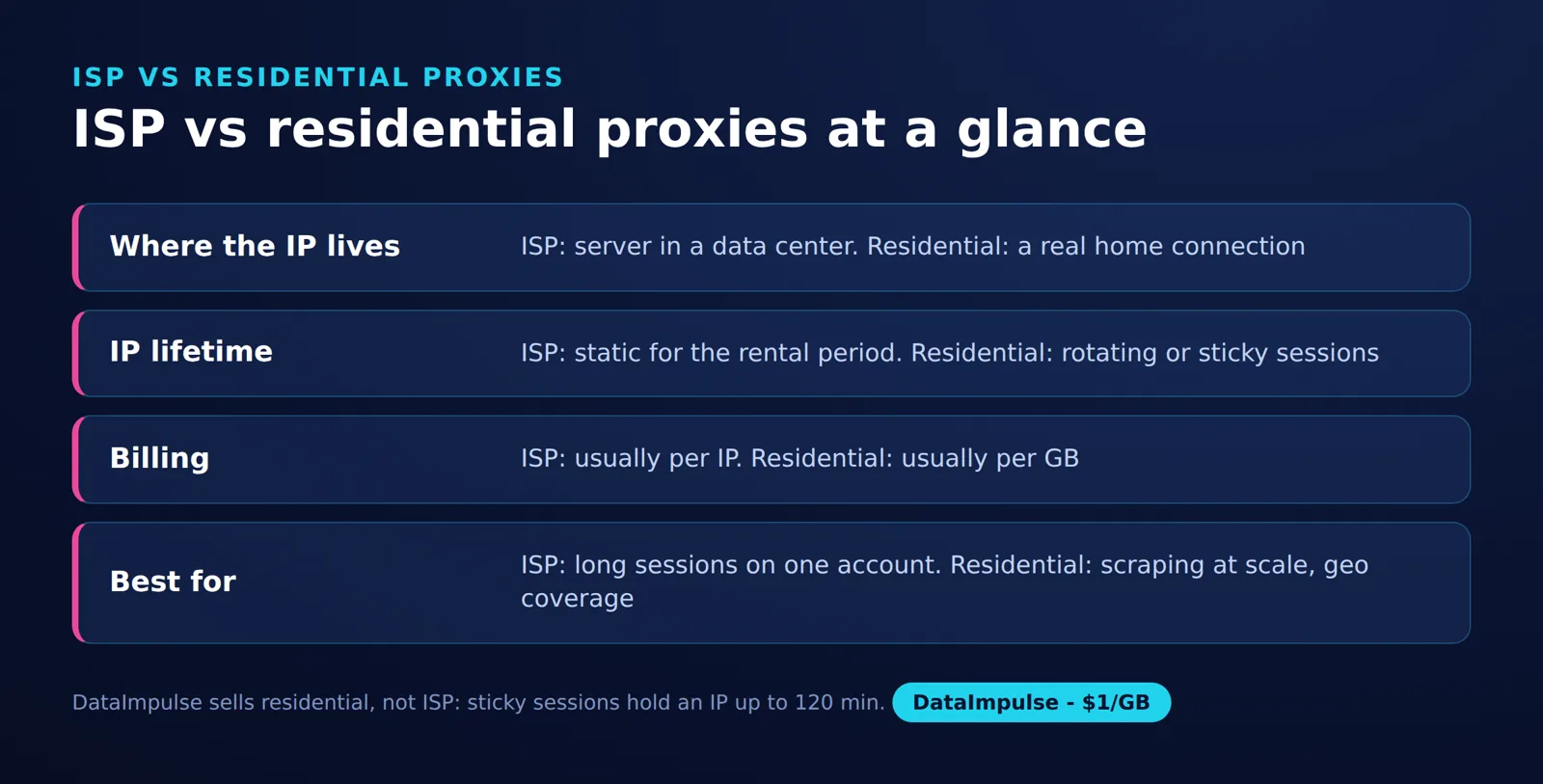
Static ISP proxy meaning: A static ISP proxy is generally an ISP-associated address intended to remain assigned under the service’s allocation terms. Static describes address persistence; it does not establish exclusive use or permanent ownership.
The phrase residential ISP can describe the network serving a household or a commercial proxy category. Ask whether the actual exit runs on a consumer connection or server infrastructure. The Oxylabs ISP definition explicitly separates ISP registration from datacenter hosting.
Competitor data: taken from each provider’s official pricing and documentation pages linked in this article, collected on November 10, 2026. Prices and limits change; check the provider’s page before buying.
For the related allocation terminology, see static versus rotating proxies. Rotation policy and physical hosting are separate properties, so neither should be inferred solely from a product name.
How Do ISP and Residential Proxies Compare with Datacenter Proxies?
ISP and datacenter proxies mainly differ in the networks their IP addresses are associated with: an ISP or a hosting provider. Both can run on server infrastructure; retention and exclusivity depend on the plan.
A datacenter proxy typically uses an address associated with a hosting network. An ISP proxy typically uses an ISP-associated address, even when the machine handling requests is in a datacenter. A residential exit uses a consumer connection whose availability can change.
These distinctions do not establish a universal performance ranking. Target behavior, route length, concurrency and response size all affect the result. If an authorized target accepts datacenter traffic and retained ISP registration offers no operational benefit, compare datacenter costs before paying for another category.
Our October 16, 2026 infrastructure snapshot recorded 1,999 successful residential requests out of 2,000, or 99.95%, and 1,997 successful datacenter requests out of 2,000, or 99.85%. Success meant HTTP 200 plus the complete file.
The method used US rotating exits, Python requests 2.31.0 and 10 parallel workers requesting a 9 KB static file on cdnjs between 15:12 and 15:21 UTC. This was a snapshot of one small CDN target, not a benchmark of protected websites, account sessions or ISP services. No ISP proxies were included.
See datacenter versus residential proxies for the broader infrastructure comparison. Select the least costly route that meets your actual completion and continuity requirements.
Is a Sticky Residential Session the Same as a Static ISP IP?
No. A sticky residential session requests temporary persistence, while a static ISP allocation is intended to retain an assigned address under the service agreement.
A sticky session can support a connected workflow, but its requested duration is not proof that the exit will remain available throughout that period. Static allocation also needs explicit replacement and retention terms.
A multi-step form might need one exit until submission. A partner allowlist might need an address retained across renewals. Those requirements should not be treated as equivalent just because both involve using the same IP more than once.
Separate three clocks: the requested session duration, the exit’s actual availability and the period for which an address is contractually allocated. Reusing a session identifier does not by itself reserve an unavailable consumer exit or recover an expired allocation.
Also separate IP continuity from application state. Cookies, authentication tokens and browser state still matter. Keeping an IP does not preserve an expired login, and keeping cookies does not ensure that an application will accept an unexpected address change.
For bounded workflows, define what happens if the exit changes: stop, restart a safe operation or require user review. Avoid blindly replaying a transaction whose completion status is unknown. Our guide to sticky versus rotating sessions explains the session-level choice.
Which fits account management, sneaker checkout and regional checks?
Repeated authorized logins can justify an ISP allocation with explicit retention terms; regional inventory checks can suit rotating residential exits. Checkout needs continuity through the transaction, but neither proxy category assures acceptance.
Use the 4-factor workload-fit check: continuity, geographic breadth, traffic volume and target restrictions. Resolve continuity first because an address-retention requirement can eliminate an otherwise economical option.
- Continuity: Must the address survive one request, one workflow or repeated access over a longer allocation period?
- Geographic breadth: Do you need a few stable locations or independent observations across regions?
- Traffic volume: Count request and response traffic, browser assets and retries.
- Target restrictions: Confirm that the intended access and automation are permitted.
Authorized account management
For accounts you are authorized to operate, repeated access from a retained address may simplify continuity requirements. Consider dedicated allocation when exclusive use is part of that requirement, and verify how replacements affect your workflow.
If each task is brief and long-term address retention is unnecessary, a sticky residential session may be sufficient. It should not be treated as a stable address for future logins. See the practical considerations for managing multiple accounts.
Sneaker checkout
Keep an authorized cart and checkout sequence on a consistent session where possible. Avoid rotation in the middle of a transaction unless the application explicitly supports it. A retained ISP address may fit repeated activity; a sticky residential session may fit a bounded checkout.
Neither choice reserves stock, changes purchase limits or assures payment acceptance. The relevant question is whether the entire permitted workflow completes reliably. See proxy considerations for sneaker workflows.
Regional inventory checks
Independent stock or price observations can suit rotation, with location selected for each observation. Keep the exit stable when several requests must describe the same cart, store or session.
Before choosing, specify how long the IP must remain unchanged, whether exclusive use is required, and what your application should do if the exit changes.
ISP vs Residential Proxies: When Is ISP Pricing Worth It?
ISP pricing is worth considering when retained addresses have operational value or an applicable per-IP plan costs less for the same workload. Compare total spending, bandwidth allowances and minimum commitments before comparing unit prices.
Residential usage cost = billable GB multiplied by the applicable rate. Per-IP allocation cost = purchased IPs multiplied by the rate for the billing period, plus applicable traffic charges and fees. Then account for package minimums, taxes and any additional commitment.
ISP pricing is not exclusively per-IP. Bright Data lists shared, dedicated and bandwidth-billed ISP options; its bandwidth option lists $8/GB with no monthly commitment (as of November 2026). See its official ISP pricing.
Hypothetical worked cost example
Assume a workload transfers 20 billable GB in one month and does not require reserved or exclusive IP addresses. Compare residential usage at $1/GB with Bright Data’s 10-IP shared and dedicated packages; the dedicated option adds exclusivity that this workload does not require. Assume the residential workload uses country targeting only, and that either allocation model is technically acceptable. These are hypothetical workload inputs, not measured usage.
At our regular residential rate of $1/GB, 20 billable GB costs $20 in usage. This purchases traffic through the pool; it does not reserve 10 addresses.
Bright Data lists a shared 10-IP package at $1.80/IP per month, or $18 monthly, and a dedicated 10-IP package at $3.50/IP per month, or $35 monthly (as of November 2026). Its package prices and billing units establish the package commitment; the hypothetical totals here exclude applicable taxes and extra charges.
The same pricing page states a fair-use allowance of 100 GB per IP per month, pooled across purchased IPs, with possible additional charges beyond the allowance (as of November 2026). Purchasing 10 IPs at the beginning of the month therefore gives the hypothetical workload room within that stated allowance.
For this hypothetical workload, residential usage is $20, the shared allocation is $18 and the dedicated allocation is $35. The options purchase different allocation properties. If exclusive use is required, the shared package is not an equivalent substitute.
At $1/GB, $18 corresponds to 18 billable GB and $35 corresponds to 35 billable GB. Those are arithmetic crossover points for the stated assumptions, not recommendations or universal break-even thresholds.
Cash outlay also differs from usage cost. Our residential service has a one-time $5 Intro plan for new customers, followed by top-ups from $50; traffic does not expire. A $20 usage estimate therefore should not be described as a $20 top-up option.
Before scaling, measure billable traffic for representative completed tasks. A browser page can include substantial assets, and retries can increase spending without increasing useful output. Compare cost per completed task alongside the consequences of losing an address.
How should you evaluate ISP providers?
Evaluate assignment terms before comparing brands: retention, exclusivity, replacement and fair-use rules determine whether an ISP service fits. Then validate representative authorized workflows under the proposed plan.
- Hosting and sourcing: Is the address ISP-associated, and where does the exit actually run?
- Exclusivity: Is the address shared, dedicated across customers or exclusive only for specified destinations?
- Retention: Does the same allocation survive renewal, plan changes and periods of inactivity?For example, Oxylabs states that assigned ISP IPs remain with the account when moving from a free plan to a paid plan, upgrading, or downgrading. This answers the plan-change question; check failure and replacement terms separately.
- Replacement: What triggers replacement, can you decline it, and how much notice is available?
- Failure recovery: Can an unavailable address return, or must your application accept a replacement?
- Usage rules: What bandwidth, concurrency and destination restrictions apply?
- Billing: Are addresses charged daily or monthly, and what happens to unused commitments?
For a concrete limit, Oxylabs states that concurrency falls from 100 to 10 sessions per purchased ISP IP after the applicable 50 GB-per-IP traffic threshold is reached in a billing cycle (as of November 2026). Its official fair-use terms show why a bandwidth allowance and usable concurrency must be evaluated together.
Ask for written answers covering your actual allocation. A statement about session duration does not necessarily cover address retention after renewal, replacement after failure or exclusive use. If the documentation leaves an essential condition unclear, resolve it before treating the service as suitable for allowlisting.
During evaluation, measure useful completed results, address changes and recovery behavior. A successful connection to an IP-echo endpoint verifies routing at that moment; it does not validate the target workflow.
Are ISP proxies detectable?
Yes. An ISP-registered IP does not prevent bot detection. For example, Cloudflare evaluates request headers, session characteristics, browser signals and behavioral patterns. Test the intended workflow and record blocks, challenges and completed tasks; the proxy category alone cannot predict acceptance.
When DataImpulse rotating, sticky or premium residential fits
DataImpulse does not sell ISP or static residential proxies. Our product fits independent requests using rotating residential exits and bounded workflows using sticky sessions; persistent static allocation requires another provider.
Our sticky sessions average 30 minutes, with a 120-minute maximum. These session durations describe temporary persistence, not reserved static addresses.
Regular residential proxies start at $1/GB with country targeting included. State, city, ZIP and ASN targeting on regular residential count traffic at 2x. Include that multiplier when estimating billable usage.
Premium residential costs $5/GB with all targeting included. It remains residential service; the Premium label does not turn a sticky session into static allocation.
Choose rotation for independent observations and sticky sessions for connected tasks that fit the temporary continuity window. If an address must remain on an allowlist across renewals, make explicit retention and replacement terms the purchasing requirement.
If temporary continuity fits, start with the paid, one-time $5 Intro plan for new customers. Record completed tasks, address changes and billable traffic before committing more usage. Subsequent top-ups start at $50.
Frequently Asked Questions
What is the main difference between ISP and residential proxies?
ISP proxies usually pair ISP-associated addresses with server infrastructure, while residential proxies route through consumer connections. For purchasing decisions, also check whether an address is allocated to you or selected from a pool. Hosting and address persistence are separate questions.
What does static ISP proxy mean?
It generally means an ISP-associated proxy address intended to stay assigned under the service agreement. The word static does not establish exclusive use, ownership or protection from replacement. Ask how the allocation behaves at renewal and after failure.
Is a sticky residential session equivalent to a static IP?
No. Stickiness requests temporary exit persistence for a session, while static allocation concerns retaining an address over an agreed period. A sticky exit can become unavailable before the requested duration ends.
Which is better for authorized account management?
An ISP allocation can fit repeated access when retaining the same address is necessary. Sticky residential sessions can fit short tasks that do not require that address at the next login. Confirm the platform’s access rules and your recovery process before choosing.
Should sneaker checkout use rotating or sticky proxies?
A connected checkout generally needs continuity, so avoid changing exits between related steps unless the application supports it. A sticky session or retained ISP allocation may fit, depending on duration. Neither assures stock availability or checkout acceptance.
When is per-GB pricing preferable to per-IP pricing?
Per-GB billing can fit occasional traffic or requests that need varied locations without reserved addresses. Per-IP billing can fit sustained usage or address-retention requirements. Compare package minimums, allowances and completed-task costs using the same workload.
Are ISP proxies detectable?
Yes, an ISP-associated address is not proof that a connection will be accepted. Network classification and application behavior can both affect the outcome. Evaluate the authorized workflow rather than relying on the category name.
Last updated: November 10, 2026.

 State/City/Zip/ASN Targeting