In this Article
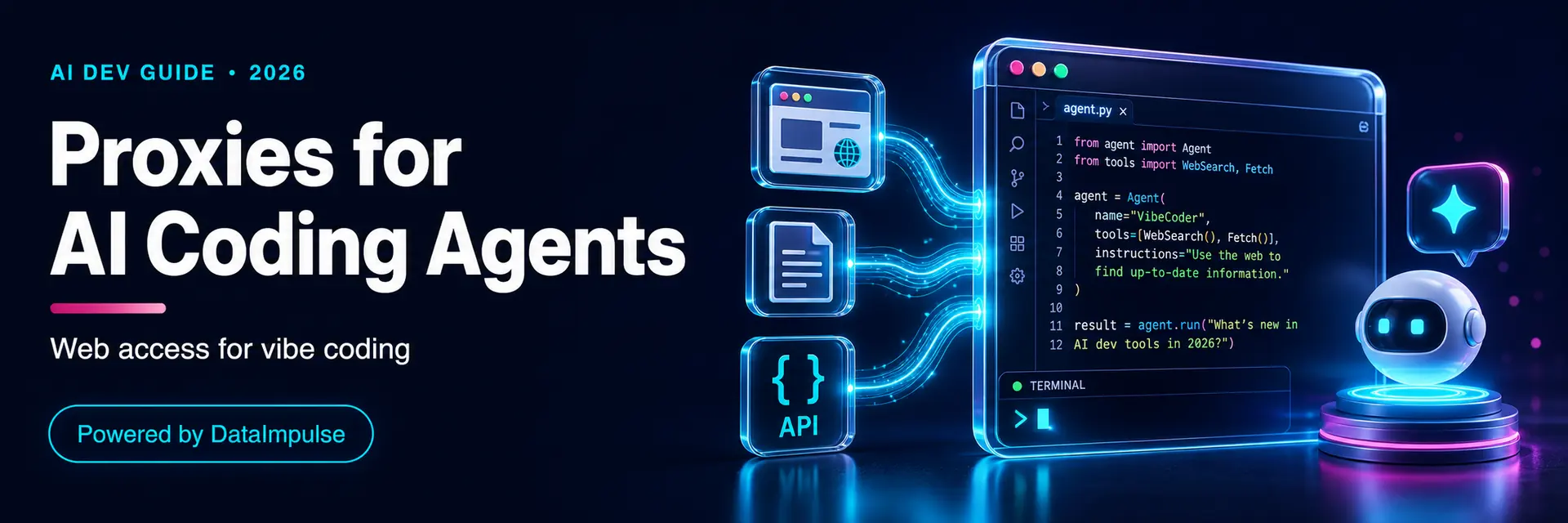
Vibe coding — describing what you want and letting an AI agent write and run the code — has made AI coding agents like Cursor, Claude Code, GitHub Copilot, Windsurf, and Cline part of daily development. And those agents increasingly reach out to the live web: pulling documentation, searching for examples, calling APIs, and scraping reference data to ground what they build. The moment a coding agent hits the web at any volume, it runs into the same walls a scraper does — rate limits, geo-gated content, and IP blocks — which is where proxies come in. This guide covers when AI coding agents need a proxy, how to give them web access through one, and why residential IPs fit.
I’m Andrii Byzov, an AI-Native Fractional CMO who wires web-data into AI workflows. Below: why vibe-coding agents touch the web, where a proxy helps, a quick setup, and how this fits a fleet of agents running in parallel.
Key Facts
- Coding agents now browse the web — docs, search results, package indexes, API responses, code examples — not just your repo.
- Web access is where they get blocked. Rate limits, region-gated docs/APIs, and IP bans hit an agent’s fetches the same way they hit a scraper.
- A proxy gives the agent a clean, geo-correct exit — many agent CLIs and the HTTP clients they spawn read standard
HTTP(S)_PROXYenv vars; a built-in browser or MCP fetch tool you point at the proxy directly. - Fleets need concurrency. Run many agents in parallel and each wants its own session/IP — a rotating residential pool covers that.
- Same rules apply. An agent fetching the web is still web access: respect robots.txt and site terms, and don’t let automation amplify abusive scraping.
What Is Vibe Coding — and Why Coding Agents Hit the Web
Vibe coding is the shift from writing every line yourself to steering an AI coding agent in natural language while it generates, edits, and runs the code. To do that well, the agent needs current, real-world context — and that context lives on the web, not in the model’s training cutoff. In practice an AI coding agent reaches out to:
- Fetch documentation — current docs for a library or API, which change faster than any model’s training data.
- Search for solutions — error messages, examples, Stack Overflow-style answers, GitHub issues.
- Call and test APIs — hitting real endpoints to check responses while building an integration.
- Scrape reference data — pulling example datasets, prices, or content the code is meant to process.
Each of those is a live web request, and increasingly it’s routed through MCP “fetch” tools, a built-in browser, or the agent’s own HTTP calls.
Where an AI Coding Agent Needs a Proxy
For a one-off lookup, the agent’s plain connection is fine. A proxy earns its place when the agent’s web access runs into:
- Rate limits — an agent looping over many doc pages or API calls trips per-IP throttling fast, and your office or datacenter IP gets cut off.
- Geo-gated content — region-specific docs, pricing, or API behavior the agent needs to see as a user in that market would.
- IP bans on scraping — when the agent gathers reference data at volume, the target flags the single IP.
- Shared-IP linkage — a fleet of agents all exiting one IP looks like one aggressive bot; separate sessions keep them distinct.
A residential proxy routes those requests through real consumer IPs, so the agent’s web access looks like ordinary traffic and keeps working at volume.
How to Give a Coding Agent Web Access Through a Proxy
The simplest route: many coding-agent CLIs and the HTTP clients they spawn honor the standard HTTP_PROXY/HTTPS_PROXY environment variables. Point them at a DataImpulse residential endpoint and that traffic routes through it. A built-in browser, WebFetch, or MCP fetch tool won’t always pick up the env var — for those, configure the fetch component directly, as in the next step.
# Most coding-agent tools read standard proxy env vars. Point them at a
# DataImpulse residential endpoint so the agent's web fetches route through it.
export HTTP_PROXY="http://LOGIN__cr.us;sid.agent1:[email protected]:823"
export HTTPS_PROXY="$HTTP_PROXY"
# A unique ;sid per agent/run gives each its own session identity, so a fleet
# in parallel doesn't share one exit IP (rotation/TTL depends on your plan).
For agents that fetch the web through an MCP server or a custom tool, give that tool the proxy directly — so each web lookup the agent makes exits through a residential IP rather than your own.
# Give an MCP "fetch" tool a proxy, so the agent's web lookups go through
# residential IPs instead of your datacenter / office IP.
import os, requests
PROXY = "http://LOGIN__cr.us;sid.mcp1:[email protected]:823"
def fetch(url: str) -> str:
"""A proxied fetch the coding agent can call as a tool."""
r = requests.get(url, proxies={"http": PROXY, "https": PROXY},
headers={"User-Agent": "Mozilla/5.0"}, timeout=30)
r.raise_for_status()
return r.text
# Wire this into your MCP server / agent tool registry as `fetch(url)`.
Use a unique session id (;sid.X) per agent so a fleet running in parallel doesn’t share one exit IP — the same concurrency pattern that matters for AI agents generally.
Why Residential Proxies for Coding Agents
Datacenter IPs are cheapest, but anti-bot-protected sites and search engines often treat datacenter ranges as higher-risk and block them (many docs and APIs gate by auth keys and quotas instead) — so an agent leaning on protected targets sees lookups fail when you’re depending on them. Residential proxies use real consumer IPs that read as ordinary users, with geo-targeting so the agent can see region-specific docs and pricing, and a rotating pool so a fleet of agents doesn’t share one address. DataImpulse residential is $1/GB, pay-as-you-go, across 195 countries — and a coding agent’s web fetches are small, so the bandwidth cost is minimal. For heavier reference-data scraping inside a dev workflow, the same setup covers it; see best proxies for web scraping.
Is It OK for Coding Agents to Scrape the Web?
An AI coding agent fetching the web is still web access, and the usual rules apply — automation doesn’t change them, it just amplifies the scale. Stick to public, non-personal data, treat robots.txt as the access-policy signal it is, follow each site’s terms, don’t bypass logins or access controls, and pace requests so an over-eager agent doesn’t hammer a docs site — enforceability comes from contracts, copyright, and privacy law, not robots.txt alone. Using proxies for legitimate purposes is generally lawful, but using them to evade bans, access controls, geo-restrictions, or contractual limits creates legal and account risk — what matters is what the agent does. For the full picture, see our guide on whether web scraping is legal. This is general information, not legal advice.
Frequently Asked Questions
Do AI coding agents need a proxy?
Not for a single lookup, but yes once the agent hits the web at any volume — looping over docs, calling APIs, or scraping reference data trips rate limits and IP bans, and your office or datacenter IP gets cut off. A residential proxy gives the agent a clean, geo-correct exit so its web access keeps working.
How do I add a proxy to Cursor, Claude Code, or Copilot?
Many coding-agent CLIs and the HTTP clients they spawn honor the standard HTTP_PROXY/HTTPS_PROXY environment variables, so setting those to a DataImpulse residential endpoint routes that traffic through it. A built-in browser or MCP fetch tool won’t always pick up the env var — for those, give the fetch component the proxy directly.
Why use residential proxies instead of datacenter for coding agents?
Anti-bot-protected sites and search engines often treat datacenter IP ranges as higher-risk and block them (many docs and APIs gate by auth keys and quotas instead), so an agent’s lookups to protected targets start failing. Residential IPs read as ordinary users, support geo-targeting for region-specific docs and pricing, and rotate so a fleet of agents doesn’t all share one address.
What does vibe coding have to do with proxies?
Vibe coding means leaning on AI coding agents that pull live context from the web — current docs, examples, API responses. That web access is exactly where rate limits and blocks bite, so a proxy is what keeps a vibe-coding workflow’s web lookups reliable at scale.
Is it legal for an AI coding agent to scrape sites?
An agent fetching the web follows the same rules as any scraping — automation amplifies scale but doesn’t change the law. Stick to public, non-personal data, follow robots.txt and site terms, don’t bypass logins, and pace requests. Using proxies for legitimate purposes is generally lawful, but evading bans, access controls, geo, or contract limits creates legal and account risk — the activity is what’s regulated. Not legal advice — see our web scraping legality guide.
Conclusion
Vibe coding put AI coding agents at the center of development, and those agents lean on the live web — docs, search, APIs, reference data — to do their best work. That web access is where they hit rate limits and blocks, and a residential proxy is the simple fix: a clean, geo-correct, rotating exit the agent’s tools pick up through standard env vars or a proxied fetch. Keep it inside the defensible lane, and your coding agents (and the fleet of them you’ll eventually run) get reliable web access at $1/GB. See best proxies for AI agents and proxies for MCP servers for the broader agent setup.
Last updated: June 25, 2026.
 State/City/Zip/ASN Targeting