
In this Article
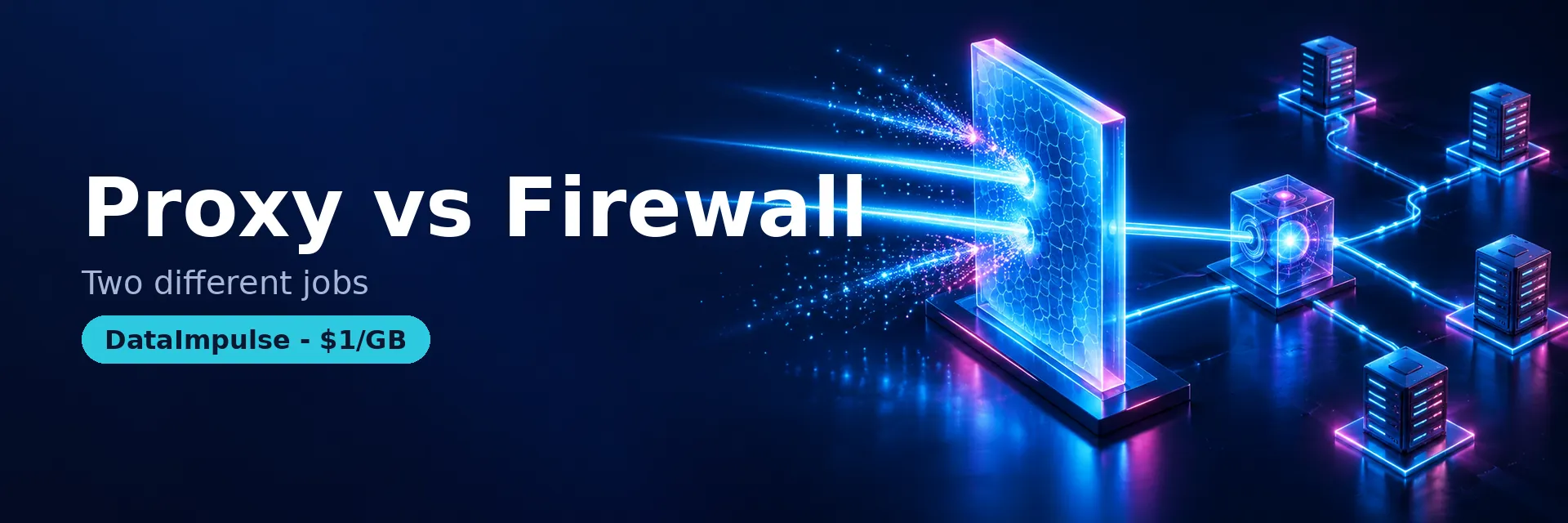
Proxy and firewall get compared as if you would pick one. They solve different problems: a firewall decides whether traffic is allowed through, while a proxy handles traffic on someone’s behalf. Nearly every managed network runs both.
This guide sets out what each one actually does, what each can see, where modern products have merged them, and which questions each is the right answer to.
Key Facts
- A firewall permits or denies. It sits in the path and makes a pass or block decision on traffic that is not addressed to it.
- A proxy participates. Traffic is addressed to it, it makes its own request, and it returns the answer.
- That difference decides what each can see. A classic firewall reasons about addresses and ports; a proxy reads the request itself.
- Modern appliances blur the line, which is why the terms get used interchangeably even though the roles remain distinct.
- They are not alternatives. Almost every managed network runs both, for different purposes, in different places.
What is the core difference?
Whether the device participates in the connection or only observes it.
A firewall is in the path. Traffic is going somewhere else and passes through it. It inspects what it can and decides to permit or deny. The client is not talking to the firewall; the firewall is deciding about the client’s traffic.
A proxy is a destination. The client connects to the proxy and asks it to fetch something. The proxy makes its own connection outward and returns the result. It is an intermediary the client is aware of and, usually, configured to use.
Everything else follows from that. Because a proxy terminates the connection, it can read and modify the request. Because a classic firewall does not, it reasons about the envelope rather than the contents.
What can each one actually see and do?
The proxy vs firewall question comes down to four capabilities. We call it the 4-point capability model.
| Capability | Firewall | Proxy |
|---|---|---|
| 1. Address and port rules | Core function | Not its job |
| 2. Connection state | Tracks sessions, permits return traffic | Holds its own connections on both sides |
| 3. Request content | Only with deep inspection or TLS interception | Reads it natively; that is the design |
| 4. Caching and rewriting | No | Yes: caching, header changes, content filtering |
Row four is the one with no firewall equivalent. Serving a cached copy, rewriting a header, or replacing the source address of an outbound request are things a proxy does because it is making the request itself. A firewall can only let the original request through or stop it.
Where do the two overlap?
In modern products, substantially, which is the main reason the terms get muddled.
Next-generation firewalls do application-aware inspection and often terminate TLS to see inside, which is proxy behaviour applied to a firewall’s job. Secure web gateways are proxies with policy and filtering attached. Reverse proxies such as CDNs and load balancers sit in front of servers and increasingly carry a web application firewall inside them.
The useful way to keep it straight is to ask what the device is for rather than what it is called. If its purpose is deciding whether traffic may pass, it is doing a firewall’s job. If its purpose is handling requests on someone’s behalf, it is doing a proxy’s job. Many appliances do both, and that is a deployment choice rather than a category error.
Which do you need?
Use the row that matches your goal, and avoid the tool in the right column for that goal.
| Goal | Use this when | Avoid when |
|---|---|---|
| Block traffic to or from specific addresses and ports | Firewall | A proxy will not stop traffic routed around it |
| Control and log which sites staff reach | Forward proxy or secure web gateway | A firewall alone sees destinations, not requests |
| Protect a public web application | Reverse proxy with a WAF | A network firewall does not read application traffic |
| Change the source address of outbound requests | Forward proxy | Firewalls do not do this |
| Collect public web data from specific countries | Residential forward proxy | Neither a firewall nor a VPN fits this shape |
The last row is where our product sits: a forward proxy used deliberately by an application to make requests from a chosen location. DataImpulse residential exits cover 195 countries at $1 per GB with country, city and ZIP targeting.
What are the limits?
Neither is a complete security posture. A firewall does not stop a compromised credential and a proxy does not stop a compromised endpoint. Both are controls in a layered design, not the design.
A forward proxy only covers what is configured to use it. An application that ignores the proxy setting goes direct, which is why enforcement usually pairs proxy policy with firewall rules that block the direct path.
TLS interception has a cost. Reading encrypted traffic means terminating and re-signing it, which needs a trusted internal certificate authority and creates a real point of exposure. It is a deliberate trade, not a free feature.
The vocabulary is loose in the market. Read the datasheet for what a product does rather than the category it is sold under.
Related: what is a web proxy, SmartDNS vs proxy vs VPN.
Frequently Asked Questions
What is the difference between a proxy and a firewall?
A firewall sits in the path of traffic going elsewhere and decides whether to permit or deny it. A proxy is itself the destination: the client asks it to fetch something, and it makes its own outbound request and returns the result.
Can a proxy replace a firewall?
No. A proxy only handles traffic configured to use it, so anything routed around it is unaffected. Blocking traffic at the network level is a firewall’s job, which is why managed networks run both.
Is a next-generation firewall a proxy?
It borrows proxy behaviour. Application-aware inspection and TLS termination mean the device reads request content the way a proxy does, while its purpose remains permitting or denying traffic. The roles stay distinct even when the box does both.
Do I need a proxy if I already have a firewall?
If you need to control and log which sites users reach, cache content, or change the source address of outbound requests, yes. A firewall reasons about addresses and ports and does not do any of those.
Where does a residential proxy fit in this picture?
It is a forward proxy used deliberately by an application to make requests from a chosen location, typically for collecting public data or checking how a page renders in a given country. Neither a firewall nor a VPN serves that shape of work.
A forward proxy, used on purpose
When the job is making requests from a chosen country rather than filtering traffic, a forward proxy is the right tool. DataImpulse residential covers 195 countries at $1 per GB with country, city and ZIP targeting. Create an account.
Related: what is a web proxy · SmartDNS vs proxy vs VPN · proxies for web scraping.
Last updated: September 18, 2026.
 State/City/Zip/ASN Targeting