
In this Article
Octo Browser is one of the fastest-growing antidetect browsers for multi-accounting — running many marketplace, social, affiliate, or ad accounts from one machine, each in its own Chromium profile with a real-device fingerprint. But the fingerprint is only half the disguise; the other half is the IP. Reuse one IP across profiles, or run a flagged datacenter IP, and the accounts get linked and banned no matter how good the fingerprint is. So the proxy you put behind each Octo Browser profile is what makes or breaks the setup. This guide shows exactly how to add a proxy in Octo Browser (per profile and in bulk), the one-IP-per-profile rule, and the best proxies for Octo Browser in 2026 — with DataImpulse mobile at $2/GB as the value pick.
I’m Andrii Byzov, an AI-Native Fractional CMO who runs antidetect-browser stacks for account management. Below: the exact setup (including DataImpulse’s sticky-session syntax), the rules that keep accounts alive, and the providers worth your budget.
Key Facts
- One profile = one dedicated, sticky IP. Never share an IP across two Octo Browser profiles — that links the accounts and gets them banned. Each profile needs its own stable IP.
- Mobile and ISP/static residential IPs are best for accounts. They’re the most trusted and stay stable; rotating residential is for scraping, not account management.
- Octo Browser supports HTTP, HTTPS, SOCKS5 (plus SOCKS4 and SSH) proxies per profile, with a built-in Proxy Manager for saving, tagging, and bulk-importing proxy lists, a one-click proxy check, and mass proxy rotation across hundreds of profiles. Its API works with Selenium, Puppeteer, and Playwright for automation (API access starts on the Base plan).
- Geo + sticky is set in the proxy username. With DataImpulse you append parameters:
__cr.us;city.newyork;sessid.{profile}pins a US-New York IP and keeps it sticky per profile. - Octo Browser is built on the latest Chromium with fingerprints from real devices, and plans start small (entry tiers around €10-29/month as of June 2026, with discounts for longer prepays) — so the proxy bill, not the browser, is usually the bigger line item at scale. That’s where $1-2/GB pay-as-you-go matters.
- DataImpulse is the value pick — mobile $2/GB and residential $1/GB on a 90M+ pool across 195 countries, with per-profile sticky sessions, country targeting included and city/ASN as a paid add-on; far below typical antidetect-proxy pricing.
How to Add a Proxy in Octo Browser
1. Per profile (the standard way)
When you create or edit a profile in Octo Browser, open the profile’s Proxy section, pick the protocol (HTTP, HTTPS, or SOCKS5), and either paste a proxy string or fill the fields:
Proxy type: HTTP
Host:       gw.dataimpulse.com
Port:       823
Username:   YOUR_LOGIN__cr.us;city.newyork;sessid.profile01
Password:   YOUR_PASSWORD
The magic is in the username. With DataImpulse you “enrich” your base login with parameters: __cr.us sets the country (US), ;city.newyork the city, and ;sessid.profile01 a sticky session ID. The same sessid keeps returning the same IP within the sticky window (~30 minutes by default, configurable up to 120; if the upstream device drops offline you transparently get a replacement), so the profile keeps a stable address. Run Octo’s proxy check — it confirms the external IP and country, and you set the profile’s timezone, geolocation, and language to match (Octo can derive them from the IP), which is what keeps the fingerprint consistent with the proxy.
2. The golden rule: a unique sessid per profile
Give every profile a different sessid (e.g. sessid.profile01, sessid.profile02) so each account gets its own IP. Never reuse the same sessid across two profiles — that puts two accounts on one IP, which is the fastest way to get them linked and banned. One profile = one fixed __cr.xx;city.xx;sessid.xx, set once and never changed.
3. Bulk-import with the Proxy Manager
For many profiles, use Octo Browser’s Proxy Manager: paste a list of proxy strings — one per profile, each with its own sticky username — and Octo saves them as reusable, taggable entries you can assign to profiles (or rotate across hundreds of profiles at once):
http://YOUR_LOGIN__cr.us;city.newyork;sessid.acc01:[email protected]:823
http://YOUR_LOGIN__cr.gb;city.london;sessid.acc02:[email protected]:823
Verify a credential first: curl -x "http://USER:[email protected]:823" http://ip-api.com/json should return the expected country and city. For the click-by-click walkthrough with screenshots, see our Octo Browser proxy setup tutorial.
Which Proxy Type for Octo Browser — Mobile, ISP, or Residential?
Account management has different needs than scraping — you want stability and trust, not rotation:
- Mobile ($2/GB) — the most trusted IP class, since thousands of real users share carrier IPs (CGNAT), so platforms rarely ban them. Best for the highest-value or most-scrutinized accounts.
- ISP / static residential — a stable, residential-looking IP dedicated to one profile. Ideal when an account needs a stable, residential-looking IP held over long windows.
- Residential ($1/GB) with sticky sessions — a real consumer IP held per profile; good value for most accounts.
- Datacenter — avoid for account work. It’s cheap but flagged fast on social and marketplace platforms; fine only for low-risk tasks.
The rule: one trusted, sticky IP per profile, matched to the account’s geo. DataImpulse offers mobile, residential, and ISP-style sticky sessions on one account, so each Octo Browser profile gets the right tier.
Best Proxies for Octo Browser at a Glance
| Provider | Best for Octo Browser | Price | Sticky / stable IP | Notable |
|---|---|---|---|---|
| DataImpulse | Best value, mobile + residential | mobile $2/GB · res $1/GB | Sticky per sessid (~30 min, to 120) |
90M+ pool, city/ASN targeting, bulk import |
| IPRoyal | Longest stable sessions | res from $7.35/GB | Sticky up to 7 days | Popular with antidetect users |
| SOAX | Mobile + residential mix | $3.60/GB Starter | Sticky supported | 33M+ mobile pool |
| NetNut | ISP-residential focus | from $3.53/GB (rotating) | Static ISP line (priced higher) | Consumer-ISP network |
| Bright Data | Enterprise pool + ISP | ~$4/GB promo; ~$8 standard | Dedicated/ISP options | Large pool; premium pricing |
| Oxylabs | Enterprise SLA + ISP | res from $6/GB | ISP/static available | 175M+ pool |
| Decodo | Mid-market, full geo grid | $3.75/GB (~$2 at 1TB+) | Sticky to 24h | 115M+ pool, ISP line |
| Webshare | Budget / self-serve | from $3.50/mo (rotating res) | Static residential per-IP (~$0.30/IP) | Free tier, cheapest entry |
The picks, briefly
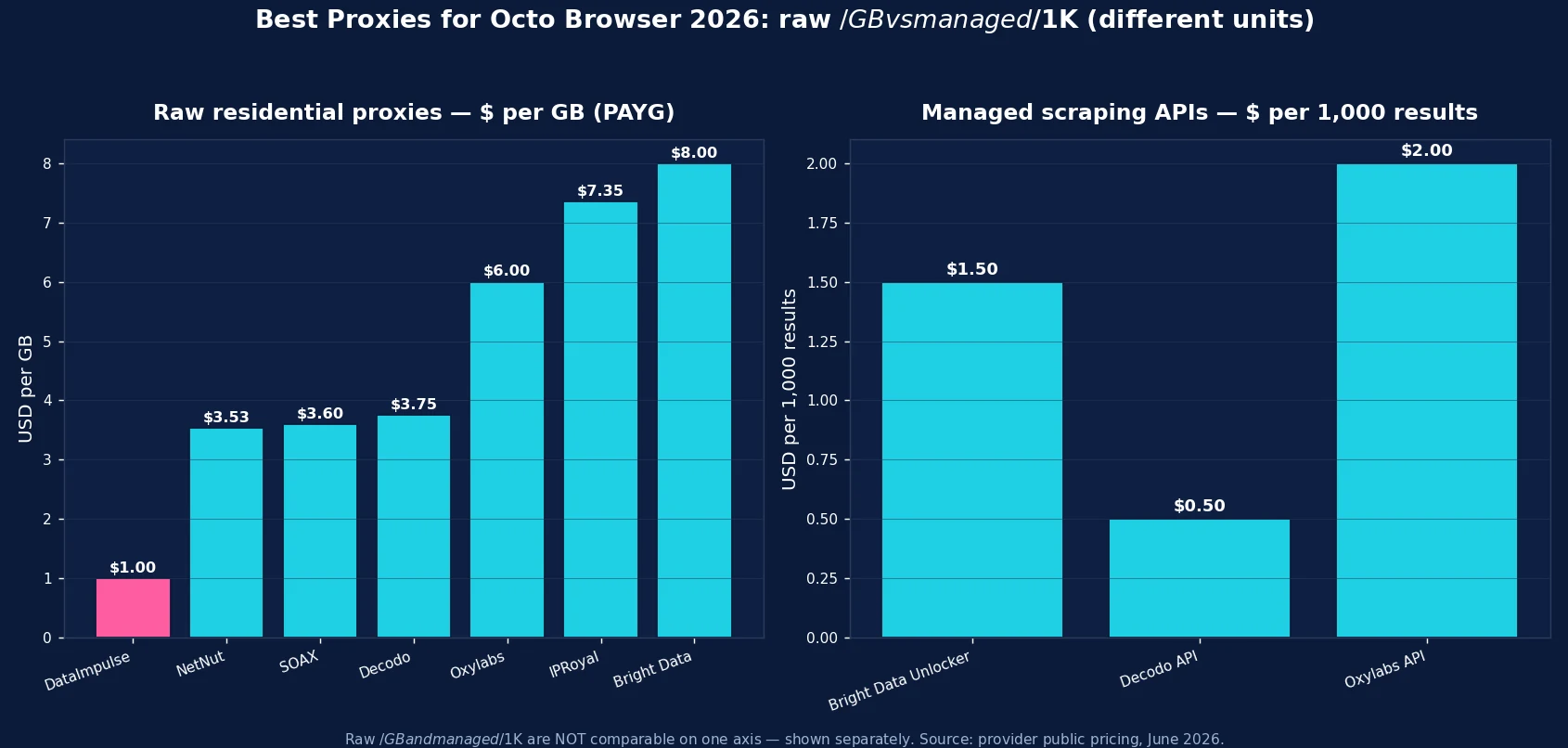
DataImpulse is the value pick for Octo Browser — mobile IPs at $2/GB (the most trusted class for accounts) and residential at $1/GB, on a 90M+ pool across 195 countries, with per-profile sticky sessions via the sessid parameter, country targeting included (city/ASN as a paid add-on), and bulk import into Octo’s Proxy Manager. Pay-as-you-go, traffic never expires, so a stack of profiles doesn’t lock you into a subscription. Published success rate 99.51%; G2 4.8/5; 24/7 human support. For multi-accounting at scale, it’s the lowest cost per trusted, sticky IP.
IPRoyal is popular with antidetect users for its up-to-7-day sticky sessions (from $7.35/GB) — the longest stable window. SOAX ($3.60/GB, 33M+ mobile) is strong when you want mobile and residential together. NetNut (rotating residential from $3.53/GB; its static ISP line is priced separately and higher) focuses on consumer-ISP stability. Bright Data (~$8/GB standard, ~$4 promo) and Oxylabs (from $6/GB) are the enterprise pools with ISP/dedicated options. Decodo (from $3.75/GB, sticky to 24h) is the balanced mid-market choice, and Webshare (free tier; rotating residential from $3.50/mo, static residential priced per-IP) is the budget start.
Common Octo Browser Proxy Mistakes
- Sharing one IP across profiles. The cardinal sin of multi-accounting — two accounts on one IP get linked and banned. Unique sticky IP per profile, always.
- Rotating mid-session. Account work needs a stable IP; a rotating proxy that changes IP mid-session looks like a hijack and trips security checks. Use sticky sessions.
- Using datacenter IPs for social/marketplace accounts — they’re flagged fast. Use mobile, ISP, or sticky residential.
- Geo mismatch. Keep the proxy country (and ideally city) consistent with the account’s history and the profile’s timezone/locale in Octo Browser.
- Changing a profile’s geo later. One profile should keep the same
__cr.xx;city.xx;sessid.xxfor life; switching countries on a live account is a red flag.
How to Start with DataImpulse + Octo Browser
Step 1. Create a DataImpulse account, grab your base login and password from the dashboard, and choose mobile (best for accounts) or residential. The $5 / 5GB intro never expires.
Step 2. In Octo Browser, create or edit a profile → Proxy → type HTTP, host gw.dataimpulse.com, port 823, username YOUR_LOGIN__cr.us;city.newyork;sessid.profile01, your password. Give each profile a unique sessid. Run the proxy check.
Step 3. For many profiles, paste a proxy list into the Proxy Manager (one sticky line per profile). Match each profile’s geo to the account, and never reuse a sessid. See the mobile proxies and residential proxies pages, the Octo Browser setup tutorial, and our GoLogin and AdsPower guides if you run several antidetect tools.
FAQ
How do I add a proxy in Octo Browser?
Create or edit a profile, open the Proxy section, choose the protocol (HTTP, HTTPS, or SOCKS5), and enter host, port, username, and password — e.g. host gw.dataimpulse.com, port 823, username YOUR_LOGIN__cr.us;city.newyork;sessid.profile01. Run the proxy check to confirm the IP, then save. For many profiles, paste a list into Octo’s Proxy Manager and assign one entry per profile.
What’s the best proxy for Octo Browser?
Mobile or ISP/static residential, because account management needs trusted, stable IPs. DataImpulse is the value pick — mobile $2/GB, residential $1/GB, with per-profile sticky sessions, country targeting included and city/ASN as a paid add-on. IPRoyal (up to 7-day sticky) and NetNut (consumer-ISP network; static line priced separately) are also strong for accounts. Avoid datacenter IPs for social and marketplace profiles.
Can I use one proxy for multiple Octo Browser profiles?
No — that’s the fastest way to get accounts linked and banned. Each profile needs its own dedicated, sticky IP. With DataImpulse, give every profile a unique sticky session ID in the username (sessid.profile01, sessid.profile02…) so each gets a different stable IP. Never share a sessid across profiles.
Does Octo Browser support SOCKS5 proxies?
Yes — Octo Browser supports HTTP, HTTPS, and SOCKS5 (plus SOCKS4 and SSH) proxies per profile, and its Proxy Manager stores and tags entries of any supported type for bulk assignment. DataImpulse works over HTTP, HTTPS, and SOCKS5 on the same credentials, so use whichever protocol your workflow expects — the sticky-session username syntax is identical.
Should I use rotating or sticky proxies with Octo Browser?
Sticky. Account management needs a stable IP per profile — a rotating proxy that changes IP mid-session looks like account hijacking and trips security checks. Use sticky sessions (DataImpulse holds an IP per sessid for ~30 min by default, configurable up to 120 min; reconnecting with the same sessid returns the same IP within that window; IPRoyal offers up to 7 days). Rotating proxies are for scraping, not accounts.
How much do Octo Browser proxies cost?
It depends on type. DataImpulse mobile is $2/GB and residential $1/GB pay-as-you-go (traffic never expires); IPRoyal residential from $7.35/GB with long sticky; NetNut rotating from $3.53/GB (static ISP higher); SOAX $3.60/GB; Decodo $3.75/GB; Bright Data ~$8/GB standard (~$4 promo); Webshare from $3.50/mo for rotating residential (static residential is priced per-IP). For multi-accounting, budget per trusted sticky IP rather than per GB, since account profiles use little bandwidth — often the proxy bill stays in single digits per month even with dozens of profiles.