In this Article
Web data for LLM training is the text and content collected from the open web that large language models learn from. Modern LLMs are trained on enormous corpora, and a large share of that comes from crawling the public web — articles, forums, documentation, code, and more. How that data is gathered, filtered, and sourced shapes what the model knows and how defensible it is. This guide defines web training data, where it comes from, how it’s collected at scale, and where proxies fit.
I’m Andrii Byzov, an AI-Native Fractional CMO who builds web-data pipelines for ML teams. Below: a plain definition, the sources, the collection workflow, the proxy layer, and the quality and legal questions. It’s part of the broader web data infrastructure for AI.
Key Facts
- Web data for LLM training = web-collected text/content used to pre-train or fine-tune language models.
- Sources mix: open web crawl, curated public datasets, licensed corpora, and increasingly synthetic data.
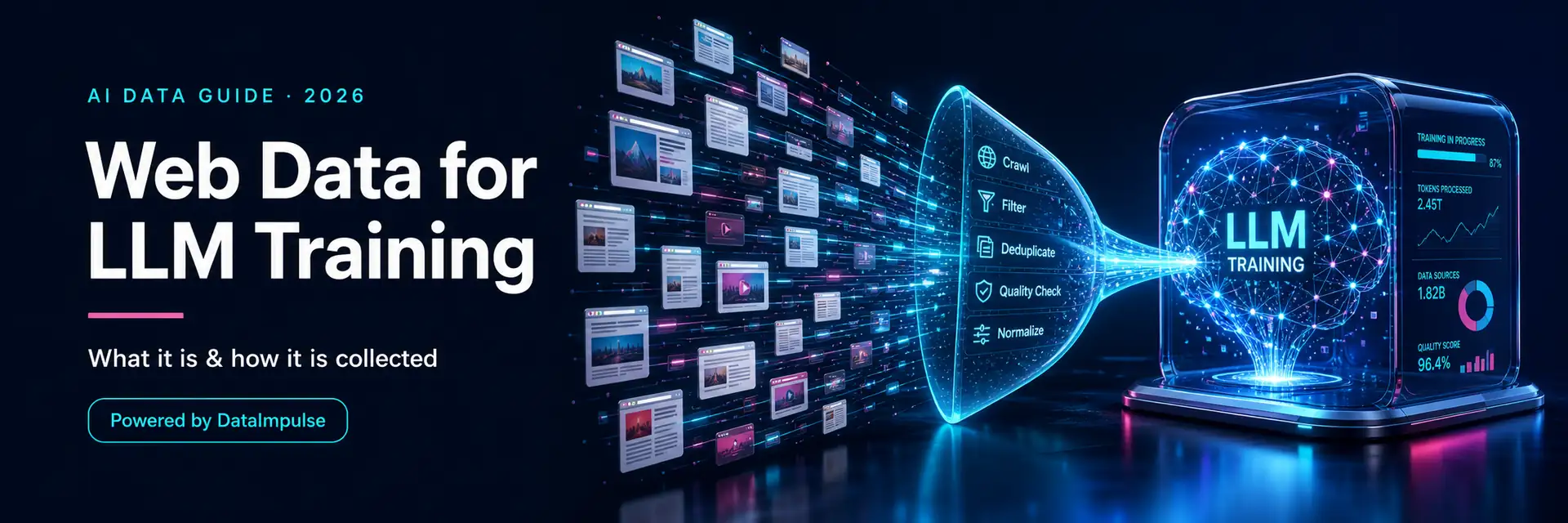
- Collection is a pipeline: crawl → filter → deduplicate → clean → validate, before anything reaches training.
- Diversity matters. A corpus pulled from one region or a few sites inherits that narrowness; geo-distributed collection broadens it.
- Proxies support the crawl’s access. Sites rate-limit and block at scale, so residential proxies help keep large, geo-diverse collection reachable (the scraper does the crawling; the proxy routes it).
What Is Web Data for LLM Training?
It’s the web-sourced portion of an LLM’s training corpus — the text and structured content a model ingests to learn language, facts, and patterns. While some training data is licensed or synthetic, a large share is collected from the public web at massive scale. The phrase covers both the raw collected pages and the cleaned, filtered dataset that actually goes into training. It’s distinct from the proxy mechanics of gathering it (that’s LLM scraping) — here we mean the data itself: what it is, where it comes from, and what makes it good or risky.
Where Training Data Comes From
- Open web crawl — large-scale crawling of public pages (a major source in many disclosed general-purpose training mixtures, e.g. Common Crawl-style data).
- Curated public datasets — filtered, ready-made corpora built on top of web crawls.
- Licensed data — content obtained through agreements with publishers or platforms.
- Synthetic data — model-generated data, increasingly used to fill gaps (and best kept grounded against real web data).
How Web Training Data Is Collected
Raw web pages aren’t training data — they become it through a pipeline. Crawl the target pages, filter out boilerplate, spam, and low-quality or unsafe content, deduplicate (duplicates waste compute and skew the model), clean and normalize the text, and validate quality before it joins the set. The crawl step is ordinary web collection at extraordinary scale, which is exactly where access becomes the hard part.
import requests
# Collecting a web sample for a training corpus: route the crawl through
# residential proxies so it reaches geo-diverse pages without being blocked.
proxies = {"http": "http://LOGIN__cr.us:[email protected]:823",
"https": "http://LOGIN__cr.us:[email protected]:823"}
def collect(url):
r = requests.get(url, proxies=proxies,
headers={"User-Agent": "Mozilla/5.0"}, timeout=30)
r.raise_for_status()
return r.text # -> filter, dedupe, clean, then add to the training set
# Vary the exit country to gather a more diverse, multi-market corpus
for url in seed_urls:
raw = collect(url)
Why Proxies Matter for Training-Data Collection
Collecting at training scale means hitting many sites, many times, from many places — and target sites rate-limit by IP, personalize by geography, and flag datacenter ranges fast. Two needs follow: scale (sustained, high-volume crawling without being throttled) and geo-diversity (a corpus that reflects more than one market). Residential proxies route the crawl through real consumer IPs across markets — DataImpulse residential from $1/GB (mobile from $2/GB) across 195+ locations, rotating and high-concurrency — so large, diverse collection stays reachable where lawful and appropriate (alongside other sources like Common Crawl, APIs, and licensed feeds). The proxies support access; your pipeline handles filtering and quality.
Quality and Legality
Two things separate a usable corpus from a liability. Quality: aggressive filtering and deduplication matter more than raw volume — a smaller, cleaner, well-deduped set often beats a bigger noisy one. Provenance and law: training data has become heavily litigated, and public availability doesn’t settle copyright, contract, or privacy questions — legality depends on jurisdiction, source, data type, and use. Keep collection defensible: favor public, non-personal data, respect site terms and treat robots.txt as a policy signal, avoid bypassing logins or access controls, pace requests, and track where every part of the corpus came from. Using proxies for legitimate collection is generally lawful; the use of the data is what’s scrutinized. See whether web scraping is legal. This is general information, not legal advice.
Frequently Asked Questions
What is web data for LLM training?
It’s the text and content collected from the public web that large language models learn from — a large share of most general models’ training corpora. The term covers both the raw crawled pages and the cleaned, filtered dataset that actually goes into training, alongside licensed and synthetic data.
Where does LLM training data come from?
Four main sources: large-scale open web crawl (usually the biggest), curated public datasets built on crawls, licensed content from publishers or platforms, and synthetic model-generated data. Most general-purpose models lean heavily on web crawl, then filter and deduplicate it heavily.
How is web training data collected?
Through a pipeline: crawl target pages, filter out boilerplate and low-quality or unsafe content, deduplicate, clean and normalize, then validate quality before it joins the training set. The crawl step is web collection at huge scale, where IP rate-limits and blocks make access the hard part.
Why are proxies used for training-data collection?
Collecting at training scale hits many sites repeatedly from many locations, and sites rate-limit and block automated traffic. Residential proxies route the crawl through real consumer IPs across markets, so high-volume, geo-diverse collection stays reachable — which also makes the corpus more diverse than collecting from one location.
Is collecting web data for LLM training legal?
It’s heavily litigated and not unconditional. Public availability doesn’t settle copyright, contract, or privacy questions, and legality depends on jurisdiction, source, data type, and use. Favor public, non-personal data, respect site terms and robots.txt, don’t bypass access controls, pace requests, and track provenance. Using proxies for legitimate collection is generally lawful. Not legal advice.
Conclusion
Web data is a major input to most LLMs, and it’s only as good as how it’s collected, filtered, and sourced. Diversity and clean deduplication beat raw volume; provenance and legal care separate an asset from a liability. The collection step is web access at scale — which often relies on a proxy access layer (residential proxies, alongside Common Crawl, APIs, or datacenter IPs) to keep large, geo-diverse crawls reachable. Build your filtering and quality pipeline; rent the access. See the bigger picture in web data infrastructure for AI, the collection mechanics in proxies for LLM scraping, and best proxies for ML training.
Last updated: June 27, 2026.
 State/City/Zip/ASN Targeting