
In this Article
Bulk email verification is the step that keeps a list from destroying a sending reputation: check addresses before you use them, remove the dead ones, and keep bounce rates inside what mailbox providers tolerate. It is often discussed alongside proxies, and that pairing deserves a straight answer rather than a sales pitch.
This guide explains the four validation stages, why the SMTP stage does not work through rotating proxies, where proxies genuinely contribute, and what actually protects deliverability.
Key Facts
- Proxies are the wrong tool for the SMTP stage. Port 25 is blocked on most consumer networks, and rotating IPs makes mailbox providers trust a probe less, not more.
- Verification runs in four stages, and only two of them touch the web in a way a proxy affects at all.
- Catch-all domains defeat SMTP checks entirely. They accept every address, so a clean result there means nothing.
- Sender reputation lives on the sending IP and domain, which is exactly what a proxy cannot change. Verification protects reputation; it does not create it.
- Verify at collection time, not before the send. A list verified once and stored for six months is a list with a fresh bounce problem.
How does email verification work?
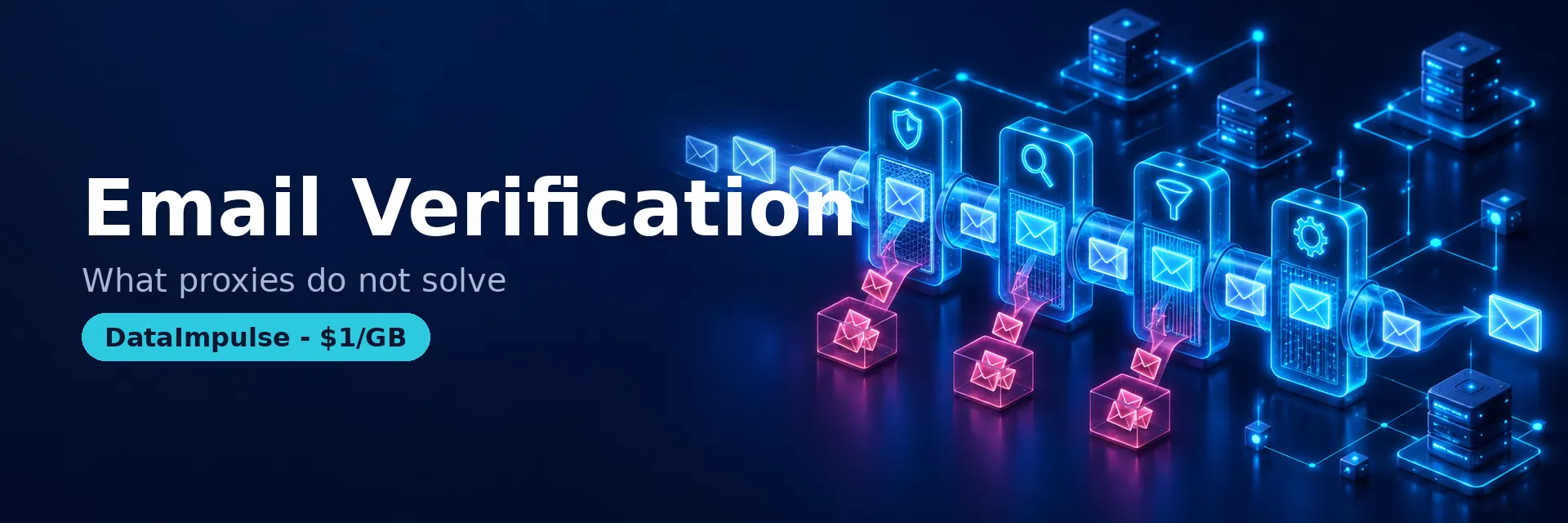
In four stages, cheapest first. We call it the 4-stage validation model.
| Stage | Check | Removes |
|---|---|---|
| 1. Syntax | Format and character rules | Typos and malformed entries, instantly and for free |
| 2. Domain | MX records, domain resolution, disposable-domain lists | Dead domains and throwaway providers |
| 3. Mailbox | SMTP conversation up to the recipient command | Non-existent mailboxes, where the provider answers honestly |
| 4. Risk | Role accounts, known complainers, spam traps | Addresses that are real and still damaging to send to |
Stages one and two are the ones that pay for themselves. Stage three is where most of the complexity, and most of the false confidence, lives.
Why does SMTP probing through proxies fail?
The probing IP is the whole signal, and a rotating exit destroys it. Four reasons, and they compound.
Port 25 is usually blocked. Consumer ISPs and most residential proxy networks do not carry outbound SMTP, because that path is how botnets send spam. A residential exit is therefore not available for the probe at all in most cases.
Reputation is the point of the check. Mailbox providers weigh the probing IP’s history. An address with no history, appearing once and never again, is exactly the profile that gets a generic answer or an outright refusal, so rotation makes results worse rather than better.
Catch-all domains say yes to everything. A large share of business domains accept all recipients and sort later, so the SMTP conversation returns success for addresses that do not exist. No amount of network engineering changes that.
Aggressive probing is itself a reputation event. Repeated recipient checks against one provider look like directory harvesting and get the source blocked.
The practical conclusion: for the SMTP stage, use a verification provider that runs a maintained pool of reputable sending IPs, or skip the stage and rely on a gradual warm-up with careful bounce handling. This is one of the places where the honest answer is that our product is not the right tool.
Where do proxies genuinely help?
| Task | Use | Avoid when |
|---|---|---|
| Collecting business contact data from public sources | Rotating residential | The source has an API or an export |
| Checking whether a company domain is live and what it hosts | Datacenter or no proxy | Never over-engineer a DNS lookup |
| Verifying that a company page still lists a contact | Residential, matching the company’s region | The page is region-independent |
| Any SMTP mailbox probe | Neither: use a verification provider | Always |
Searches for email verification proxies usually come from the SMTP row of that table, and the honest answer for that row is that no proxy type fixes it. The pattern is consistent: proxies belong to the collection side of the pipeline, where you are reading public web pages at scale, and not to the sending or probing side, where identity and reputation are the entire mechanism.
DataImpulse residential is $1 per GB across 195 countries, which is the layer that makes the collection half reproducible across markets.
What actually protects deliverability?
Authenticate properly. SPF, DKIM and DMARC on the sending domain do more for inbox placement than any list hygiene tool, and they are a one-time configuration.
Verify at collection, not before the blast. Addresses decay continuously as people change jobs. Verifying when the record enters your system, and re-verifying anything older than a few months before use, spreads the cost and catches decay.
Warm up gradually. A new sending domain going from zero to tens of thousands of messages is the single clearest spam signal available.
Handle bounces immediately. Suppress hard bounces on the first occurrence. Most reputation damage comes from repeatedly sending to addresses that already refused.
Respect consent. Under the GDPR, the ePrivacy rules and CAN-SPAM, the relevant question is whether you may contact the person at all, and verification says nothing about that. Buying a verified list does not make it a permitted one. General information, not legal advice.
Watch the metric that matters. Bounce rate is the number mailbox providers act on, and the practical ceiling is low single digits before placement suffers. Complaint rate is stricter still. Both are visible in the postmaster tools the major providers publish for free, and checking them weekly catches a list problem before it becomes a domain problem.
Frequently Asked Questions
Do I need proxies for bulk email verification?
Not for the verification itself. The SMTP stage depends on the reputation of the probing IP and usually needs port 25, which most residential networks block, so rotating exits make results worse. Proxies belong to the collection side, where you are gathering public business data at scale.
Why does SMTP verification return false positives?
Mostly catch-all domains, which accept every recipient and sort the mail afterwards. The SMTP conversation returns success for addresses that do not exist, so a clean result on a catch-all domain carries no information at all.
Can I run my own verification service?
Technically yes, practically it is a reputation business rather than a code problem. You would need a pool of IPs with established sending history, careful pacing per provider, and constant monitoring for blocks. Most teams get better results from a provider that already maintains that.
How often should a list be re-verified?
Verify at the moment an address enters your system, then re-verify anything older than a few months before it is used. People change jobs continuously, so a list verified once and stored is a list with a growing bounce problem.
Does verification make a purchased list safe to email?
No. Verification answers whether an address exists, not whether you have a lawful basis to contact the person. Consent rules under the GDPR, ePrivacy and CAN-SPAM apply independently of deliverability. General information, not legal advice.
The collection half, done properly
Gathering public business data across markets is the part of this pipeline where the exit address matters. DataImpulse residential proxies cover 195 countries at $1 per GB with country and city targeting. Create an account and test one source before scaling.
Related: data enrichment · proxies for web scraping · is web scraping legal.
Last updated: September 17, 2026.

 State/City/Zip/ASN Targeting



