
In this Article
To diagnose a Craigslist IP block, save the exact error, check for an outage, isolate browser state, and compare the same page once over another connection. A blocked page or failed post alone cannot tell you whether the restriction concerns your network, account, request, or listing.
Our quick run on October 18, 2026 illustrates the distinction: ordinary search pages worked, while an RSS-format request failed through both connections. Start with that diagnostic mindset before changing settings or paying for another connection.
Key Facts
- An HTTP 403 response alone does not establish an IP block.
- Clearing cookies does not change your public IP address.
- A successful cellular comparison suggests network dependence, not account reinstatement.
- Our quick run on October 18, 2026 covered 20 requests.
- Public search pages worked through both routes in our snapshot.
- The RSS-format request returned a 248-byte block page through both routes.
What does a Craigslist IP block actually mean?
An IP block means access is restricted based on the network address associated with a request. An explicit IP-denial message is stronger evidence than a generic error, but it still needs context.
HTTP’s definition of 403 Forbidden describes a refusal to fulfill a request; it does not specify an IP-based cause. Likewise, a removed listing or failed submission does not establish that browsing is blocked.
Record whether the failure affects a public page, login, or one posting action. Our IP blocking explainer covers the underlying distinction. If the error arrived in an email bounce, use Craigslist’s email rejection guidance; that page concerns mail delivery, not website access.
Why does a Craigslist IP block happen?
The visible error rarely reveals the complete cause. Treat automated traffic, shared-network activity, and request-specific rejection as hypotheses rather than confirmed detection rules.
First ask what changed: an auto-refresh tool, browser extension, work connection, or particular URL. A shared connection makes attribution harder because your activity may not be the only traffic using that address.
Our snapshot shows why the URL matters. The ordinary search and RSS-format requests behaved differently through the same routes. That observation supports investigating the request before blaming the address; it does not reveal Craigslist’s internal enforcement logic.
How can you check whether your IP is blocked?
Use the 4-step access diagnosis check to change one variable at a time. The goal is evidence you can interpret, not repeated attempts until something loads.
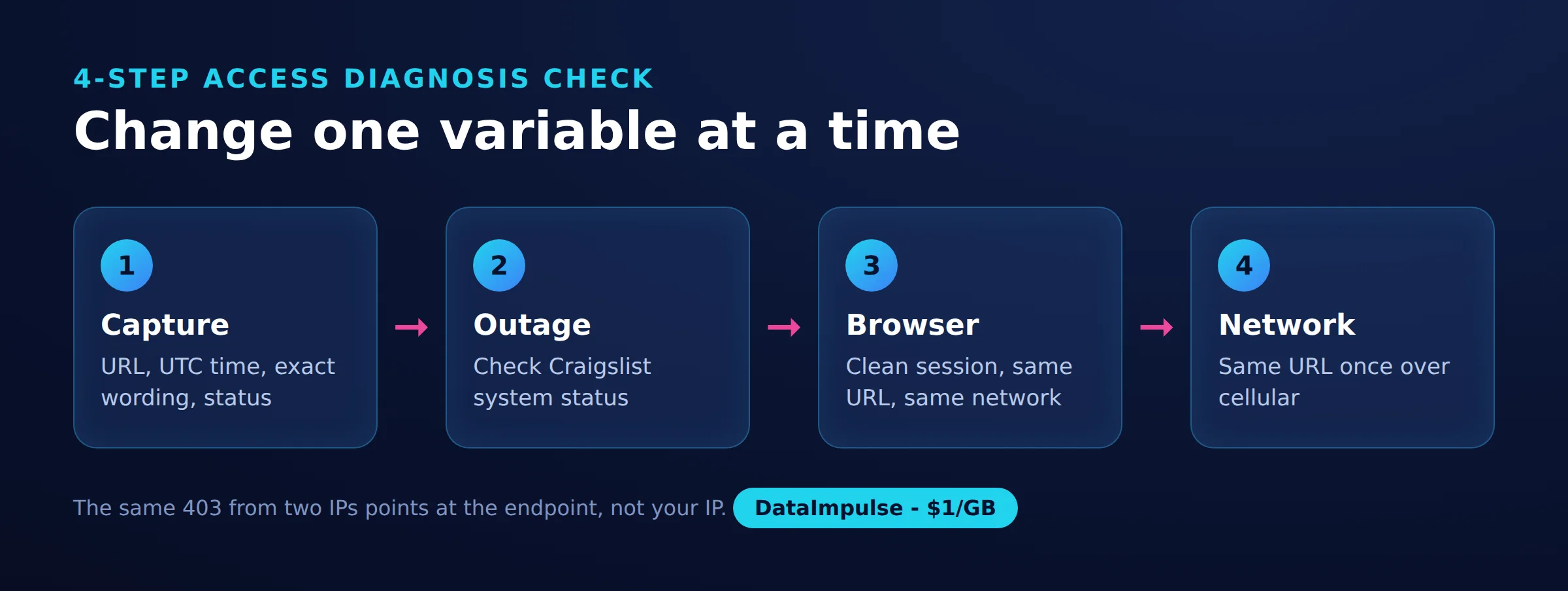
- Step 1: Capture the error. Save the URL, UTC time, screenshot, exact wording, and any block identifier. Record the HTTP status if available.
- Step 2: Check for an outage. Consult Craigslist system status before changing your connection.
- Step 3: Isolate the browser. Try a clean browser session on the same connection. Keep the URL unchanged.
- Step 4: Compare the network. Try that public URL once over cellular, keeping the browser and login state as consistent as possible.
Success only over cellular suggests network dependence, not definitive proof of an IP ban. Matching failures also cannot rule out restrictions affecting both networks. See our guide to interpreting 403 responses.
Our quick run on October 18, 2026 comprised 20 requests on Linux with Python 3.12, between 16:00 and 16:13 UTC, with 4-5 second pauses. We compared direct datacenter access with a DataImpulse US residential route using requests and curl_cffi’s Chrome mode. There was no login or posting.
| UTC window | Route | Endpoint | HTTP | Observed result | Body size | Elapsed ms |
|---|---|---|---|---|---|---|
| 16:00-16:13 | Direct | sfbay /search/sss | 200 | OK, 335 results | About 438 KB | Unrecorded in summary |
| 16:00-16:13 | Residential | sfbay /search/sss | 200 | OK, 335-348 results | About 443 KB | Unrecorded in summary |
| 16:00-16:13 | Both | newyork /search/bia?query=bike | 200 | OK | About 448 KB | Unrecorded in summary |
| 16:00-16:13 | Both | sfbay /search/sss?format=rss | 403 | BLOCK_PAGE | 248 bytes | Unrecorded in summary |
| 16:00-16:13 | Both | sapi /web/v8/postings/search/full | 200 | JSON response | About 141 KB | Unrecorded in summary |
Source: our run notes and diagnostic script, craigslist_block_check.py, which writes block_report.json. Rows aggregate requests; library versions, individual timestamps, and exact per-request byte counts are unavailable in this summary. This was a live snapshot, not a benchmark or a controlled simulation.
No response displayed the automatic IP-block message. The RSS-format response said “Your request has been blocked” through both routes and both clients. That suggests request-specific refusal, but does not prove its cause. The classifier passed seven offline examples; its advice overstates what two-route comparisons can establish.
Which recovery steps should you try first?
Stop repeated requests first, then investigate browser state and network dependence. Change one thing, record the outcome, and stop if an explicit restriction persists.
Pause automation and auto-refresh extensions. Save unfinished work before clearing Craigslist site data, since this can remove session state. Restarting a router is worth considering only if your ISP confirms that reconnection may assign a different dynamic address; renewal is not guaranteed.
| Option | Use X when… | Avoid X when… |
|---|---|---|
| Clear site data | Use site-data cleanup when isolating browser/session problems. | Avoid it when expecting an IP change. |
| Cellular comparison | Use cellular when testing network dependence once. | Avoid it when treating success as account reinstatement. |
| Router restart | Use a restart when your ISP may assign another dynamic address. | Avoid it when assuming guaranteed renewal. |
| Proxy/VPN | Use another route when testing an authorized connection. | Avoid it when expecting guaranteed access or moderation reversal. |
Our broader IP-ban recovery guide adds context, but a connection change cannot resolve every failure.
How long does a block last, and how do you request review?
There is no verified universal duration to promise. Treat claims of automatic recovery after 24 or 48 hours as unsupported unless your specific notice states that timing.
Use the official contact form and choose the issue matching your evidence. Send a concise report rather than repeated submissions:
I encountered [exact error] at [UTC time] on [URL]. The problem affects [public browsing/login/posting]. On my usual connection, [result]. In a clean browser session, [result]. On cellular, [result]. The block identifier is [identifier]. I stopped repeated attempts. Please review the restriction or advise which issue applies.
Attach a redacted screenshot. Keep passwords, session cookies, and proxy credentials out of the report.
When should you use a different connection, proxy or VPN?
A different connection can help isolate a network-dependent failure. It cannot restore a moderated account or guarantee that a request will be accepted.
For ordinary browsing, a single cellular comparison is usually enough evidence to begin troubleshooting. If you need authorized proxy testing, read our Craigslist connection guide and proxy versus VPN comparison.
Keep regional testing separate from geographic permission: an exit location does not establish posting eligibility or authorization. Avoid changing location and browser state together. Consider who operates the connection, protect account credentials, and never install an unknown certificate just to make a page load.
How can you prevent repeat browsing or posting problems?
Use a consistent browsing workflow and check posting requirements before resubmitting. Do not interpret a posting interval as a browsing allowance.
Craigslist’s posting-removal guidance limits each item or offering to one posting every 48 hours (as of October 2026). Its checklist also supports these practical checks:
- Choose the correct category.
- Use the single geographic area closest to you or the offering.
- Keep prices, fees, and descriptions accurate.
- Avoid keyword spam and other people’s personal information.
There is no verified secret-word checklist here. Keep notes on the failed action and avoid repeated submissions while investigating.
What should data collectors know about limits and blocking?
Our run establishes neither a safe request rate nor a guaranteed safe section. Rotating addresses or User-Agent strings does not establish permission or reliable access.
The 4-5 second pauses describe our method, not an approved interval. Successful JSON responses likewise do not establish a supported public API. Review authorization before collection; our general collection guidance is background, not site-specific permission.
For scale context only, one search response had a compressed payload of 69,877 bytes. At $1/GB, payload bytes x 1,000 / 1,000,000,000 x $1 gives about $0.07 per 1,000 similar responses, versus roughly $0.44 using the raw size. This is not an all-request mean; overhead, retries, and minimum purchase are excluded.
For automated checks, the script below is the one from our quick run on October 18, 2026. It requests one public URL directly and, if PROXY_URL is set, once more through that proxy, then labels each response as OK, BLOCK_PAGE, HTTP_403, HTTP_429, CAPTCHA or OTHER and prints a recommendation. In our run, search pages returned OK from both routes, while the RSS format returned the same 403 from both, which points at the endpoint rather than the IP.
import json, os, sys, time
import requests

PROXY = os.environ.get("PROXY_URL")  # e.g. http://USER__cr.us:[email protected]:823
HEADERS = {
    "User-Agent": "Mozilla/5.0 (Windows NT 10.0; Win64; x64) AppleWebKit/537.36 "
                  "(KHTML, like Gecko) Chrome/141.0.0.0 Safari/537.36",
    "Accept-Language": "en-US,en;q=0.9",
}
BLOCK_TEXT = ["this ip has been automatically blocked", "your request has been blocked",
                 "blockid="]
CAPTCHA_TEXT = ["captcha", "are you a human", "verify you are human", "cf-chl"]

ADVICE = {
    "OK": "Page looks normal. Keep your current pace.",
    "BLOCK_PAGE": "Craigslist block page. Stop, wait, and test the same URL from a second IP.",
    "HTTP_403": "Forbidden without the usual block text. Check URL, headers and IP.",
    "HTTP_429": "Rate limited. Slow down (10+ s between requests) and back off.",
    "CAPTCHA": "Challenge page. Do not solve it; slow down or change IP and client.",
    "OTHER": "Unexpected response. Save the body and read it before retrying.",
}


def classify(status, body):
    text = body[:20000].lower()
    if status == 429:
        return "HTTP_429"
    if any(t in text for t in BLOCK_TEXT):
        return "BLOCK_PAGE"
    if any(t in text for t in CAPTCHA_TEXT) and status != 200:
        return "CAPTCHA"
    if status == 403:
        return "HTTP_403"
    if status == 200 and ("cl-static-search-result" in text or "craigslist" in text):
        return "OK"
    return "OTHER"


def check(url, proxy=None):
    proxies = {"http": proxy, "https": proxy} if proxy else None
    t = time.time()
    try:
        r = requests.get(url, headers=HEADERS, proxies=proxies, timeout=30)
    except requests.RequestException as exc:
        return {"status": None, "kb": 0, "ms": 0, "verdict": "OTHER", "error": type(exc).__name__}
    return {"status": r.status_code, "kb": round(len(r.content) / 1024),
            "ms": int((time.time() - t) * 1000), "verdict": classify(r.status_code, r.text),
            "items": r.text.count('class="cl-static-search-result"')}


def recommend(direct, via_proxy):
    if via_proxy is None:
        return ADVICE[direct["verdict"]]
    if direct["verdict"] == "OK" and via_proxy["verdict"] == "OK":
        return "Both routes fine. Nothing to fix."
    if direct["verdict"] != "OK" and via_proxy["verdict"] == "OK":
        return "Blocked only from your own IP: an IP block. Rotate IPs and slow down."
    if direct["verdict"] == via_proxy["verdict"] != "OK":
        return "Same failure from two different IPs: the URL or request is the problem, not your IP."
    return f"Mixed result: direct={direct['verdict']}, proxy={via_proxy['verdict']}. Re-test later."


if __name__ == "__main__":
    urls = sys.argv[1:] or ["https://sfbay.craigslist.org/search/sss",
                            "https://sfbay.craigslist.org/search/sss?format=rss"]
    report = []
    for url in urls:
        direct = check(url)
        time.sleep(5)
        via_proxy = check(url, PROXY) if PROXY else None
        time.sleep(5)
        row = {"url": url, "direct": direct, "proxy": via_proxy,
               "advice": recommend(direct, via_proxy)}
        report.append(row)
        print(json.dumps(row, indent=2))
    with open("block_report.json", "w") as f:
        json.dump(report, f, indent=2)
Run: pip install requests; PROXY_URL="http://USER__cr.us:[email protected]:823" python3 craigslist_block_check.py [url ...]
What legal and policy issues matter?
Technical access, contractual permission, and legal compliance are separate questions. A successful response settles only the first.
Craigslist’s terms restrict collection and interacting software unless separately licensed, and prohibit bypassing moderation (as of October 2026). Its robots.txt disallows paths including /reply and /flag (as of October 2026). Under RFC 9309, robots directives are not access authorization.
Where GDPR applies, processing personal data requires a lawful basis and compliance with principles including minimization and transparency under Articles 5 and 6. Public visibility does not remove those obligations. EU database rights can also restrict substantial extraction or reutilization from qualifying databases.
The 2022 hiQ v. LinkedIn opinion affirmed preliminary relief involving public profiles and serious questions about CFAA application. It did not grant blanket scraping permission or resolve every contractual claim. Assess the intended activity, applicable jurisdiction, and any permission before collection; the reader decides, check local law.
What alternatives reduce repeated checking?
Saved-search alerts can replace repeated manual refreshes. Craigslist’s search-alert instructions describe email notifications with a maximum of 20 results per email (as of October 2026).
Enable the alert checkbox for a saved search in your account. For data requirements beyond notifications, seek an authorized arrangement rather than treating an internal endpoint or an old RSS URL as a supported export service.
Frequently Asked Questions
Can Craigslist block your IP address?
An IP-based restriction is possible, but a generic refusal does not identify its scope. Preserve any explicit IP-denial wording and compare it with the behavior of ordinary public pages.
Does a 403 or blocked posting prove an IP ban?
No. A 403 records refusal, while a posting failure concerns a particular action; either needs more evidence before you attribute it to the network address.
Does clearing cookies or restarting the router remove a block?
Cookie cleanup can help isolate session problems, but leaves your public address unchanged. A router restart might change a dynamic address depending on the ISP, with no guarantee of restored access.
How long do Craigslist IP blocks last?
The evidence here establishes no standard expiry period. Follow any specific notice and request review when the cause remains unclear.
Can a proxy restore a blocked Craigslist account?
A different route does not reinstate an account. Account restrictions need to be addressed through the relevant support process.
Did residential access perform better in the quick run?
The snapshot showed no access advantage: public searches succeeded and the RSS-format request failed through both routes. Twenty requests cannot establish broader reliability or comparative block rates.
Need an authorized connection comparison?
DataImpulse residential proxies start at $1 per GB for projects that need another testing route. DataImpulse is a proxy service, not a scraping API, managed unblocker, or VPN; access and moderation outcomes remain outside its control.
Last updated: October 18, 2026.

 State/City/Zip/ASN Targeting



