In this Article
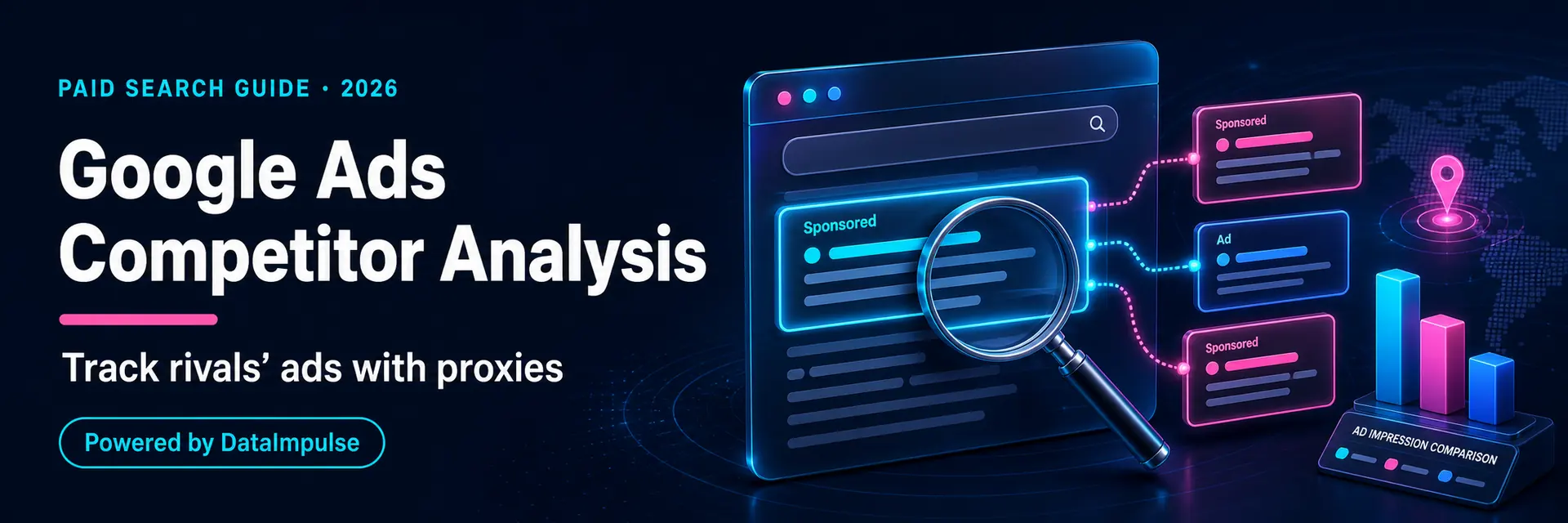
Google Ads competitor analysis is the practice of tracking which ads your rivals run — their headlines, copy, landing pages, and the queries their ads show up on — so you can sharpen your own campaigns. Their ads are public; the challenge is collecting them systematically, because Google personalizes results by location and throttles automated queries. This guide covers what to track, the methods that work (Google’s Ads Transparency Center and SERP ad scraping), and how proxies make competitor ad monitoring reliable across markets.
I’m Andrii Byzov, an AI-Native Fractional CMO who runs paid-search and competitive-intelligence pipelines. Below: the data worth collecting, two practical collection methods, a code example, the legal line, and where proxies fit.
Key Facts
- Competitors’ ads are public data — headlines, copy, and landing pages show on the SERP and in Google’s Ads Transparency Center.
- Two collection methods: the Ads Transparency Center (approved ads an advertiser ran recently, ~last 30 days) and SERP ad scraping (the ads that appear for your target queries).
- Ads are geo-personalized — what shows in New York differs from London — so accurate competitor analysis queries from an IP in each target market.
- Google throttles automated queries and flags datacenter IPs fast, so SERP-based monitoring at scale needs rotating residential proxies.
- This is competitor ad intelligence, not ad verification — tracking rivals’ ads, not checking that your own ads display correctly.
What Is Google Ads Competitor Analysis?
Google Ads competitor analysis (or Google AdWords competitor analysis, in the old name) means monitoring the paid-search activity of the companies you compete with: which queries surface their ads, what their headlines and offers say, where their ads point, and how persistent each campaign is. (What you observe is the queries their ads appear on, not proof of the exact keywords or bids behind the scenes — broad match, Performance Max, and auction effects all play in.) Done continuously, it tells you which messages rivals are betting on, what landing-page angles convert for them, and where there are gaps you can attack. It’s distinct from ad verification, which checks that your own ads render correctly — here you’re studying everyone else’s.
What Data Can You Track?
- Ad headlines & copy — the messaging and offers competitors test.
- Landing-page URLs — where each ad sends traffic, and how those pages are built.
- Trigger queries — the searches where a competitor’s ads appear in your runs (a signal of targeting, not proof of exact keyword bids).
- Ad persistence & frequency — which campaigns run long-term (the winners) vs short tests.
- Geo & device — which markets and devices a competitor prioritizes.
Methods to Track Competitor Ads
1. Google Ads Transparency Center
Google’s Ads Transparency Center is a public library showing the approved ads a verified advertiser has run recently — generally the last 30 days — with formats and regions, subject to location and eligibility limits. It’s the cleanest starting point for competitor ad intelligence — a verified advertiser’s recent ads in one place. You can review it manually or collect from it systematically (through proxies, since it’s still geo-aware and rate-limited).
2. SERP Ad Scraping
The other method is scraping the search results themselves: query your target keywords and capture the sponsored results that appear. This shows the exact competitive landscape for a keyword — who’s bidding, in what order, with what copy. Because ads are geo-personalized and Google rate-limits hard, this is where rotating residential proxies and the right gl/hl parameters matter most. (See our best proxies for SERP scraping guide for the SERP layer.)
3. Third-Party Tools
Tools like SEMrush and SpyFu estimate competitors’ keywords and ad spend from their own datasets — convenient, but you don’t control the methodology or freshness. DIY SERP and Transparency-Center collection gives you exactly the keywords, markets, and cadence you care about.
How to Scrape Competitor Ads from the SERP
The DIY route: send your target keyword to Google from the right market through a residential proxy, then parse the sponsored blocks. First, fetch the SERP with country/language parameters that match the proxy’s location.
import requests
from urllib.parse import quote_plus
HEADERS = {"User-Agent": "Mozilla/5.0 (Windows NT 10.0; Win64; x64) "
"AppleWebKit/537.36 (KHTML, like Gecko) Chrome/126.0.0.0 Safari/537.36",
"Accept-Language": "en-US,en;q=0.9"}
# Ads are geo-personalized, so query from an IP in the target market.
proxies = {"http": "http://LOGIN__cr.us;sid.ads1:[email protected]:823",
"https": "http://LOGIN__cr.us;sid.ads1:[email protected]:823"}
def fetch_serp(keyword, gl="us", hl="en"):
"""Fetch a Google SERP for a keyword from a specific country (gl) and
language (hl), routed through a residential proxy in that market."""
url = (f"https://www.google.com/search?q={quote_plus(keyword)}"
f"&gl={gl}&hl={hl}")
r = requests.get(url, headers=HEADERS, proxies=proxies, timeout=30)
r.raise_for_status()
# bail out if Google served a consent/CAPTCHA/block page instead of results
if "sorry/index" in r.url or "consent" in r.url or "unusual traffic" in r.text.lower():
raise RuntimeError("Got a consent/CAPTCHA/block page, not a SERP")
return r.text
Then extract the ad blocks — headline, landing URL, and copy — into structured rows you can log over time. Google’s SERP markup changes frequently, so treat the selectors as a starting point and verify them in DevTools.
from bs4 import BeautifulSoup
def extract_ads(html):
"""Pull the sponsored results (your competitors' live ads) from the SERP:
headline, display/landing URL, and copy. Google's markup changes often, so
confirm the current selectors in DevTools."""
soup = BeautifulSoup(html, "html.parser")
ads = []
for block in soup.select("div[data-text-ad], div.uEierd"):
head = block.select_one("div[role='heading'], span")
link = block.select_one("a[href]")
body = block.select_one(".MUxGbd, .Va3FIb")
ads.append({
"headline": head.get_text(strip=True) if head else None,
"url": link["href"] if link else None,
"copy": body.get_text(strip=True) if body else None,
})
return ads
ads = extract_ads(fetch_serp("crm software", gl="us"))
print(ads)
Run this across your keyword list on a schedule, log each ad with a timestamp, and you build a history of competitors’ messaging and which campaigns persist — the core of ongoing Google Ads competitor analysis.
Why Proxies Matter for Competitor Ad Monitoring
Two reasons SERP-based competitor analysis needs proxies. First, geo-personalization: Google shows different ads by location, so to see a competitor’s ads in a given market you query from an IP there — without it, your view is just your own location’s. Second, rate limiting: Google throttles automated queries and flags datacenter IPs quickly, so monitoring a real query set across markets is hard without rotating IPs. DataImpulse residential proxies ($1/GB, rotating, 195 countries with city targeting) give you per-market, real-user IPs — but proxies affect localization, they don’t make scraping compliant: check Google’s Terms and robots, rate-limit, and prefer permitted APIs or licensed vendors where you can.
Is It Legal to Track Competitor Ads?
The ad data itself is public — competitors’ ads are shown to everyone, and Google’s Ads Transparency Center is explicitly a public library. Collecting public, non-personal ad data for competitive research is broadly defensible. But public-facing doesn’t erase the caveats: Google’s terms restrict automated querying and bypassing protections, so automated SERP collection can raise ToS and other legal issues — not just rate-blocking. Prefer permitted APIs or licensed vendors where possible, and get legal review for scaled collection. Either way, stay in the defensible lane — collect public ad data, don’t bypass logins or access controls, respect rate limits, and don’t scrape personal data. For the full framework, see our guide on whether web scraping is legal. This is general information, not legal advice.
Frequently Asked Questions
What is Google Ads competitor analysis?
It’s monitoring the paid-search activity of your competitors — which keywords trigger their ads, their headlines and copy, the landing pages they use, and how long each campaign runs. The goal is to learn which messages and offers rivals are betting on and find gaps you can exploit. It’s different from ad verification, which checks your own ads.
How do I see what Google Ads a competitor is running?
Two ways: Google’s Ads Transparency Center, a public library of the approved ads a verified advertiser has run recently (generally the last 30 days, with location limits); and SERP ad scraping, where you query your target keywords and capture the sponsored results. The Transparency Center shows an advertiser’s recent ads in one place; SERP scraping shows the ads appearing for a query in your runs.
Do I need proxies to track competitor ads?
For SERP-based monitoring at any scale, yes. Google shows different ads by location and rate-limits automated queries, flagging datacenter IPs fast. Rotating residential proxies in each target market return location-accurate ads and reduce blocks — though they don’t override Google’s terms.
Is tracking competitors’ Google Ads legal?
The ad data is public — ads are shown to everyone and the Ads Transparency Center is a public library — so collecting it for competitive research is broadly defensible. But public-facing doesn’t remove the caveats: Google’s terms restrict automated querying and bypassing protections, so automated SERP collection can raise ToS and other legal issues — prefer permitted APIs or licensed vendors where possible, and get legal review for scaled collection. Respect rate limits, don’t bypass access controls, and avoid personal data. Not legal advice.
What’s the difference from ad verification?
Ad verification checks that your own ads display correctly and aren’t subject to fraud or misplacement. Competitor analysis tracks other companies’ ads to inform your strategy. Same proxy infrastructure, opposite direction.
Conclusion
Google Ads competitor analysis turns rivals’ public ads into a strategy input: their messaging, landing pages, the queries their ads appear on, and which campaigns persist. Combine Google’s Ads Transparency Center with SERP ad scraping, run it per-market through geo-targeted residential proxies, and log results over time. Keep to public ad data and respect rate limits, and you stay in the defensible lane. For the SERP layer, see best proxies for SERP scraping; for the broader setup, best proxies for web scraping.
Last updated: June 25, 2026.
 State/City/Zip/ASN Targeting