

In this Article
Implement python requests retry with a Session, an HTTPAdapter, and a urllib3 Retry policy, then set explicit timeouts on each call. Keep replay safety, attempt counts, and server pacing in the same design.
Start with the tested scripts below. Our quick run on October 16, 2026 shows what happened against controlled local failures, including a persistent 503 that remained a failure after every retry.
Key Facts
- urllib3 Retry mounted on an HTTPAdapter adds retries to every call in a requests.Session.
- A 503, 503, 200 endpoint succeeded on attempt 3 after 1.2 s in our local test.
- A 429 with Retry-After: 2 waited exactly 2.0 s before the retry.
- A permanently failing endpoint stopped after 6 attempts and 15.7 s instead of looping.
- POST is not retried by default; add it only for idempotent calls.
- Tenacity gives the same pattern for any function, with every wait logged.
How do you implement Python Requests Retry?
Mount a retry-configured adapter for both HTTP and HTTPS, then call through that Session. This is our tested requests_retry.py; start the local server shown later before running it.
import logging, time
import requests
from requests.adapters import HTTPAdapter
from urllib3.util.retry import Retry

logging.basicConfig(level=logging.WARNING)
logging.getLogger("urllib3.connectionpool").setLevel(logging.DEBUG)  # shows each retry


def make_session(total=5, backoff=0.5):
    retry = Retry(
        total=total,                       # overall cap across all error types
        connect=3, read=2,                 # separate caps for connection and read failures
        status_forcelist=(429, 500, 502, 503, 504),
        allowed_methods=frozenset({"GET", "HEAD", "OPTIONS"}),  # never auto-retry POST
        backoff_factor=backoff,            # sleeps 0, 1, 2, 4 ... seconds (0.5 x 2^n, first retry immediate)
        backoff_jitter=0.3,                # random extra delay so many clients do not retry in sync
        respect_retry_after_header=True,   # wait what a 429/503 Retry-After says
        raise_on_status=False,             # return the last response instead of raising RetryError
    )
    s = requests.Session()
    adapter = HTTPAdapter(max_retries=retry)
    s.mount("http://", adapter)
    s.mount("https://", adapter)
    return s


if __name__ == "__main__":
    s = make_session()
    base = "http://127.0.0.1:8377"
    s.get(f"{base}/reset")
    for path in ("/ok", "/flaky", "/limited", "/down"):
        t = time.time()
        r = s.get(base + path, timeout=(3.05, 10))   # (connect, read) timeouts
        print(f"{path:9} -> {r.status_code} after {time.time() - t:.2f}s, body {r.text}")
Requests does not retry failed connections by default. A Session retains settings and pools connections; its mounted HTTPAdapter passes the retry policy to urllib3. See Requests advanced usage.
This measurement script prints the final response, including errors. In application code, call raise_for_status() before consuming a successful result and handle terminal RequestException failures at the caller boundary. The reset call is local setup and has no explicit timeout; do not copy that omission into remote calls. See Requests error handling.
Which failures should Python Requests Retry handle?
Retry failures that could plausibly disappear, and only when repeating the operation is acceptable. Use this 4-step retry safety check before choosing settings.
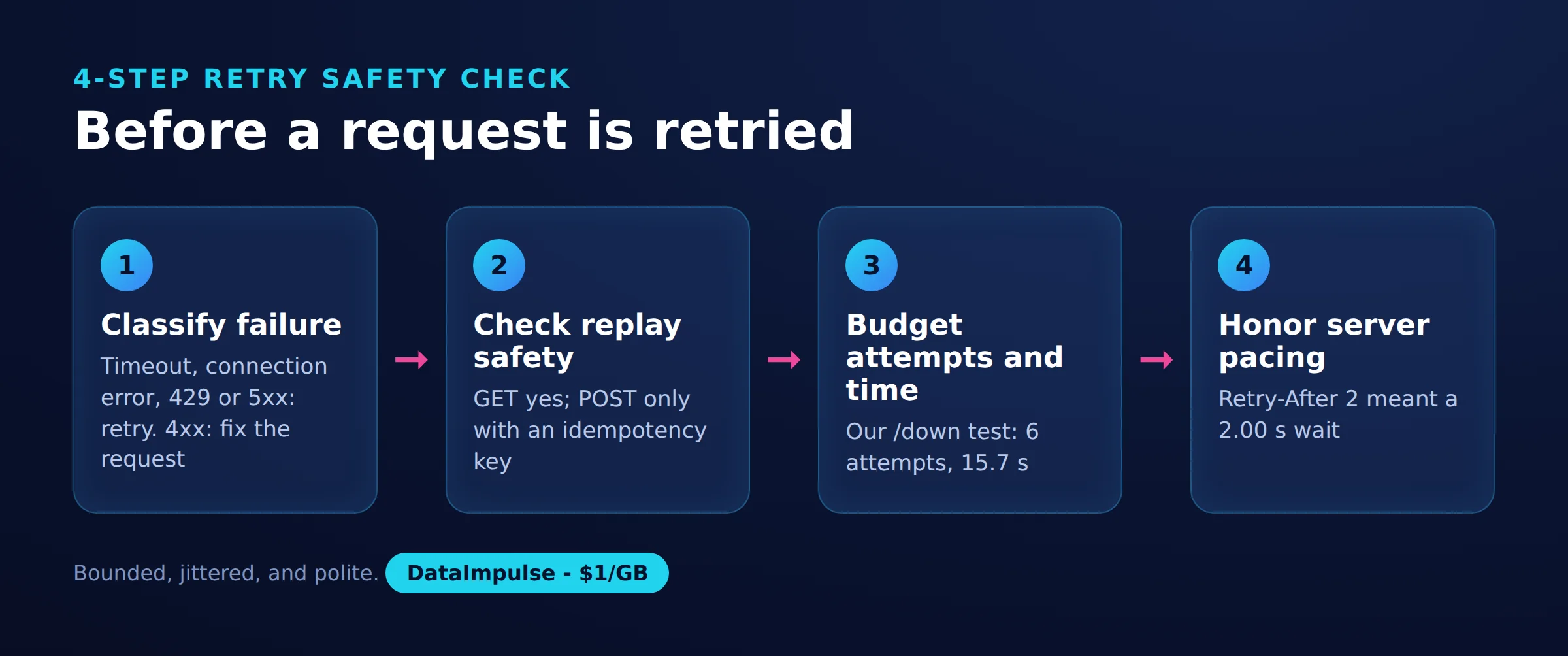
- Step 1: Classify failure. Separate connection failures, read failures, and HTTP responses. Our candidate status list is 429, 500, 502, 503, and 504; review it against the endpoint’s contract.
- Step 2: Check replay safety. Decide whether another request could duplicate a write or another side effect.
- Step 3: Budget attempts and time. Define the maximum calls, acceptable waiting, and caller deadline before enabling retries.
- Step 4: Honor server pacing. Respect Retry-After and stop or defer work when the required wait exceeds your budget.
Do not use retries as a universal repair. Investigate 403 responses and 407 proxy authentication errors separately. A python requests retry strategy should preserve access conditions and applicable data rules.
How do exponential backoff and jitter work?
Exponential backoff increases the delay after repeated failures; jitter adds randomness. In our configuration, the base sleeps were 0, 1, 2, 4, and 8 seconds.
For retry number k, starting at 1, urllib3’s first backoff is zero; subsequent delays use backoff_factor * 2**(k-1). Add uniform jitter from zero through backoff_jitter, subject to backoff_max. The urllib3 2.0.7 reference documents these controls.
Our environment used urllib3 2.0.7, which accepts backoff_jitter. Match the example to your installed version rather than assuming compatibility. Change the factor to tune growth and the jitter range to spread retries; a custom wait policy belongs in a deliberately chosen retry layer.
The observed 1.20-second flaky result reflects one random draw and local execution overhead. It does not predict your API’s latency.
How should you handle 429 and Retry-After?
Honor a valid Retry-After value before trying again, unless the operation must stop. The header accepts either delay-seconds or an HTTP-date, as explained in MDN’s Retry-After reference.
With header handling enabled, urllib3 uses a positive Retry-After delay ahead of its calculated backoff. Without a usable positive delay, exponential backoff applies; malformed headers need explicit error handling. See urllib3’s sleep behavior.
Our local 429 requested two seconds, and the next attempt succeeded after 2.00 seconds. The script has no overall deadline enforcement: if a server requests more waiting than your operation permits, stop or reschedule instead of shortening its requested wait. Plan that behavior alongside your API rate limiting policy.
How do connection and read timeouts affect retries?
A timeout bounds a particular waiting stage, not the complete operation. Connection establishment, response reading, repeated attempts, and backoff all contribute to elapsed time.
In timeout=(3.05, 10), the first value controls connection waiting and the second controls read inactivity. Neither is a wall-clock deadline; Requests also has no default timeout. See Requests timeout semantics.
Our five-retry budget allowed six attempts. Connection and read counters restrict their respective failure categories within that overall budget, rather than adding extra allowances. The Retry budget controls include total=0 to prevent retries (as of October 2026).
Do not assume every body-read failure is replayed. The Requests adapter source passes preload_content=False; failures during later body consumption can occur outside the adapter’s retry cycle. Test interrupted bodies separately, and enforce any strict deadline at an application boundary capable of stopping the operation.
Can you safely retry POST requests?
A POST timeout alone cannot establish that replay is safe. The server may have completed the write before the client lost its response.
Only replay when the API documents idempotent behavior or a deduplication mechanism covering the operation. Reuse the same operation identity and payload under that contract; adding an arbitrary idempotency header does not create a guarantee. This follows the replay considerations in HTTP’s idempotency specification.
urllib3’s default method set excludes POST. Our narrower set permits GET, HEAD, and OPTIONS for status and read retries; method filtering is not a universal prohibition on connection retries before transmission. See Retry method and failure categories. Keep this example focused on reads.
How do you log attempts and diagnose exhausted retries?
Record the failure category, attempt number, chosen wait, elapsed time, and terminal outcome. Use a sanitized route label instead of a complete URL.
The scripts enable diagnostic logging for harmless localhost requests. Before adapting them, remove sensitive URL components from logs and exceptions; the Tenacity example includes its URL in an exception message. Never log credentials, authorization headers, or private response bodies.
Our persistent 503 remained a response because raise_on_status=False. Transport failures can still raise exceptions; Requests translates underlying failures into types such as ConnectionError, ConnectTimeout, and RetryError. An integer max_retries also does not express the explicit status policy shown here. See the adapter implementation.
Check that calls use your configured Session and matching mount. Close it when finished, and investigate network-specific failures with the proxy troubleshooting guide. Avoid adding a second retry loop around an already-retrying client.
When should you use urllib3 Retry, Tenacity, or backoff?
Choose one layer to own retries. Use transport configuration for HTTP policy and a function wrapper when application outcomes determine whether to repeat work.
| Option | Use X when… | Avoid X when… |
|---|---|---|
| urllib3 Retry | Use urllib3 Retry when transport and status policy fits. | Avoid urllib3 Retry when retrying an entire application workflow. |
| Tenacity | Use Tenacity when custom results, exceptions, or coroutines drive retries. | Avoid Tenacity when wrapping an already-retrying client without coordinating budgets. |
| backoff | Use backoff when a decorator-based policy fits. | Avoid backoff when expecting automatic HTTP status classification without configuration. |
Retry centralizes HTTP filtering. Tenacity separates retry, wait, and stop policies, supports coroutine retries, and offers logging callbacks. Its stop_after_attempt counts calls, including the first (as of October 2026). See the Tenacity documentation and wait policy reference.
Our tested tenacity_retry.py repeats the same flaky GET with different timing. It is not equivalent for 429: it does not inspect Retry-After.
import time
import requests
from tenacity import (retry, retry_if_exception_type, stop_after_attempt,
                      wait_exponential_jitter, before_sleep_log)
import logging
logging.basicConfig(level=logging.INFO, format="%(message)s")
log = logging.getLogger("retry")


class RetryableStatus(Exception):
    pass


@retry(
    retry=retry_if_exception_type((requests.ConnectionError, requests.Timeout, RetryableStatus)),
    wait=wait_exponential_jitter(initial=1, max=30, jitter=1),
    stop=stop_after_attempt(5),
    before_sleep=before_sleep_log(log, logging.INFO),
    reraise=True,
)
def get_json(url):
    r = requests.get(url, timeout=(3.05, 10))
    if r.status_code in (429, 500, 502, 503, 504):
        raise RetryableStatus(f"{r.status_code} from {url}")
    r.raise_for_status()
    return r.json()


if __name__ == "__main__":
    requests.get("http://127.0.0.1:8377/reset")
    t = time.time()
    print(get_json("http://127.0.0.1:8377/flaky"), f"{time.time() - t:.2f}s")
Here, selected statuses become exceptions, waits use exponential jitter, and exhaustion re-raises the final exception. The broad connection exception category needs endpoint-specific review.
For comparison, backoff combines on_exception or on_predicate with a wait generator; its documented default jitter is full jitter. Status filtering needs your predicate or exception policy. Its max_tries limits total calls (as of October 2026). See the official backoff repository. We did not measure backoff.
What does a quick reproducible retry run show?
Our quick run on October 16, 2026 demonstrated recovery, server-directed waiting, and exhaustion. It is a small snapshot, not a benchmark.
Andrii ran Linux, Python 3.12, requests 2.31.0, urllib3 2.0.7, and tenacity 9.1.4. Sources: requests_retry.py, tenacity_retry.py, and retry_server.py, reproduced here. The sample was one invocation per endpoint with urllib3 and one flaky-endpoint invocation with Tenacity, resetting local counters between scripts. All traffic stayed on 127.0.0.1.
| Policy and endpoint | Final status | Attempts | Elapsed |
|---|---|---|---|
| urllib3 /ok | 200 | 1 | 0.00 s |
| urllib3 /flaky | 200 | 3 | 1.20 s |
| urllib3 /limited | 200 | 2 | 2.00 s |
| urllib3 /down | 503 | 6 | 15.69 s |
| Tenacity /flaky | 200 | 3 | 3.82 s |
Tenacity logged waits of 1.36 and 2.45 seconds. Different wait settings explain the timing difference; these observations cannot rank libraries. There were no repeated trials, concurrent clients, remote connections, or measured timeout failures.
Run retry_server.py in one terminal, then each client separately in another:
# Local test server: /flaky fails with 503 twice then 200; /limited answers 429 + Retry-After: 2 once then 200.
import http.server, json, threading
hits = {}
class H(http.server.BaseHTTPRequestHandler):
    def do_GET(self):
        n = hits[self.path] = hits.get(self.path, 0) + 1
        if self.path == "/reset":
            hits.clear(); return self.send(200, {"reset": True})
        if self.path == "/flaky" and n <= 2: return self.send(503, {"attempt": n})
        if self.path == "/limited" and n == 1: return self.send(429, {"attempt": n}, {"Retry-After": "2"})
        if self.path == "/down": return self.send(503, {"attempt": n})
        self.send(200, {"ok": True, "attempt": n})
    def send(self, code, body, extra=None):
        self.send_response(code)
        for k, v in (extra or {}).items(): self.send_header(k, v)
        self.send_header("Content-Type", "application/json"); self.end_headers()
        self.wfile.write(json.dumps(body).encode())
    def log_message(self, *a): pass
http.server.ThreadingHTTPServer(("127.0.0.1", 8377), H).serve_forever()
Bandwidth was not measured. For planning, estimate transferred bytes by summing request, response, and protocol bytes across attempts; six equal-sized exchanges would cost roughly six times one exchange, but actual error bodies differ.
A future seeded simulation could compare custom jitter with library policies under identical attempt budgets, recording latency, scheduling collisions, and simulated success probability. Those would be simulated metrics, separate from this observed table.
Frequently Asked Questions
Does Python Requests retry automatically?
Not by default for failed connections. Configure the adapter deliberately, then verify behavior against a controlled failure.
How do Session, HTTPAdapter, and urllib3 Retry work together?
The Session selects its mounted adapter for the request URL. The adapter passes the retry policy into urllib3’s transport calls.
How are exponential-backoff delays calculated?
Our factor of 0.5 produced base waits of 0, 1, 2, 4, and 8 seconds. Jitter affected later waits, so repeated runs need not match the measured elapsed times.
How should Python handle 429 and Retry-After?
Wait as requested when the operation can afford it. Otherwise stop or defer the operation instead of retrying earlier.
Is retrying a POST after a timeout safe?
A timeout leaves the write’s outcome uncertain. Require an API-specific replay guarantee before sending it again.
Did these scripts enforce an overall deadline?
No. Their attempt policies and per-call timeouts do not establish a hard elapsed-time limit.
Need a proxy alongside your retry policy?
If your authorized workload needs proxy routing, review proxy options for Python Requests and DataImpulse residential proxies. DataImpulse supplies proxies, not a scraping API, managed unblocker, VPN, or dataset. Keep replay decisions, pacing, and failure handling in your client.
Last updated: October 16, 2026.

 State/City/Zip/ASN Targeting



